Intelligent Multi-Emitter Transmitter System Design and Validation
Project Team Team Lead: Ararat Stepanyan (NIY) Team Advisor: Susanna Tadevosyan (YEAE) Team Members: Manouel Ohanian (MS Student) Meri Mkhitaryan (BS Student) Milena Mkhitaryan (BS Student)
Project Timelines Start Date: August 2024 End Date: April, 2024 Duration: 9 months
Abstract
Radar warning receivers validation is a sensitive field under study, hence this research centers around the development and validation of an intelligent multi-emitter transmitter system. Wireless communication using electromagnetic waves that has become common in modern days, requires reliable technologies which work in different signaling environments with many interferences. The aim of this work is to solve this obstacle by providing a flexible multi-emitter transmitter that can produce a spectrum of radar beams, reproducing familiar radar types like Pulsed, CW, and FMCW.
The primary goal is to validate and test radar early warning receivers within complex, multi-emitter environments by simulating a diverse range of radar signals encountered in real-world scenarios. Therefore, hardware and software development for signal modeling plus creation of a user-friendly interface is a carefully planned approach allowing for generation of customized signals.
This study aims at generating signal traits that are em to different radar systems, taking into consideration attenuation, noise, and frequency variations caused by ambient effects. Signal integrity is achieved by a combination of LabView modeling and FPGA-integrated hardware.
Introduction
The use of electromagnetic waves is increasingly vital in our daily routines. Wireless devices, from telecommunication gadgets to navigation tools, depend on transmitting technologies. These devices use EM wave emitters and receivers to establish wireless channels in the air, vulnerable to various noises—natural or human-made—that might disrupt
communication channels between devices
.
In the case of sensitive systems, even small signals can cause significant effects, triggering changes in the system
depending on the signal and system nature
.
Early Radar Warning Receivers, operating in a multi-emitter environment, pick up signals from radars, jamming systems, mobile telecommunications, GPS, and satellite communications. This complexity poses a challenge for these
radar sensors in detecting desired signals.
This research aims to implement a multi-emitter transmitter system and integrate various radar signal types into a complex signal scenario and also implement FMCW Signal Analyzer to measure, display, and log parameters of FMCW signals, primarily used in FMCW RADARs. This setup will help validate and test radar early warning receivers. The focus will be on the most commonly used radar types employing three main methods to detect targets through (Pulsed,
CW, or FMCW) signal generation.
Research Questions/Hypotheses
This research involves creating a multi-emitter transmitter system that produces diverse radar signals with distinct parameters on a multi-channel, phase-coherent platform. The goal is to validate radar warning receivers.
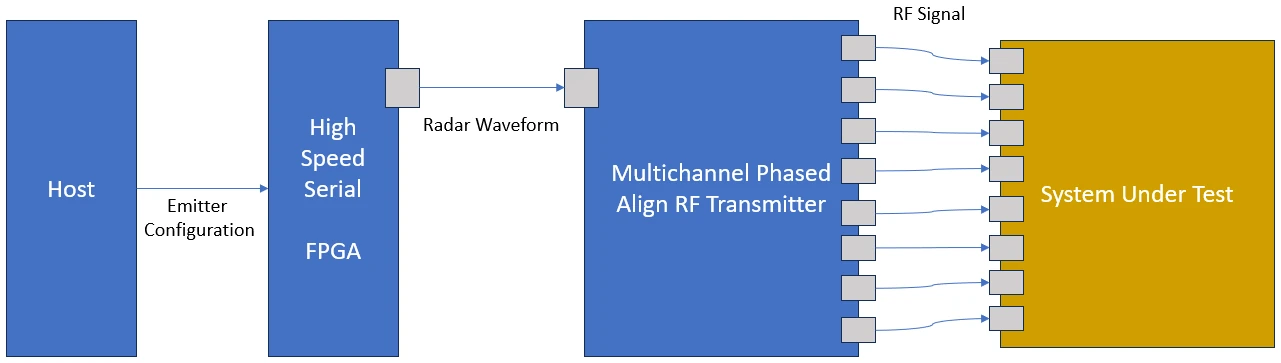
The overall process is shown above, it will be done in three stages:
● Signal modeling and characterization
● Multi-emitter signal generation hardware
● Vector Signal Analyzer for the validation of the generated signals and FMCW analyzer for measure, display
and log parameters of FMCW signal
Several challenges arise in implementing a validation system for EarlyRWRs, include:
Radar Signal Characteristics: Different radar types use various methods and signal modulations to detect targets, resulting in different signal characteristics. Defining these characteristics is a significant challenge, considering environmental effects like power loss, added noises, and frequency shifting.
Multi-Emitter Setup: Operating a multi-emitter system requires hardware supporting software control and multi-channel parallel signal generation. A Software Defined Radio with multi-channel output suits this purpose well.
Signal Modeling: Signal modeling will be done in the LabView environment. All generated signals will be modeled in LabView and uploaded to the FPGA of the SDR, ensuring the signals' reusability on other instruments.
Creation of User Control Software: The user interface needs to be user-friendly, enabling control over initial signal parameters and radar types containing default methods used in each radar type. This allows users to generate custom-configured signals based on the DUT testing parameters.
Cost Effectiveness: Synchronized multi-emitter transmitter generation can be expensive without suitable hardware. Using hardware with multi-channel parallel and phase-coherent outputs, driven by a high-speed FPGA, proves cost-effective for this process, and decreases test time and increases the reliability of the generated signal.
FMCW Signal Demodulation: Demodulate FMCW signal with 4GHz bandwidth on FPGA
Scientific Objectives
The scientific objective of this research is to design, implement, and validate a versatile multi-emitter transmitter system capable of generating diverse radar signals, encompassing commonly used radar types (Pulsed, CW, FMCW). This system will facilitate the strict validation and testing of radar early warning receivers in complex, multi-emitter environments by creating custom-configured signals, assessing receiver performance, and optimizing hardware-driven signal generation for cost-effectiveness and reliability.
Research Plan
● Materials and Methods:
Hardware:
Ettus USRP X440 is a USRP Software Defined Radio (SDR): 30 MHz to 4 GHz, 1.6 GHz Bandwidth, GPS-Disciplined OCXO [1] PXIe-7975R FlexRIO FPGA module, NI 5783 baseband transceiver ADC adapter module
Signal Modeling and Software:
LabView Environment: Used for signal modeling and development of signal generation algorithms, also LabVIEW FPGA is a software add-on for LabVIEW that you can use to more efficiently and effectively design FPGA-based systems through a highly integrated development environment, IP libraries, a high-fidelity simulator, and debugging
features [2]
.
Signal Analyzing LabView Environment: Develop system for the demodulation of signals with up to 4GHz of bandwidth, measurement of key parameters of the demodulated signal, and performance of time-domain and frequency-domain measurements on the received signal.
User Control Software: Designing a user-friendly LabView front panel for signal parameter customization.
System Implementation:
Multi-Emitter Transmitter Setup:
The system will be set-up, and proper drivers will be installed on Implementation of software controls for signal modulation and multi-emitter scenarios.
Signal Modeling and Validation:
Generation of diverse radar signals representing different radar types (Pulsed, CW, FMCW) using LabView. Validation and testing to assess the system's capability in generating and reproducing accurate radar signals.
● Technical Approach:
Radar Signal Characteristics:
Analyze and define signal characteristics specific to different radar types considering environmental effects like noise, power loss, and frequency shifting.
Multi-Emitter Setup:
Integrate SDR and FPGA-based systems for precise, multi-channel signal generation with software control
capabilities
.
Signal Modeling in LabView:
Develop signal models in LabView, ensuring reusability and compatibility with other instruments via FPGA integration.
Signal Analyzing in in LabView:
Develop signal demodulation algorithm on FPGA and measure signal parameters on host.
User Control Software Development:
Create an intuitive interface allowing users to customize signal parameters and radar types for tailored signal generation.
Cost-Effectiveness Measures:
Utilize hardware with phase-coherent outputs, driven by a high-speed FPGA, to optimize signal generation for cost-effectiveness, decreased test time, and increased reliability.
Figure 1.System architecture
● Timeline
Phase 1: System Setup and Development (Aug - Sep 2024)
Familiarizing with new hardware and understanding its functionality: Ettus USRP X440.
Learning LabView FPGA development environment.
Set up the multi-emitter transmitter system for phase-coherent and multi-channel signal generation.
Phase 2: Signal Modeling and Software Development (Oct-Dec 2024)
Developing signal modeling algorithms in LabView for various radar signal types (Pulsed, CW, FMCW), also developing environmental effects on signal (Power Loss, added noise, multi-path signal effects).
Developing FMCW signal demodulation algorithm in LabVIEW FPGA Developing user control software with a friendly interface for signal parameters adjustments and creating multiple scenarios that can be chosen by the user, to validate the DUT in different situations.
Developing measurement of key parameters of the demodulated FMCW signal, and performance of time-domain and frequency-domain measurements on the received signal. Display the spectrum, spectrogram, and power of the signal over time, as well as the demodulated signal. Measurement results on the demodulated data shown in a table and can be exported into a tab-delimited file. Embedded algorithms will automatically detect the type of FMCW chirp (rising chirp, falling chirp, triangle chirp, or CW tone) and measure key parameters such as deviation, chirp period, and chirp linearity.
Phase 3: Integration and Validation Testing (Dec 2024 - Jan 2025)
Integrate signal models into the Ettus USRP X440 for signal generation and validation.
Perform initial validation tests to assess signal fidelity and system functionality.
Phase 4: Complexity Testing and Optimization (Feb - March 2025)
Generate complex multi-emitter scenarios using the developed system.
Optimize hardware-driven signal generation for reliability.
Phase 5: Documentation (March - April 2025)
Documentation will be done through all phases, from requirements to validation results, and in this phase the final documents will be prepared.
● Introduction to Modern EW Systems by Andrea De Martino (Chapter 2)
Research Projects
Non-Intrusive Gearbox Monitoring Techniques Based on Variable Reluctance Sensors
Project Team Team Lead: Andranik Aghajanyan (Project Integration) Team Advisor: Alex Vartan Natania (AESA) Team Members: Hovhannes Hovhannisyan Elen Bardughimeosyan Gayane Hovsepyan Hayk Sargsyan Artyom Yaribekyan
Project Timelines Start Date: August 2024 End Date: October, 2024 Duration: 3 months
Abstract
Gearbox monitoring is essential for ensuring the reliability and performance of machinery in industries such as manufacturing, automotive, and aerospace. Traditional monitoring techniques often involve intrusive methods that require direct access to the gearbox, leading to operational downtime and increased maintenance costs. This research aims to develop a non-intrusive gearbox monitoring system utilizing multiple variable reluctance sensors (VRS) and signal processing techniques. The objectives include designing a sensor network, implementing real-time data acquisition and processing algorithms, and validating the system's performance through experimental and real-world testing.
The proposed system leverages VRS for their robustness and ability to operate in harsh environments. Signal processing algorithms, including Digital Filtering, Fast Fourier Transform (FFT) and other techniques will be used to extract meaningful information from the sensor signals. A comprehensive evaluation will compare the proposed system with existing monitoring solutions in terms of accuracy, reliability, and cost-effectiveness.
The three-month research plan, starting from August 1, includes a literature review, sensor selection, system design, and preliminary signal processing algorithm development. Expected outcomes include an experimental setup for non-intrusive monitoring system, a comprehensive evaluation of the system's performance in experimental and real-world scenarios and analysis on industrial possible applications.
Introduction
Gearbox monitoring is crucial in various industries, including manufacturing, automotive, and aerospace, to ensure reliable operation and prevent unexpected failures. Traditional monitoring techniques often involve intrusive methods that require direct access to the gearbox, leading to operational downtime and increased maintenance costs. This proposal aims to develop a non-intrusive gearbox monitoring system utilizing multiple variable reluctance sensors (VRS) and advanced signal processing techniques. Non-intrusive monitoring techniques have gained popularity due to their ability to provide real-time condition monitoring without disrupting normal operations. VRS are particularly suitable for this purpose due to their robustness, simplicity, and ability to operate in harsh environments.
Variable reluctance sensors are magnetic sensors that detect changes in magnetic reluctance caused by the movement of ferromagnetic objects. They have been widely used in various applications, including automotive engine timing and speed sensing.
Signal processing plays a crucial role in interpreting the data collected by VRS. Techniques such as Digital Filtering, Fast Fourier Transform (FFT) and other techniques have been employed to extract meaningful information from the sensor signals.
Research Questions/Hypotheses
Variable reluctance sensors can provide accurate and reliable data for gearbox monitoring without direct access to the gearbox.
Using multiple VRS and Advanced signal processing techniques can effectively extract significant features from sensor signals to diagnose gearbox conditions.
The proposed monitoring technique can be used in various modern applications due to its non-intrusiveness.
Scientific Objectives
Develop a non-intrusive gearbox monitoring system using multiple VRS.
Implement signal processing algorithms to analyze sensor data.
Validate the system's performance through experimental testing.
Compare the performance of various types of sensors available in the market and identify the key parameters that are influencing.
Identify possible applications in modern industry.
Research Plan
The current research is planned for four months starting from 2024 August 1 to 2024 October 31 with the following timeline:
Phase 1 - Literature Review and Initial Planning – August 1 to September 1
• Literature Review:
o Conduct an in-depth review of existing gearbox monitoring techniques and VRS applications.
o Identify existing applications, gaps and opportunities.
o Document findings and relevant references.
• Initial Planning:
o Define detailed project milestones and deliverables.
o Prepare a comprehensive list of required equipment and materials.
Phase 2 - System Design & Algorithm Development of the Experimental Setup – September 1 to October 1
Sensors Selection:
Research and select appropriate VRS based on subtype, sensitivity, range, and environmental conditions.
Procure selected VRS and any additional necessary components.
System Design:
Develop the experimental setup.
Develop the data acquisition system for real-time data collection and logging.
Signal Processing Algorithm implementation
Implement signal filtering algorithms.
Implement signal analysis algorithms.
Preliminary Testing:
Conduct preliminary tests to ensure sensors and data acquisition system are functioning correctly.
Make any necessary adjustments based on test results.
Phase 3 - Experiments and Reporting October 1 to October 31
Data Collection
Results summary
Reporting
Outcomes
An experimental setup for non-intrusive gearbox monitoring.
Comprehensive evaluation of the system's performance in experimental and real-world scenarios.
Comprehensive analysis on industrial possible applications.
References
Hong, H., & Liang, Y. (2017). Application of Variable Reluctance Sensors in Condition Monitoring of Rotating Machinery. Sensors, 17(5), 1015.
Jiang, Y., & Yan, Y. (2016). Gearbox Condition Monitoring Based on Vibration Signal Analysis. Mechanical Systems and Signal Processing, 72-73, 536-558.
Wang, P., & Li, X. (2019). Non-Intrusive Gearbox Health Monitoring System Using Magnetic Sensors. Sensors and Actuators.
Research Projects
Sounding Rocket Control System Research
Project Team Team Lead: Davit Torgomyan (Yerevan Aerospace Engineering) Team Advisor: Gevorg Arakelyan (Yerevan Aerospace Engineering) Team Members: Arayik Karapetyan Levon Soghomonyan Nane Marutyan Adelina Stepanyan Aram Poghosyan
Project Timelines Start Date: August 2024 End Date: December, 2024 Duration: 5 months
Abstract
Sounding rockets are vital for conducting atmospheric and space research, providing valuable data on conditions that are otherwise inaccessible. Effective control systems are crucial for the stability and accuracy of these rockets, as they ensure precise trajectory and payload deployment. This research focuses on developing an advanced control system for sounding rockets that enhances flight stability and performance. The proposed control system integrates a suite of sensors, including inertial measurement units (IMUs), GPS, and telemetry systems, coupled with sophisticated control algorithms to manage dynamic flight conditions.
The research objectives are to design a robust control system architecture, implement real-time data acquisition and processing, and optimize control algorithms for enhanced flight stability and precision. The system will utilize adaptive control techniques to adjust to varying atmospheric conditions and mission profiles, improving the rocket's ability to achieve and maintain desired trajectories. The effectiveness of the proposed control system will be assessed through both simulation and live flight tests.
This study will contribute to the advancement of sounding rocket technology by providing a comprehensive evaluation of the proposed system's performance, including its accuracy, reliability, and operational efficiency. The research plan spans five months, starting from August 1, and includes system design, algorithm development, simulation testing, and real-world flight evaluations. Expected outcomes are a validated control system capable of improving the performance and reliability of sounding rockets, with potential implications for future research.
Introduction
Sounding rockets serve as indispensable tools for scientific research, offering a cost-effective means to study atmospheric phenomena, microgravity environments, and space conditions. These rockets are designed to ascend to high altitudes, providing valuable data through a variety of onboard instruments. Ensuring the stability and accuracy of sounding rocket trajectories is essential for the success of these missions. Traditional control systems often rely on pre-defined, static algorithms and manual adjustments, which may not adequately address the dynamic and unpredictable nature of rocket flight.
This proposal aims to advance the capabilities of sounding rocket control systems by developing a sophisticated, adaptive control system that leverages real-time data and advanced control algorithms. By integrating multiple sensors, such as inertial measurement units (IMUs), GPS, and telemetry systems, the new control system will provide enhanced flight stability and precision. These sensors will continuously monitor the rocket’s dynamics and environmental conditions, allowing for real-time adjustments to flight parameters.
Inertial measurement units (IMUs) are critical for providing accurate measurements of acceleration and angular velocity, while GPS systems offer precise positional data. Telemetry systems further support by transmitting real-time data back to ground stations. The integration of these technologies will facilitate the implementation of adaptive control strategies, which can dynamically respond to changing flight conditions and mission profiles.
Advanced control algorithms, including adaptive control and optimization techniques, will be employed to manage the rocket's trajectory and stability. These algorithms will process sensor data to make real-time adjustments, improving the overall performance and reliability of the rocket system. The development and validation of this control system will involve both simulation and live flight tests, ensuring that the system meets the rigorous demands of sounding rocket missions.
The research will contribute to the evolution of sounding rocket technology, providing a more robust and precise control solution that can enhance the success rate of scientific missions and improve data quality. By addressing the limitations of current control systems, this proposal aims to set a new standard in the field of rocket control and instrumentation.
Research Questions/Hypotheses
- Can the integration of multiple sensors (IMUs, GPS, and telemetry systems) in the control system of a sounding rocket improve trajectory accuracy and flight stability?
Hypothesis: Integrating multiple sensors will provide comprehensive real-time data that enhances trajectory accuracy and flight stability compared to traditional control systems that rely on fewer or less sophisticated sensors.
- How effective are adaptive control algorithms in managing dynamic flight conditions of a sounding rocket compared to static control strategies?
Hypothesis: Adaptive control algorithms will demonstrate superior performance in managing dynamic flight conditions, improving the rocket’s ability to adjust to varying atmospheric and mission parameters compared to static control strategies.
- Can real-time data processing and adjustment enhance the reliability of sounding rocket missions and data quality?
Hypothesis: Real-time data processing and adaptive adjustments will increase the reliability of sounding rocket missions and the quality of the data collected, leading to more accurate and actionable research outcomes.
- What are the potential limitations and challenges of implementing advanced control systems in sounding rockets, and how can they be addressed?
Hypothesis: Potential limitations such as sensor calibration issues, data processing delays, and system integration challenges can be mitigated through rigorous testing, calibration protocols, and robust algorithm design.
- How does the performance of the proposed control system compare with existing sounding rocket control systems in terms of accuracy, reliability, and overall mission success?
Hypothesis: The proposed control system will outperform existing systems in accuracy and reliability, leading to improved mission success rates and better overall performance metrics.
Scientific Objectives
- Design and Develop an Advanced Control System for Sounding Rockets - Create a comprehensive control system architecture integrating multiple sensors, such as inertial measurement units (IMUs), GPS, and telemetry systems, to enhance flight stability and trajectory accuracy. - Implement and Optimize Adaptive Control Algorithms - Develop and refine adaptive control algorithms capable of real-time adjustments based on dynamic flight conditions, optimizing the rocket’s performance throughout its mission. - Conduct Simulation and Experimental Testing - Validate the proposed control system's effectiveness through detailed simulations and live flight tests, assessing its performance in various atmospheric conditions and mission scenarios. - Evaluate and Compare Sensor Performance - Analyze the performance of different sensor types used in the control system, comparing their accuracy, reliability, and integration capabilities to determine the most effective combinations for rocket control. - Explore and Define Practical Applications - Identify potential applications of the advanced control system in other aerospace missions and related fields, examining how the technology can be adapted for various operational contexts and mission requirements.
Research Plan
The research project is planned for five months, starting from August 1, 2024, to December 31, 2024, with the following timeline:
Phase 1 - Literature Review and Initial Planning – August 1 to September 1, 2024
Literature Review:
Conduct a thorough review of existing control systems for sounding rockets, including current sensor technologies, control algorithms, and performance metrics.
Identify gaps and limitations in existing systems, and explore opportunities for improvements and innovations.
Document relevant findings and compile a comprehensive list of references.
Initial Planning:
Define detailed project milestones, objectives, and deliverables.
Prepare a comprehensive list of required sensors, components, and equipment.
Develop a preliminary project schedule and allocate resources for subsequent phases.
Phase 2 - System Design & Algorithm Development of the Experimental Setup – September 1 to November 31, 2024
Sensors Selection:
Research and select appropriate sensors (IMUs, GPS, telemetry systems) based on performance criteria such as accuracy, reliability, and environmental resilience.
Procure selected sensors and any additional components required for the experimental setup.
System Design:
Design the experimental setup for the control system, including sensor integration and data acquisition framework.
Develop the data acquisition system for real-time data collection, processing, and logging.
Algorithm Development:
Implement adaptive control algorithms, including real-time data processing and adjustment mechanisms.
Develop and test signal processing algorithms to analyze and interpret sensor data.
Preliminary Testing:
Conduct preliminary tests to ensure that the sensors, data acquisition system, and algorithms function as expected.
Analyze test results and make necessary adjustments to the system and algorithms.
Phase 3 - Experiments and Reporting – November 1 to December 31, 2024
Data Collection:
Perform comprehensive experiments and live flight tests to evaluate the control system's performance under various conditions.
Collect and log data for analysis.
Results Analysis:
Summarize and analyze experimental results to assess the effectiveness of the control system in improving trajectory accuracy and flight stability.
Compare the performance of the proposed system with existing control systems.
Reporting:
Prepare a detailed research report documenting the methodology, results, and conclusions.
Highlight key findings and recommendations for future research and potential applications of the control system.
Outcome
• Development of an Advanced Control System for Sounding Rockets:
- A fully integrated control system prototype, incorporating multiple sensors (IMUs, GPS, telemetry systems) and adaptive control algorithms. This system will be designed to enhance flight stability and trajectory accuracy for sounding rockets
Comprehensive Evaluation of System Performance: - A detailed assessment of the control system's performance through extensive simulation and live flight tests. This evaluation will focus on the system's accuracy, reliability, and effectiveness in managing dynamic flight conditions and optimizing rocket trajectories. - Comparative analysis with existing control systems to demonstrate improvements in performance metrics, mission success rates, and data quality.
• Detailed Analysis of Practical Applications:
- A thorough exploration of potential applications of the advanced control system beyond sounding rockets, including other aerospace missions, satellite launches, and high-altitude research. This analysis will identify how the technology can be adapted and utilized in various operational contexts and mission profiles. - Recommendations for future developments and enhancements based on the research findings, including potential industrial collaborations and technology transfer opportunities.
References
- Gagg Filho, L. C., & Oliveira, S. G. (2019). Adaptive Control Systems for Aerospace Applications: A Review. Aerospace Science and Technology, 92, 105322. - Teng, H., & Liu, Y. (2018). Inertial Measurement Units in Aerospace Applications: A Survey. IEEE Transactions on Aerospace and Electronic Systems, 54(4), 1962-1983. - Gonçalves, R. M., & Cacace, J. (2020). Sensor Fusion Techniques for Flight Control Systems: A Comparative Review. Journal of Aerospace Engineering, 33(3), 04020024. - Li, X., & Zhang, Z. (2021). Real-Time Data Processing Techniques for Aerospace Systems. IEEE Transactions on Aerospace and Electronic Systems, 57(2), 935-948. - Smith, J. C., & Johnson, M. (2022). Performance Evaluation of Advanced Control Systems for Spacecraft: Methods and Case Studies. Acta Astronautica, 183