
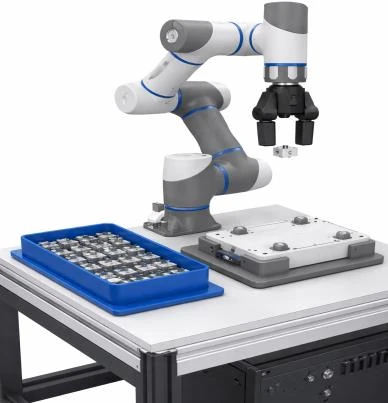
Collaborative Robot-Based Pick & Place Assembly of Screw-Mounted Connectors on Product Enclosures
English translation
This is a joined project of the ARC (Smart Manufacturing & Robotics Lab) and YEA Manufacturing.
Project Title | Collaborative Robot-Based Pick-and-Place Assembly of Screw-Mounted Connectors on Product Enclosures | |
Submitted By: Narbeh Nahapetian | Submitted Date: April 19, 2026 | |
Purpose-Goals
The purpose of this project is to demonstrate and evaluate the use of a collaborative robot (DOBOT CR3A) for performing pick-and-place assembly of screw-mounted connectors, aiming to develop a practical educational framework and assess its effectiveness in simplifying robotic integration into manufacturing tasks.
Study Abstract
This project focuses on the educational implementation of a collaborative robot (DOBOT CR3A) for performing pick-and-place assembly of screw-mounted connectors on a product enclosure. The study explores how a simplified robotic system—without the use of machine vision—can be effectively utilized in manufacturing tasks through structured setup and programming. A dedicated component tray will be designed for consistent part feeding, and a sample product will be used as a case study to validate the approach. The project aims to demonstrate practical methods for integrating collaborative robots into assembly processes, providing a foundation for training, skill development, and future industrial applications.
Project Scope
This project focuses on the implementation of a collaborative robot (DOBOT CR3A) to perform pick & place assembly of screw mounted connectors on a sample product enclosure within an educational framework. The product used as a case study will be positioned on a pre designed jig to ensure consistent placement conditions, with the jig itself designed as part of the project. The scope includes designing a dedicated component tray for reliable part feeding, programming the robot for precise pick a& place operations, and developing a structured workflow for task execution. The system will operate without the use of machine vision, relying on predefined positions and controlled conditions. The project is limited to connector placement only and does not include the screwing process. It is further limited to a POC (proof of concept) setup and does not cover full industrial automation or complex multi robot integration.
Challenges
Potential risks include positioning inaccuracies due to the absence of a vision system, which may affect placement precision and require careful calibration of the robot and jig. Mechanical tolerances in the designed tray and jig could impact consistency in part handling. The use of a general-purpose gripper instead of a task specific gripper may reduce handling reliability and placement accuracy.
Project Deliverables
System Implementation: A functional proof-of-concept setup demonstrating pick-and-place assembly of screw-mounted connectors using the DOBOT CR3A, including the designed jig and component tray.
Documentation: Comprehensive documentation covering system design, robot programming workflow, tray and jig design, along with demonstration and training materials for educational use and knowledge transfer.
Next Steps
Future work may include integrating vision systems for flexible part detection and positioning, as well as expanding the system to handle multiple component types and more complex products.
Commercial Potential
We expect that the outcome of the research could be used for the developing of the following commercial product:
This project demonstrates a low-cost approach to adopting collaborative robots in manufacturing and training environments. The concept can be extended to real production with added capabilities such as vision systems and automated fastening.