
The ARC Journal
Issue 4/2026
Setting the pages…
A Technology Research Publication

The ARC Journal

Issue 4/2026 · Yerevan, May 13, 2026

The Advanced Research Center (ARC)

The Advanced Research Center (ARC) was created at the Engineering City to conduct research in technologies, products, and applications of the future. It currently consists of five labs – Smart Manufacturing & Robotics Lab, Aerospace Lab, Semiconductor Lab, Automotive Lab, and Cybersecurity & Computetion Lab.

Published by the Engineering Association

The ARC JournalIssue 4/2026Published by the Engineering AssociationYerevan, May 13, 2026
End of issueThe ARC JournalIssue 4/2026Table of ContentsFront coverOriginal PDF

Table of Contents

New ProjectsAI-Based Production Master-BOM Analysis and Verification & Validation AssistantPurpose-GoalsStudy AbstractProject ScopeChallengesProject DeliverablesNext StepsCommercial PotentialEducational Embedded System Design with Stock-Oriented Component Selection Using Automatic Tester Development as a Case StudyPurpose-GoalsStudy AbstractProject ScopeChallengesProject DeliverablesNext StepsCommercial Potential
New Projects

AI-Based Production Master-BOM Analysis and Verification & Validation Assistant

English translation

Project Category: Smart Manufacturing & Robotics

Purpose-Goals

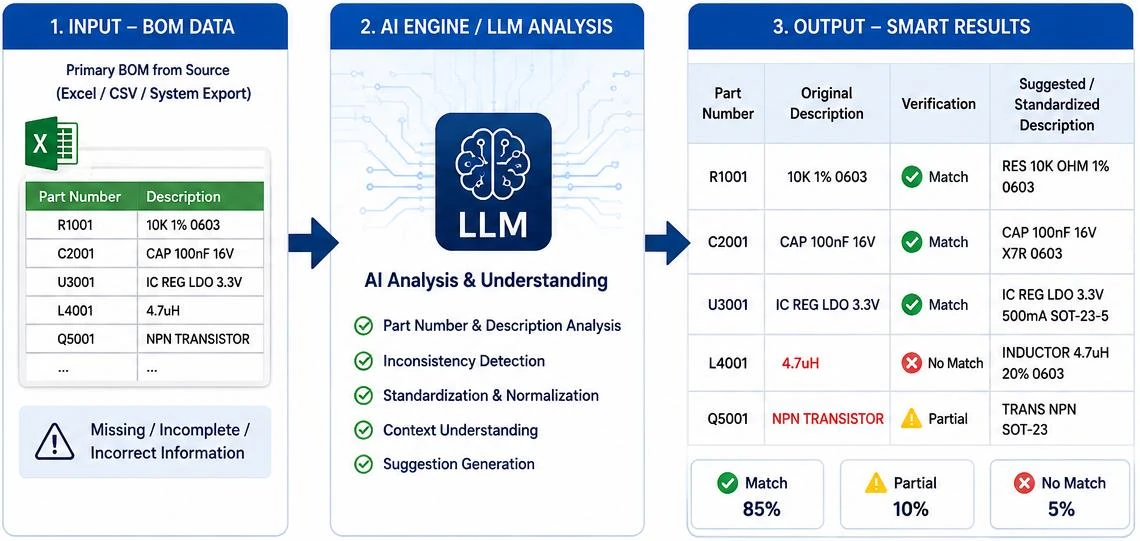
The purpose of this project is to develop an AI-based assistant for analyzing, verifying, and validating Production Master BOM data to improve accuracy, consistency, and efficiency in manufacturing processes. The project aims to verify the consistency between part numbers and component descriptions, and suggest improved or standardized descriptions for incomplete or inconsistent BOM entries.

Study Abstract

This project focuses on the development of an AI based assistant for Production Master BOM analysis, verification, and validation using Large Language Models (LLMs) such as GPT. The proposed system will analyze BOM part numbers and component descriptions to identify inconsistencies, improve incomplete descriptions, and support data standardization within manufacturing environments. By leveraging AI-driven language understanding and contextual analysis, the project aims to reduce manual verification effort, improve BOM data quality, and establish a foundation for more intelligent manufacturing and supply chain management processes.

Project Scope

The project scope includes analyzing BOM part numbers and descriptions, detecting inconsistencies between component identifiers and related descriptions, and suggesting improved or standardized descriptions for incomplete or incorrect entries. The system is intended to users in accelerating BOM verification and correction tasks, particularly in cases where primary BOMs contain amounts of missing, incomplete, or incorrect information. The project is limited to a POC (proof of concept) software implementation operating within a controlled manufacturing data environment and does not include direct ERP/MRP integration or automated procurement decision-making.

Challenges

Potential challenges include handling inconsistent and unstructured BOM data, variations in part numbering and description formats across different suppliers or vendors, and ensuring reliable AI interpretation with technical component information. Additional challenges may arise from validating AI generated suggestions, maintaining data accuracy, controlling and optimizing token usage to reduce overall operational costs, and minimizing analysis time during communication with LLM platforms to ensure efficient system performance.

Project Deliverables

  • AI-Based BOM Verification Assistant: A POC software tool capable of analyzing, verifying, and validating Production Master BOM data using LLM-based technologies.

  • Technical Documentation: Documentation covering system architecture, AI workflow, BOM analysis methodology, and operational guidelines.

Next Steps

Future development may include automatic component group classification, AI based replacement suggestions using available stock data, and integration with ERP/MRP systems to support more advanced manufacturing and supply chain decision making processes.

Commercial Potential

The solution has potential for future integration into real ERP/MRP and smart manufacturing systems.

New Projects

Educational Embedded System Design with Stock-Oriented Component Selection Using Automatic Tester Development as a Case Study

English translation

Project Category: Smart Manufacturing & Robotics

Purpose-Goals

The purpose of this project is to provide an educational framework for learning the fundamentals of embedded system design, including library creation, schematic and PCB design, and embedded C programming, while promoting stock-oriented component selection to minimize new component orders through the development of an automatic tester as a practical case study.

Study Abstract

This project focuses on the educational development of an embedded automatic tester system using STM32 or Arduino platforms as a practical case study for learning embedded system design methodologies. The project covers the fundamental stages of library development, schematic and PCB design using Altium, embedded C programming, and system integration. A major focus of the project is the implementation of a stock oriented component selection approach, encouraging the use of currently available components to minimize new purchasing requirements and improve resource utilization. The developed system will be capable of automatically testing multiple DUTs (Device Under Tests) within a controlled proof-of-concept environment, providing practical engineering experience in both hardware and software development processes.

Project Scope

The project scope includes electronic library creation, schematic and PCB design using Altium, embedded C programming and basic software integration. The project also emphasizes stock oriented component selection by prioritizing the use of currently available components to reduce new orders and optimize existing resources. The developed system will operate as a POC (proof of concept) platform within a controlled educational environment.

Challenges

Potential challenges include learning multiple embedded system development stages simultaneously, such as library creation, schematic and PCB design, and embedded C programming. One of the major challenges for students will be implementing stock oriented component selection, where the system design must adapt to currently available components instead of ideal component choices.

Project Deliverables

  1. Automatic Tester Prototype: A functional POC automatic tester system based on STM32 or Arduino platforms capable of testing multiple predefined DUTs.

  2. Design and Development Documentation: Documentation covering electronic library creation, schematic and PCB design, embedded software development, and system integration processes as a training reference.

Next Steps

Future development may include expanding the tester to support additional DUT types, integrating advanced communication interfaces and data logging features, implementing modular hardware architecture, and introducing AI-assisted diagnostic and testing capabilities.

Commercial Potential

This project can support educational and industrial training programs in embedded systems and automated testing. The developed concepts may also be expanded into low-cost customized tester solutions for manufacturing domains.

© 2026 The Authors of the articles

All materials contained in The ARC Journal may be used with reference to the Authors.

For feedback on the Journal, its content, and its articles please send to info@engineeringcity.am.

To submit articles, please send to info@engineeringcity.am. Articles can be in any language.