
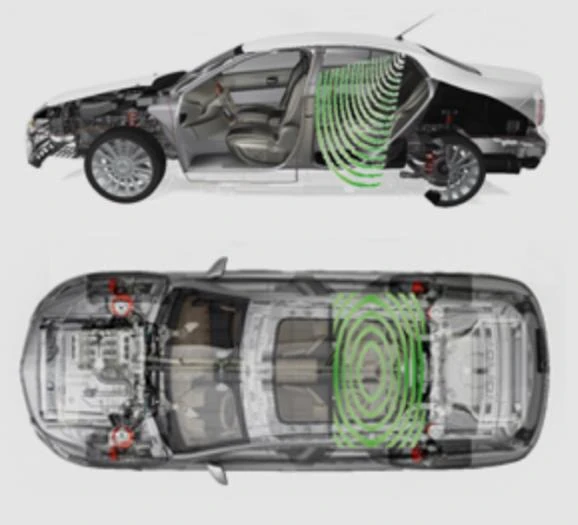
Vehicle In-Cabin Radar Test System (Proof of Concept)
Project Category: Automotive
Purpose-Goals
The goal of this Proof of Concept (PoC) is to practically test whether we can mimic human physiological micro-movements-specifically breathing and heart rate-using a hardware-based simulation loop instead of real human subjects. Before manufacturing a full active reflector matrix array, we need to de-risk the core physics of the system on a smaller, faster scale.
The immediate technical objectives are:
Establish a reliable baseline by collecting real, over-the-air (OTA) human vital signs using a TI AWRL6844EVM 60 GHz radar module.
Verify if a corner reflector movement, can replicate sub-millimeter chest wall displacements within the necessary biological frequency bands.
Build a single-axis motorized mechanical rig.
Confirm that the radar module’s out-of-the-box processing algorithms accept these mechanical signatures as a living subject, accurately reporting respiration rates and pulse metrics without software errors.
Study Abstract
New automotive safety standards like Euro NCAP are pushing for mandatory inside-the-cabin monitoring, focusing heavily on Child Presence Detection (CPD) and wider Occupancy Monitoring Systems (OMS). Frequency-Modulated Continuous Wave (FMCW) radar operating at 60 GHz is the preferred hardware because it provides excellent spatial resolution and respects passenger privacy.
This study validates a method for simulating physical micro-movements by using automated retroreflectors driven by mechanical components.
Project Abstract
This document outlines the execution of a Proof of Concept (PoC) engineering campaign focused on validating an alternative approach to vehicle cabin radar testing. Using a Texas Instruments AWRL6844EVM evaluation board, the engineering team will execute a tight schedule split into three distinct tasks: human baseline benchmark data collection, motor-driven mechanical tracking.
The development sequence begins with open-air human vital signs testing to capture clean benchmark datasets. The team will then design and build a single lightweight corner reflector. This setup will allow us to introduce highly controlled micro-oscillations into the radar's path using an integration lab setup.
Finally, the focus will shift to transitioning to a motorized slider mechanism, writing the microcontroller code to manage linear displacement profiles along the Z-axis. The project will conclude with a completed device datasheet and a final PoC report, validating the core mechanics before scaling up to a multi-channel array.
Project Scope
The scope of this testing is strictly limited to ensuring rapid verification of the concept without getting bogged down in
large-scale manufacturing.
Initial configuration and firmware bring-up of the AWRL6844EVM radar module using standard Texas
Instruments reference examples.
Gathering Over-the-Air (OTA) baseline phase recordings from human subjects to map genuine heartbeat and
respiration signatures.
Development of a triangular corner target.
Building a single-axis motorized translation track to control physical movement along the radar’s line of sight.
Writing low-level firmware to control the actuator's displacement profile, cycle frequencies, and turnaround
points.
Drafting a preliminary technical specification sheet and a final PoC performance evaluation report.
Challenges
Building an electromechanical simulator for millimeter-wave radars introduces several distinct physics-based bottlenecks:
Electric motors generate subtle high-frequency jitter. At 60 GHz, a tiny mechanical vibration of just a few microns can completely distort the phase spectrum, flooding the radar's DSP with noise and masking the target's simulated heart rate.
Any slight twisting, tilt, or mechanical play in the slider track shifts the reflector's phase center off-axis. This causes the target to lose signal stability or display false movement characteristics.
Project Deliverables
The project will yield the following engineering deliverables:
A structured collection of data captured from live human subjects during the initial OTA test.
Physically machined, single triangular corner reflector optimized for 60 GHz return loss.
A benchtop testing fixture consisting of the fabricated reflector driven by analog laboratory instruments.
Software deployed on a microcontroller to manage single-axis motor translation, turnarounds, and acceleration curves.
A technical specifications document outlining the mechanical limits, achievable displacement amplitudes, and frequency ranges of the single-axis setup.
A comprehensive engineering document comparing the simulated motor signatures against the live human benchmarks to prove the concept's viability.
Next Steps
Following the validation of this single-axis baseline proof of concept, the project will advance to full system scaling:
Moving from a single active reflector to the matrix configuration featuring completely independent elements.
Building a real-time embedded control board to handle synchronized channels.
Commercial Potential
Validating this test methodology addresses immediate needs within the automotive manufacturing and safety ecosystem:
Provides a repeatable, standardized Over-the-Air (OTA) verification tool for automotive Tier-1 suppliers to calibrate in-cabin radar modules without needing human operators in the test cells.
Radar software developers can programmatically simulate specific, or rare biological events (such as sleep apnea, sudden infant distress, or extreme hyperventilation) instantly within a lab environment, shortening design cycles.