
The Engineering City Journal
Issue 30/2023
Setting the pages…
Engineering Association
Issue30/2023

The EngineeringCity Journal

Yerevan, December 31, 2023

Engineering Management CornerAfter the Project-Delivery
ECJ 30/2023

The Engineering City Journal

Issue 30/2023 · Yerevan, December 31, 2023

The purpose of the Journal is to disseminate knowledge, experience, and best practice in engineering & manufacturing. The articles are written by practicing professionals in the Engineering City (EC). They cover issues relevant to their projects, operations, and organizations. The articles address the challenges of the time. As such, the Journal is also a chronicle of the evolution of the EC, its companies, and its individuals. It is the aim of the Journal to advance the engineering & manufacturing practice, to enrich the engineering & manufacturing community, and to contribute to the worldwide discourse in engineering & manufacturing.

Published by the Engineering Association

The Engineering City JournalIssue 30/2023Published by the Engineering AssociationYerevan, December 31, 2023
End of issueThe Engineering City JournalIssue 30/2023Table of ContentsFront coverOriginal PDF

Table of Contents

Engineering Management CornerAfter the Project-DeliveryLife of the ProductLife of the Development ProcessThe Product Care-TakerThe Benefit to the CommunityMarkets CornerThe VUCA World – What to anticipate in 2024Musings CornerWhat I wish myself during the New Year HolidaysWishes for the EC Community in the New YearWishes for Armenia
Engineering Management Corner

After the Project-Delivery

Life of the Product

Delivering a project is certainly a big milestone. It is the milestone at which we get paid for the work done.

But it is not the last milestone. Why so?

Because, like anything else in heaven and on earth, the product must have its own life trajectory (S-Curves) regardless of a particular customer.

The product that has just been delivered is nothing but one instance on the curve.

Let’s take for example the ADAS-HIL product.

Pic. The Continuous Improvement S-Curve

The product takes on a life on its own. Each customer is a driver for the next version of the product, a better version of the product. This improvement is recorded by the version number. Here, ADAS-HIL version 1.0, then, ADAS-HIL version 1.1, …. This climb is guaranteed by the “Continuous Improvement” process.

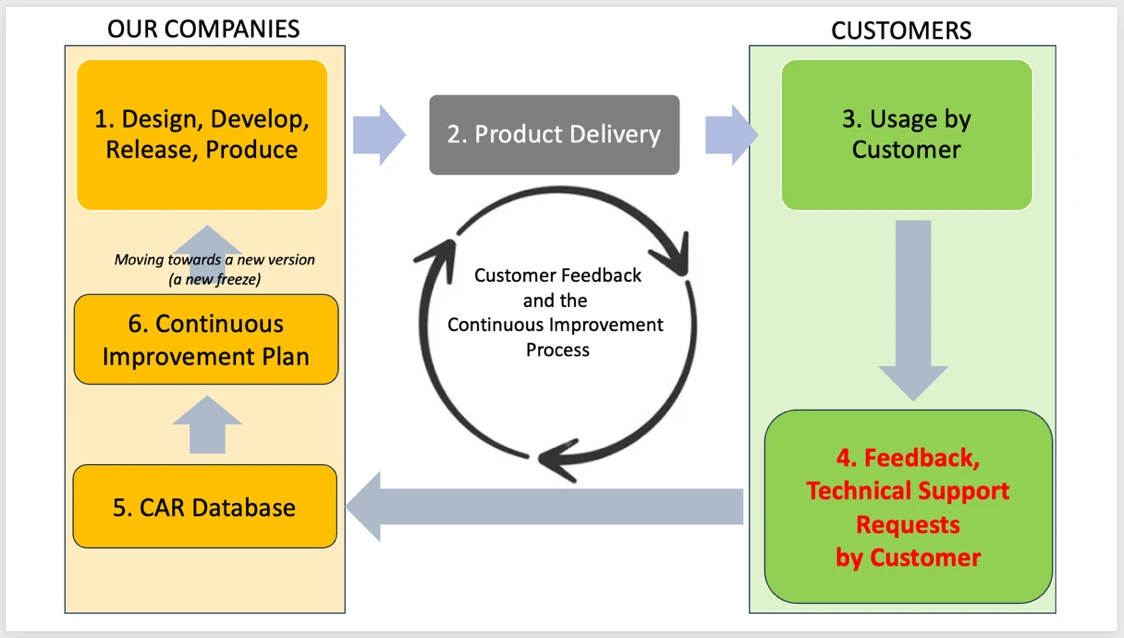
Pic. The Continuous Improvement Process as triggered by feedback and technical support requests from the customer.

The point here is that the feedback and technical support requests from the customer is the most valuable information that comes straight from the marketplace. This information must be captured in the “Customer Action Requests (CAR)” database. This database then must be used to create the new version of the product.

Here it should be also mentioned that the CAR database is not only used to capture customer requests, but also used internally to record future improvement ideas that appear during the development of the current version – ideas that will be implemented in the next versions. The CAR database is a practical mechanism to realize the Continuous Improvement idea.

With every new customer the product moves up the curve – a move that gets fixed in the version number.

But the continuous improvement process must not turn into an endless process. At some point, a major transition must happen to the next S-Curve, which is Innovation. This is when a newly available technology gets introduced into the product, or a new design philosophy adopted. Why is this necessary? This is dictated by the concept of competitive strategy, which is the strategy that keeps us always ahead of competition. Imagine that the rival competitor introduces the newly available technology ahead of us. That will throw us right out of the market. The Product Owner must always be aware of this. The newer S-curve is usually marked by a change in the first digit of the version – ADAS – HIL 1.2 becomes ADAS-HIL 2.0, and so on.

And we get the following life story of the product as in the picture below

Pic. The life story of the product through continuous improvements and continuous innovations.

The moral of the story is that a product does not end with its delivery. The product has its own dynamic that calls for continuous improvement and continuous innovation.

Life of the Development Process

As mentioned above – anything in heaven and on earth has its own life trajectory (S-Curves). In the previous paragraph we talked about the life trajectory of the product. Now we will be talking about the life trajectory of the Development Process. It too can be shown as the sequence of S-Curve.

Warning: Above we are showing S-curves of two different things – one was for the product, the other one is for the process. They must not be confused with each other. They are different things, except for the method of analysis, which here are the S-Curve method.

How do we accomplish this speed? It is through internal technologies that must be developed and packaged in every version of the product. The more the internal packaged technologies, the faster the development of the next version. In the below picture we see how the development of the system moves from high-level of customization (left picture) to a very low level of customization (right picture). Meaning that the time to deliver the last version of the system has been dramatically reduced because of the big number of pre-packaged modular technologies.

Why is this needed? For one, this will reduce the cost of development by 10X at each subsequent version of the system, which translates to bigger Gross Margins. For two, the debugging and supporting of the newer versions will be greatly reduced. For three, the extra people capacity can be directed onto new projects.

For more reading about this, we can refer to two articles written about this in the 3rd Issue of the EC Journal titled “The 3-Layered Architecture” and “Packaging Internal IPs and Technologies”.

The Product Care-Taker

It is the Product Owner who is the “Care-Taker” of this product. This Care-Taking is no less than taking care of the growth of a child – from kindergarten to school to university. Perhaps, Care-Taker is a stronger word than Product Owner.

For the Care Taker to realize this, he must own the project folders. This entails:

  • Cleaning up the folders.

  • Freezing the files in the Release Folder stamped by the version and date.

  • Creating the CAR database and nurturing it.

  • Packaging the internal technologies in a separate folder with appropriate descriptions, versions, dates, and standard interfaces. These are the packaged IPs that represents the wealth of the company.

The Benefit to the Community

And finally, after delivering the project, articles for the EC Journal must be written. The bigger the project, the more articles must come out of the project team. The articles may contain the stories (the dramas) of the project, the discoveries made during the project, the technologies and science used in the project, the recommendations that came out of the project, …. In short, the articles contain everything that the team wants to transfer to the wider EC community (beyond their own organization). This will complete the stakeholder triangle.

Pic. The Stakeholder Triangle
Markets Corner

The VUCA World – What to anticipate in 2024

VUCA stands for:

  • V - Volatile (Frequent sudden and unpredictable changes)

  • U - Uncertain (Difficult to anticipate events, past experience loses relevance, difficult to plan)

  • C - Complex (Problems are multi-layered, hard to understand, no clear cause and effects)

  • A - Ambiguous (Nothing clear, nor determined)

VUCA is always present. However, over the last three years, we have been living and seems that we will continue to live in a heightened VUCA world. This is when it is difficult to anticipate, difficult to expect, difficult to plan. There are no best practices to refer to as all best practices are old practices and don’t work here. Here, probing and experimenting must be applied to spot patterns until the right path forward reveals itself.

In such situations, since there are no best or good practices to recall from, and since the contexts are always new and previous experience may not work, every single person in the organization must be engaged in finding solutions. This is an all-hands-on-deck situation.

In such times, we must take advantage of any opportunity, no matter how small, and no matter how off.

In such times, the only constants that we must hold onto are the general direction of the organization, the purpose of the organization, its values, and its aspirations.

This is the year into which we are about to enter.

Musings Corner

What I wish myself during the New Year Holidays

I wish that during the New Year holidays I can seclude myself to a shack on a mountain top away from everyone, and indulge myself in reading, writing, dreaming, and planning the new year. But, alas, this is a difficult thing to achieve since society will not let you get away with it easily.

Musings Corner

Wishes for the EC Community in the New Year

Markets

  • India. I wish this year for the EC companies to win substantial projects in the Indian market. The success in the Indian market will become strategic.

Remote Operations

  • I wish for the EC companies to learn to operate remote offices.

Business Conditions

  • I wish for the EC companies that a new law passes that lowers the income tax of its employees to 10% and its profit tax to 0% for all companies no matter how small or big, and no matter how young or old. This is an imperative on the country level as the competition now is no longer just between high-tech companies, but between countries that race to keep and attract high-tech companies to their land.

Advanced Research Center

  • I wish for the EC that it successfully kicks off the operation of the Advanced Research Center.

EC Residency

  • MNCs. I wish for the EC that one more engineering MNC becomes its resident.

  • Knowhow Diversification. I wish for the EC that new companies with new application knowhow become its residents. For example, companies with application knowhows in Photonics, Quantum Technologies, Space, …

EC Construction

  • I wish for the EC that 70% of its construction finishes by the end of the year.

  • I wish for the EC to start constructing the “Recreation/Lecture/Cafeteria” complex.

EC Fundings

  • I wish for the EC to find funding for the central “Research & Education” building.

  • I wish for the EC to find funding to move the illegal houses from the Nelson Stepanyan Street and thus opening the space between the smaller and bigger EC territories.

EC Engineers

  • I wish for the EC engineers to acquire the habit of writing in the EC Journal.

Factory City

  • I wish for the EC the acquisition of the land to build its Factory City (FC). The Factory City must become a place where we develop the culture of high-tech production.

  • I wish for the Factory City that we find an anchor MNC manufacturer that will setup a factory in the FC.

Talent Development System

  • I wish for the High-School program and the Bazovaya Kafedra programs to increase the number of their students.

  • I wish that we will find the time to revisit the curriculum of the “Industrial & Systems Engineering” MS program. This specialization must generate the core specialists for managing the manufacturing operations.

EC Business as Usual

  • I wish that the number of engineers in the EC double this year to reach 500 engineers. Our long-term goal remains 2000.

  • I wish that the EC continues accumulating its machinery and equipment wealth.

  • …

Other

  • …

  • …

Musings Corner

Wishes for Armenia

For Armenia I wish that it becomes a country that does not beg for peace, but a country that dictates peace; a country that does not lose territory, but a country that regains territory. And this will need a lot of work. Here are some prerequisites that I think that must be worked on:

  • Increase its population to 5 million. This will mean that young couples have children early. This will also mean repatriation from the Spyurk. For the latter to happen, Armenia must brand itself as a “Country of Opportunities”. This is in effect working towards changing the nation’s success code from 377 to 557.

  • Seriously work on the manufacturing pillar in the “Scientific-Technological Four-Pillar Country Model” - Science, IT, Engineering, Manufacturing. Everyone in the country must understand that without manufacturing, we will stay eternally weak, no matter how advanced our science is, no matter how advanced our technologies are, no matter how big the high-tech community is, and no matter how old our history is. At the end of the day, it is volume production.

  • That every citizen from all layers of society has real education and real work opportunities to become a responsible, productive, purposeful, and proud citizen. This will create an incredibly vibrant society on all its levels.

  • Develop an advanced school of economical, geopolitical, and historical diplomacy.

© 2023 The Authors of the articles

All materials contained in The Engineering City Journal may be used with reference to the Authors.

For feedback on the Journal, its content, and its articles please send to info@engineeringcity.am.

To submit articles, please send to info@engineeringcity.am. Articles can be in any language.