The purpose of the Journal is to disseminate knowledge, experience, and best practice in engineering & manufacturing. The articles are written by practicing professionals in the Engineering City (EC). They cover issues relevant to their projects, operations, and organizations. The articles address the challenges of the time. As such, the Journal is also a chronicle of the evolution of the EC, its companies, and its individuals. It is the aim of the Journal to advance the engineering & manufacturing practice, to enrich the engineering & manufacturing community, and to contribute to the worldwide discourse in engineering & manufacturing.
Published by the Engineering Association
The Engineering City JournalIssue 1/2024Published by the Engineering AssociationYerevan, January …, 2024
Continuous Improvement PROCESS – Not Just Continuous Improvement
by Rama, EA
The power of an organization is its ability to learn.
Learning means continuous improvement.
If an organization has a learning process in place, then it is a winning organization.
It must be a process. The learning must be defined as a process. Sporadic learning does not count here. Sporadic improvement does not count here.
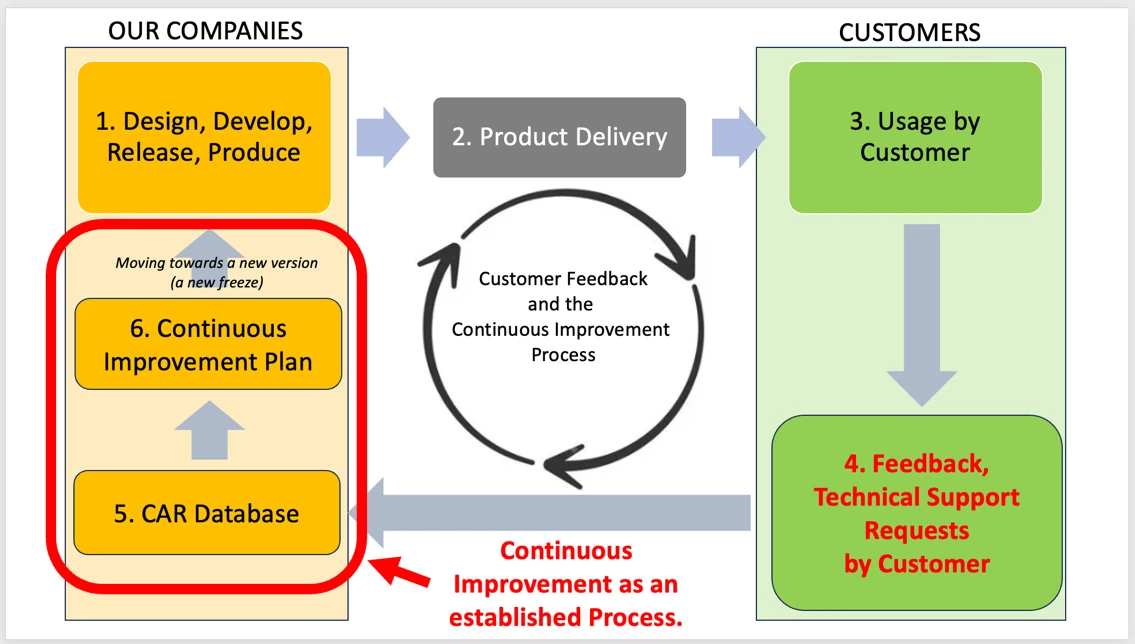
In the below picture the process of continuous improvement is highlighted in red. It starts with creating the CAR DATABASE. CAR stands for Correction Action Requests. This database must contain all the feedback and issues raised by the customers. It also must contain improvement ideas coming from withing the organization – both engineering and manufacturing. Then, regularly an improvement project must be launched to implement all these requests into the new version of the product.
It is the product “Care-Taker” who is in charge of establishing and owning this process.
Pic. Continuous Improvement as and Established Process. Here the feedback is from the customers.
Engineering Management Corner
Smart Continuous Improvement – a Machine Learning Case
by Rama, EA
The word “Smart” is now being used everywhere. It has become a marketing jargon. “Smart” may mean different things – connected, digitized, …
What the true meaning of “Smart” is, however, is that a system can improve by learning from past performance, or past mistakes and shortcomings. Meaning, that the system gets better the more it is used and malfunctions encountered. In other words, the system can fix itself. This is why humans are called smart. Now, can we make our solutions smart? This would mean the introduction of real-time machine learning in our software.
Can we develop smart systems, or smart devices, or smart solutions? In other words, can a system continuously improve by itself instead of people getting engaged in the continuous improvement process?
How does the current continuous improvement process work?
After having developed the system, it gets deployed on customer site. And during the usage of the system, the customer discovers bugs and problems during the functioning of the system and he calls us to fix the bug, or fix the system. Then, our engineers get into the software and fix things and send a patch back to the customer. And so on. The process of traditional continuous improvement looks like in the picture below. In this scheme, the developers never get out of the process.
Pic.The Traditional Continuous Improvement Process
But what if we take the people out – both the customer that alerts us about a bug and the developers that must now fix the bug. We could do this by incorporating a machine learning algorithm that will detect the malfunction itself and fix itself, improve itself.
Pic.Removing people from the Continuous Improvement Processby introducing Machine Learning Technology.
And we get a stand-alone and self-regulating system as in the picture below. And this would be a smart system that learns from its performance and improves itself without the interference of people.
Pic.The Continuous Improvement Process as an automated stand-alone Processusing Machine Learning Technology.
Can we start incorporating such algorithms into our systems? This will certainly give our products an edge over the competitors’ products, and greatly reduce the cost of the continuous improvement process.
This will be a nice application of Machine Learning in engineering – something that we always wanted to do somewhere, somehow.
Manufacturing Management Corner
Continuous Improvement Feedback Process - from Manufacturing to Engineering
by Narbeh Nahapetian, YEAM, and Rama, EA
The Manufacturing Team has introduced a “One Day Production” (ODP) Report. In the report, all problems detected during production is documented and reported back to the engineering team for future quality improvement. Below is an example of such a report.
Now it is for engineering to record this in its CAR database and schedule a product continuous improvement project with a new version number.
Pic.Feedback from Manufacturing to Engineering during Production
You can also read about the One Day Production (ODP) Instructions and Forms in a document published on the EC Journal site in October 2023.
Musings Corner
The “WHY” in what we are Doing – the Story as a Purpose
by Rama, EA
Dr. Edward Deming is famous as the father of the quality movement. The below quote is from him:
“If you can’t describe what you are doing as a process, you don’t know What you are doing.” Dr. Edward Deming
Would like to suggest a continuation to this quote as follows:
“If you can’t locate what you are doing on a continuum of the S-curves, you don’t know Why you are doing what you are doing.”
Pic.The Story as a Continuum of the S-Curves
The idea that is being conveyed here is that for something to have a purpose it has to be part of a story, in other words it has to be located on a particular continuum – a continuum that has a present, a past, and a future (a story). In a story everything is related back to the story, to the continuum.
This brings us back to the necessity of Continuous Improvement and Continuous Innovation processes (see first article in this issue of the Journal). If there is no continuous improvement and innovation, then there is no story. If there is no story, then what we are doing will turn into just one incident and that’s it. It will not have a life, it will not have a story, hence, also it will not have a purpose.
Now what about one-off projects. For these projects to make sense, something must be captured there that will become part of a story, or that could turn into a story. For example, a certain technology can come out of it that could be used in subsequent projects. Or the one-off project is by itself part of a bigger training and learning story. In other words, these one-off and unique projects may be very exciting and interesting, yet for them to be meaningful we must convert them into a story or part of a story. In another word, a story must be found for these projects, for them to become meaningful.
Announcement Corner
Convergence India Expo, January 17 – 19, 2024
This is to inform that the YEAE will be representing the Engineering City companies next week at the Convergence India Expo in Delhi.
Announcement Corner
ISO 9001-2015 Audit in the EC – End of January, 2024
This is to inform that the ISO 9001-2015 auditor will be at the EC in the last week of January.