The purpose of the Journal is to disseminate knowledge, experience, and best practice in engineering & manufacturing. The articles are written by practicing professionals in the Engineering City (EC). They cover issues relevant to their projects, operations, and organizations. The articles address the challenges of the time. As such, the Journal is also a chronicle of the evolution of the EC, its companies, and its individuals. It is the aim of the Journal to advance the engineering & manufacturing practice, to enrich the engineering & manufacturing community, and to contribute to the worldwide discourse in engineering & manufacturing.
Published by the Engineering Association
The Engineering City JournalIssue 11/2024Published by the Engineering AssociationYerevan, June 10, 2024
AMADEE (Austrian Mars Analogues for Deep Space Exploration) ծրագիրը ներկայացնում է Ավստրիական Տիեզերական Ֆորումի (OeWF) կողմից Երկրի վրա իրականացվող Մարսի սիմուլյացիոն առաքելություններ, որոնց նպատակն է նախապատրաստել և փորձարկել այն գործառույթները, գիտափորձերը, տեխնոլոգիաներն ու մեթոդները, որոնք ապագայում կօգտագործվեն դեպի Մարս օդաչուավոր առաքելությունների ժամանակ։
AMADEE-24 նախագիծը Հայաստանում
AMADEE-24-ը Մարսի առաջին սիմուլյացիոն առաքելությունն էր, որն իրականացվեց Ավստրիական Տիեզերական Ֆորումի (OeWF) կողմից Հայաստանում։ Այս նախագծի շրջանակներում OeWF-ը համագործակցեց Հայաստանի Տիեզերական Գործակալություն ՓԲԸ-ի հետ։ Արարատի մարզի Արմաշ գյուղին հարող լեռնային տեղանքը շնորհիվ իր յուրահատուկ երկրաբանական և լանդշաֆտային պայմանների ընտրվեց որպես Մարսի մակերևույթն առավել լավ նամանակող տարածք, որտեղ անալոգային աստղագնացները կարող էին փորձարկել Մարսի վրա ապագա ար-շավախմբերի համար նախատեսված գործառույթներն ու գիտափորձերը:
Առաքելությունն անցկացվեց Արարատի մարզում 2024 թվականի մարտի 12-ից ապրիլի 5-ը՝ Հայկական տիեզերական ֆորումի կողմից ստեղծված «Արմաշ» կայանում և նրա շուրջը առաքելու-թյան համար հատկացված տարածքում։
Վեց անալոգային աստղագնացըներ՝ Գերմանիայից, Ավստրիայից, Իտալիայից, Նիդերլանդներից և Իսպանիայից, չորս շաբաթվա ընթացքում ապրեցին և աշխատեցին այնտեղ մեկուսացված պայմաններում: Կայանում մեկուսացված մնալը նպաստում էր Մարսի վրա աշխատելու պայմաններին և ռեժիմին մոտ իրավիճակի ապահովմանը։ Իսկ շրջակա տարածքում սիմուլյացիոն գիտարշավներն իրականացվում էին դրա համար հատուկ նախագծված սկաֆանդրներով՝ օժտված անձնակազմի անդամների անհրաժեշտ ֆիզիոլոգիական ցուցանիշներն արձանագրող և վերահսկող սենսորներով ու համակարգերով, ինչպես նաև այնպիսի մեխանիկական համակարգերով, որոնք նմանակում էին այն մեխանիկական բեռնվածությունը, որ կունենա Մարսի վրա իրական սկաֆանդրով աշխատող աստղագնացը:
Անալոգային աստցագնացների առջև դրված էին տարբեր գիտական և գործառութային խնդիրներ, որոնք ներառում են սարքավորումների և ռոբոտների փորձարկումներ, գիտափորձերի անցկացում և կյանքի հետքեր փնտրելու մեթոդների կիրառում:
AMADEE24-ը կարևոր քայլ դարձավ Մարսի ապագա օդաչուավոր առաքելությունների նախապատրաստման գործում։ Այն նպաստեց ոչ միայն նոր տեխնոլոգիաների և մեթոդների զարգացմանը, այլև ապահովեց երիտասարդ մասնագետների ներգրավումն ու գիտելիքների խորացումը, ինչպես նաև բացեց տեղական և միջազգային համագործակցության նոր հեռանկարներ:
Քամու տուրբինի գիտափորձը
AMADEE-24-ի ծրագրում ներառվեց նաև «Բազումք» տիեզերական հետազոտությունների լաբորատորիայի առաջադրած գիտափորձը, որի նպատակն էր ստեղծել և փորձարկել հատուկ նորարարական լուծում պարունակող քամու տուրբին՝ ստուգելու համար այդ լուծման արդյունավետությունն ու Մարսի վրա այդպիսի տուրբինով քամուց էլեկտրաէներգիա գեներացնելու և դրանով ինքնավար օդերևութաբանական կայան սնուցելու նպատակահարմարությունը։
«Բազումք»-ի տնօրեն Ավետիք Գրիգորյանը պատմում է, որ այդ լուծման մտահղացումը ծնվել էր շատ վաղուց՝ դեռ 1993 թ․, իր հիմնած ԱՅԱՍ արտադպրոցական տիեզերագիտական խմբակում աշակերտների հետազոտական աշխատանքները վարելիս։
Խնդիր էր դրվել պարզել, թե ինչպես կարելի է էլեկտրական հոսանք սատանալ Մարսի վրա՝ օգ-տագործելով մարսյան քամիները: Մարսի պայմաններում էներգիայի արտադրության խնդիրը հատուկ նշանակություն ունի, քանի որ այնտեղ սովորական արևային վահանակները բախվում են մի շարք խնդիրների․ դրանց վրա արագ փոշի է կուտակվում և արդյունավետությունը գրեթե զրոյանում է, իսկ գիշերն ընդհանրապես չի աշխատում: Մինչդեռ քամիներն այնտեղ մշտական են, փչում են օր ու գիշեր, և քամու տուրբինն էլ չի վախենում փոշուց։
Մյուս կողմից, ավանդական կառուցվածքի քամու տուրբինները մարսյան պայմաններում այնքան էլ արդյունավետ չեն լինի։ Ճիշտ է, այնտեղի քամիները շատ ավելի արագ են, քան Երկրի վրա, բայց օդն էլ շատ նոսր է։ Ուստի, Մարսի վրա քամու տուրբինի կիրառումն արդյունավետ դարձնելու համար հարկավոր էր ինչ-որ կերպ մեծացնել քամով հարուցվող պտտող մոմենտը։
Առաջադրված լուծումը կայանում էր նրանում, որ կիրառվի Սավոնիուսի՝ ուղղաձիգ առանցքի շուրջը պտտվող տուրբին, որի երկու թիակներն էլ ունեն ուղղանկյունաձև բացվածքներ և դրանք իքնաբերաբար բացող ու փակող փեղկեր, որոնք բացվածքներից փոքր ինչ ավելի մեծ են։ Բացվածքների ու փեղկերի համակարգը նախատեսվում էր այնպես անել, որ փեղկերը վերադրված լինեն բացվածքների վրա թիակի գոգավոր կողմից և, պտտվելով ուղղաձիգ առանցքի շուրջը, կարողանան բացել կամ փակել բացվածքը։ Այս դեպքում, տուրբինի պտույտի ընթացքում գոգավոր կողմով քամին դիմավորող թիակի փեղկերը օդի հոսքի ճնշման ներքո կփակվեն և, ծածկելով այդ կողմի վրա արված բացվածքները, կապահովեն այդ թիակի վրա օդի հոսքի լիարժեք ճնշում։ Միևնույն ժամանակ հակադիր կողմի քամուն ընդառաջ շարժվող թիակի փեղկերը կբացվեն և օդը ազատ կհոսի բացվածքներով՝ գործադրելով այդ թիակի վրա շատ ավելի ցածր ճնշում (նկ․ 1)։ Արդյունքում քամու պտտող մոենտը կստացվի ավելի մեծ, քան առանց բացվածքների ու փեղկերի։
AMADEE24-ը լավ հնարավորություն էր այս նորամուծությունն իրականացնելու և փորձարկելու։ Ուստի, որոշում կայացվեց մասնակցելու այդ ծրագրին՝ Բազումքի կողմից առաջադրվող քամու տուրբինի գիտափորձով։
Նկար 1․ «Բազումք»-ի քամու տուրբինի կոնցեպտը
Սկսվեցին քննարկումները։ Առաջին մոտավորությամբ հաշվարկները ցույց էին տալիս, որ առաջադրված նորամուծությունն իրեն արդարացնելու է, և դրա կիրառումը Մարսի վրա լինելու է միանգամայն նպատակահարմար։
Ըստ այդ հաշվարկների էլ ստեղծվեց տուրբինը։ Առաջին հերթին ստեղծվեց տուրբինի 3D մոդելը՝ օգտագործելով Solidworks ծրագիրը (նկ․ 2)։ Մոդելավորման փուլում առաջ էին գալիս բազմաթիվ հարցեր և տեխնիկական խնդիրներ, որոնք լուծում էին պահանջում, բայց դա բավական ժամանա-կատար էր։ Ժամանակի օպտիմալ օգտագործման համար որոշ խնդիրներ լուծվում էին այլ աշխատանքներին զուգահեռ՝ մինչ դրանց հրատապ դառնալը։
Տուրբինի պտույտից էլեկտրաէներգիա ստանալու համար ընտրվեց Չինական արտադրության GDG-320 500W հզորությամբ գեներատորը, որը պտույտի մեկնարկի համար պահանջում էր նվազագույն պտտական մոմենտ՝ 0․1 Ն·մ։
Հաջորդ փուլում արդեն ստեղծվեց տուրբինի աշխատող մոդելը և, զուգահեռաբար՝ այն օդերևութաբանական կայանը, որը, սպառելով գեներացվող հոսանքը, պետք է տվիչներով գրանցեր օդի ճնշումը, ջերմաստիճանը, խոնավությունը, քամու արագությունը, տուրբինի պտույտի արագությունը և, իհարկե, գեներացվող հոսանքի բնութագրերը։ Այս փուլում գործին միացավ Ինժեներական քաղաքում Ավիատիե—զերական սարքաշինության մագիստրոսական ծրագրի առաջին տարվա դասընթացին մասնակցող ուսանողները՝ Անդրանիկ Աղաջանյանի գլխավորությամբ։
Չնայած նրան, որ հիմնական կոմպոնենտների և նյութերի ընտությունը կատարվել էր մոդելավորման փուլում, եղան փոփոխություններ՝ կապված հնարավորությունների, ռեսուրսների և իհարկե առաջ
եկած նոր խնդիրների լուծումներով։
Նկար 2․ Solidworks-ով ստեղծված 3D մոդելը
Համակարգի սահուն և անխափան աշխատանքի համար օդերևութաբանական կայանին ավելացվեց նաև կուտակիչ մարտկոց, որը կլիցքավորվեր գեներատորից և սնուցման աղբյուր կհանդիսանար կայանի միկրոկոնտրոլերի համար (որպես այդպիսին կիրառվեց STM32-ը)։ Տվիչներից ստացվող տվյալները գրանցվում էին MicroSD կրիչի վրա, հետագա ուսումնասիրությունների համար։
Համակարգն աշխատացնելու առաջին փորձերը կատարվեցին «Բազումք»-ի այգում (նկ․ 3) և բավականին հաջող էին։
Նկար 3․ Տուրբինը՝ տեղադրված «Բազումք»-ում Նկար 4․ Տուրբինի տեղափոխումը
Հաջող փորձարկումներից հետո եկավ տուրբինն անվտանգ և անվնաս կերպով «Արմաշ» կայան տեղափոխելու ժամանակը։ Դրա հետ կապված հարցերը ևս արագ լուծումներ ստացան (նկ․ 4)։
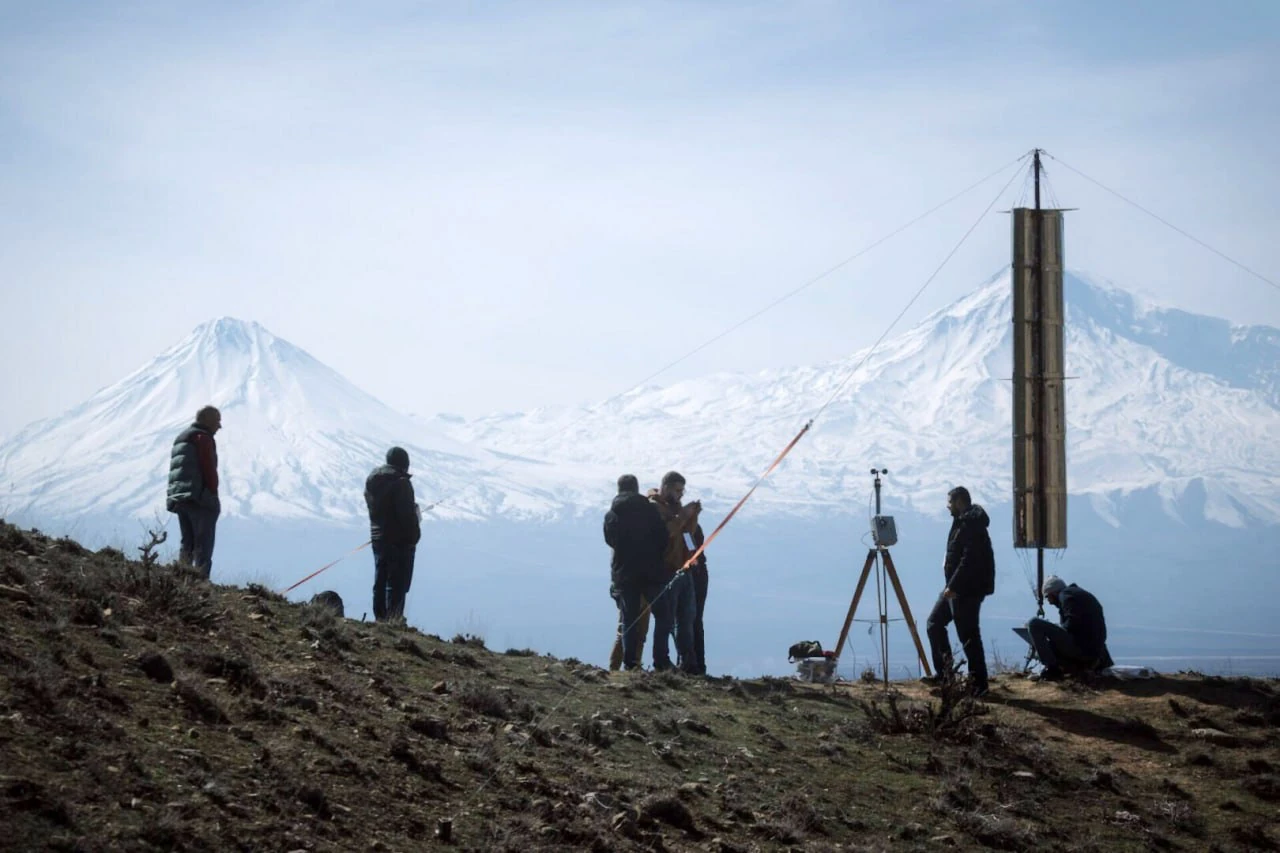
2024 թ․ մարտի 9-ին համակարգը տեղադրվեց «Արմաշ» կայանում, և ստացվեցին առաջին տվյալնները (նկ․ 5)։ Դրանց ուսումնասիրությունը ցույց տվեց, որ տեսականորեն մենք պատրաստվել էինք փոքր հոսքի ճնշումով մարսյան քամիներին, բայց «Արմաշ»-ում, հակառակ եղանակային կանխատեսումներին, ունեցանք անսովոր ուժեղ քամիներ՝ ընդհուպ մինչև 18 մ/վ արագությամբ։
Այդ իսկ պատճառով որոշում կայացվեց ներդնել արգելակման համակարգ, լրացուցիչ բեռնավորող սպառում ավելացնելով գենեարտորին, որը կապահովեր համակարգի անվտանգությունը և հնարավորություն կտար փոքր ու միջին արագությունների ժամանակ ճիշտ չափումներ կատարել։
Սակայն դա էլ չօգնեց։ Տեսնելով, թե քամու պոռթկումների ժամանակ ինչ վտանգավոր ճկումներ է ունենում տուրբինի առանցքը, որոշեցինք ռիսկի չդիմել, չթողնել տուրբինն ինքնավար ռեժիմում, որ գիշերը պտտվի առանց որևէ մեկի վերահսկողության, և առաքելության ավարտից հետո տեղափոխել այն նորից «Բազումք»՝ չափումները ավելի մեղմ քամիների պայմաններում և թիմի վերահսյկողությամբ շարունաելու համար։
Այժմ տուրբինը գտնվում է «Բազումք»ում։ Այն պետք է լրացուցիչ ամրացվի, նորից տեղադրվի այգում, որից հետո փորձարկումները կշարունակվեն։
Նկար 5․ Ստացված նախնական տվյալներՆկար 6․ Թիմի անդամներտը անալոգային աստղագնացըների հետՆկար 6․ Տուրբինը՝ տեղադրված «Արմաշ» կայանում
You can read this article on Telegram at this link.
Technology Corner
New NI Technologies (News from NI Connect 2024)
by Andranik Meliqsetyan, NIY
Engineering is the art of organizing and directing people and controlling the forces and materials of nature for the benefit of humanity. -Henry G. Scott
NI Connect 2024 Day 1 opening keynote started with above shown statement which set a stage for the rest of NI connect. You can watch the opening keynote here, it was fully focused on NI core technology values and key customer case studies. It was encouraging and energizing to see that a new leadership represented by Ritu a president of NI Test and Measurement business with Emerson going back to all the way to 50 years ago to when Doctor T started a company with a vision of automated test and measurement.
There were a few important announcements for future investments in LabVIEW + and NI PXIe HW portfolio which is a new motion in comparison for the last few years. LabVIEW is getting reprioritized, and more investments will be made in LV and LV community (check out the first day keynote for more details). List of new PXIe module will come to market this year – PXIe High power SMU 4051/4151, 3rd generation VST, new PXIe controllers on 11th generation intel processor, new USRP.
With this new product investment NI is continuing to heavily focus on Data and AI. NI announced collaborating with Microsoft around Generative AI. Watch the second day keynote for more details.
Besides the first two days there was a partner day on May 20th which was more face-to-face meetings and close door session with partner and customers. Also, there were several Leadership forums.
Next year, NI Connect will move to another location due to the reconstruction of Austin downtown convention center. They will move to the Dallas Fort Worth area. No details yet when they will bring back NI Connect to Austin.
Right after Keynotes on May 21-22 days was full of technical sessions and demonstrations in experience lounge. I also had a technical session right after the first day keynote on a new offering that we developed in Yerevan for ADG facility health monitoring, we had a packed room with customers and NI people. Also, I had a dedicated demo booth in ADG area which gained significant level of attention from customers and NI various teams.
Figure 1Experience Loung
You can see above public map of the NI connect experience lounge area which has a very symbolic arrangements, in the center you have all Software products, around the circle you have various industries or business units, the inner circle serves the BU’s or industries, and they are all interconnected. The core idea is to focus on NI core technologies in solutions that are made using various products from each BU to illuminate the siloes and the core to that is a Software, and Product Analytics (PA) software is one of the top contributors for NI business in any domain. PA portfolio has a use case for each industry and that’s where our new offering developed by NI Yerevan PA team is focused on.
I received countless number of complements both from NI and Customer on the DEMO that I presented during NI connect. Demo encapsulated the synergetic relationship of NI various products that we used in solution, it very well resonated with this year’s vision on having SW in the center and our demo showed it in real, as usual we end upped being one step further then others that captured tone of attention. Lots of people been directed to come and check out our demo, NI SW R&D people particularly are looking to productize some of the plugins that we developed for offering.
You can see below my demo booth, which has a motor bench on the table to showcase the actual data aggregation and on one of the monitors you can see the drill down dashboard which shows all our connected assets globally, and from there you drill down to other pages. Pretty much all customers have been impressed with the scale of this demo as it wasn’t just a demo, it’s a working solution that still works as it is monitoring this globally dispersed assets.
We have around 8 real assets connected globally, 5 of them are in Yerevan. What you see below is our landing page for global health monitoring on distributed assets. This solution has around 10 various pages for monitoring the connected assets. We have been able to install sensors on Yerevan EC MFG machines and even now this solution is monitoring the systems and aggregating data from Yerevan and Wisconsin.
Data is being processed upon acquisition on the edge. We are using various traditional signal processing methods but most notably we are using ML to detect abnormal trends on the edge. Overall, the demo was great, and customers were impressed. Solution sits on the top of NI SystemLink and uses NI FlexLogger for data acquisition.
I was not alone on the demo floor, Avag Tsaturyan and Armen Kirakosyan also had demos. It was great to see and spend some time with Avag and Armen. Avag was representing M3 systems NI partner company from EU with large scale demo and Armen from NI Austin was showcasing a new solution on NI STS system.
We also managed to spend some time with our Armenian friends in Austin and agreed to meet in Yerevan this summer.
From left to right Avag Tsaturyan, Armen Kirakosyan, Andranik Meliqsetyan
To view this article in Telegram please click here.
Skills Corner
My System of Writing
by Rama, EA
People often say that they have no time for writing articles for the Journal.
Here, I wanted to share my system of writing that I have developed over the years. It is very simple. You may find it useful.
During the week, I collect materials for articles. These materials come out right from the challenges we faced, the solutions we gave, and the results we reached during the week.
On Saturdays, I spend a big part of the day reading.
On Sundays, I spend a big part of the day writing. Firstly, I write for myself. I write for myself to fix the conclusions of the week in my mind. Having fixed the conclusions in my mind I feel that I can move on to the next week.
Then, I choose one of the writings and package it into an article and send it to the Journal.
This is it.
Very simple and very enlightening – through writing, I grow and I grow others.
And here is doctor’s advise:
An apple per day, keeps the doctor away, An article per week, keeps your mind at its peak.
You may want to try it.
To view this article in Telegram please click here.
Engineering Management Corner
R&D Intensity (a re-write)
by Rama, EA
This is a re-write of an article that appeared in the 6/2024 issue of the Journal. I had a wrong understanding of the Russian acronym ОКР (Опытно Конструкторские Работы). Gurgen Mardoyan pointed out my misunderstanding of the term. The confusion came from the fact that in Russian the word “Опыт” is not the same as the word “Эксперимент”. “Эксперимент” is part of Research, whereas “Опыт” is part of Development. Hence, some points of the original article had to be corrected.
Let’s first decipher the acronym R&D.
In Russian it is about Научно Исследовательские Работы (НИР) and Опытно Конструкторские Работы (ОКР), or taken together - НИОКР. Here it should be mentioned that in Russian the word “Опыт” is not the same as the word “Эксперимент”. So, “опытный образед” is what we call “engineering unit”. This is the unit that comes out of the “development phase” and is ready to be passed on to manufacturing where it will go through the process of DFM (Design for Manufacture). The “эксперимент” stage, on the other hand, is part of the Research phase and is close to what we call “Prototye” in English.
In Armenian it is about Գիտահետազոտական Աշխատանք (ԳՀԱ) ու Փորձակոնստրուկտորական Աշխատանք (ՓԿԱ), or taken together - ԳՀՓԿԱ.
The Research phase could be summarized as in the below picture:
Pic.Research (НИР, ԳՀԱ)
The Development phase could be summarized as in the below picture:
Pic.Development (ОКР, ՓԿԱ)
Together, the R&D could be summarized as in the below picture:
Pic.Research to Development (R&D) Lifecycle
For an organization, R&D intensity is the ratio of a firm’s R&D investment to its revenue (the percentage of revenue that is reinvested in R&D). For example, the R&D Intensity for National Instruments was around 20%.
For a country, R&D intensity is defined as its R&D expenditure as a percentage of GDP. Below is the R&D Intensity for European countries. For comparison purposes I added Armenia’s number in red.
Interesting to see how the smaller countries have higher R&D Intensities. Check out Belgium, Finland, Denmark, Slovenia, Estonia.
When speaking about the R&D Intensity on a country level, you may ask what gets measured – governmental investment or private investment? The answer is – both. In the below graph you can see the R&D investment in the US and how the contribution of private investment in R&D has risen from 1% of total to 74% of total, whereas government investment in R&D has declined to 19%.
Pic.R&D Investment in the US.
Armenia’s R&D Intencity is 0.21%. This is very, very low. But I don’t believe that this number reflects reality. The problem in Armenia is that few companies report the investment that goes into R&D. For example, in the EC most of the works is R&D, but I am not sure how does this get reported.
We must change this. But not only to reflect the reality, but also because the new high-tech law, if it passes, has a clause that the government may provide subsidies for R&D. So, we must learn how to report on our R&D.
There are two components to report on R&D – an accounting component and a proof component.
For the accounting component it is a matter of clearly dividing the R&D phase from the rest of the phases and report it as such. So, it is about the picture below.
The second component is the proof that what we are doing here is really R&D (НИОКР). The best way of proving that, is by publishing articles, for example in the EC Journal. Here there are clearly two logical places that can generate research articles – right after the POC, or right after the Prototype. And on the way towards the articles, there is a place that can generate a slide presentation (a lecture) – right after the technical exploration.
I believe that if we can show the published articles and interim lecture slide-presentations, then we may have a solid proof of an R&D work and claim governmental subsidy or any other monetary compensation from donors.
For the purpose of completion, I am also showing below a detailed lifecycle from R&D to Deployment. Please note that this is a general view and may change from case to case.
Pic.Detailed Lifecycle from R&D to Deployment.
To view this article in Telegram please click here.
ARC (Advanced Research Center)
What is the ARC (Advanced Research Center)
by Rama, EA
The ARC stands for - Advanced Research Center.
To start with, the ARC is a new entity in the EC.
The function of the ARC is “Applied Research”. It is not product development, it is not commercial projects, but applied research. So, it is an Applied Research Institute.
To have a “Research Institute” in the EC is a big thing. This by itself is a qualitative novelty.
The ARC must, above all, serve the EC companies. And the EC companies must learn how to use the ARC.
The idea of the ARC is for companies to delegate some of their research (fully or partially, present or future) to the ARC.
It is about off-loading some of future product research to the ARC. As such, it must enable new directions in the companies, new application spaces, new product lines, …
The below slide shows the idea of splitting the research (R) part of R&D and delegating it to the ARC.
So, in this sense, the ARC can be viewed as an extension to the EC companies.
The flow could be shown as in the below picture. The companies formulate their research projects and passe them to the ARC, the ARC conducts the research and passes the results of the research back to the companies.
The outcome of the ARC could be POCs, technologies, IPs, new concepts, …
The following type of research could be envisioned:
Short-term Research: this is research done for a current project or for the assessment of a potential project.
Mid-term Research: this is research done for the next project or the next product.
Long-term Research: This is usually defined by the CTO of the company. CTOs are the individuals who look at technology trends and seek to incorporate them into their products and solutions.
As such, the ARC should be involved in future-looking activities of the companies.
This will save time and resources, the companies will gain new knowledge, new application spaces will open, and the companies will propel themselves into the future.
Any part of the research phase could be possibly given to the ARC.
From the S-curve evolution point of view, we could show the below picture.
The companies will have to learn how to use the ARC. It may not come natural in the beginning as both research and development are currently done within the same company. But like anything else, we will have to learn how to do it. Any delegation does not come naturally in the beginning, but then we learn. But the benefits in time reduction, in getting into new products and application spaces, and in positioning for the future must be understood as a competitive advantage. And like anything else, it is the company leaders that must take a lead in this endeavor.
Currently, there are five labs in the ARC:
Automotive Research Lab
Aerospace Research Lab
Semiconductor Research Lab
Smart Manufacturing Research Lab
Cybersecurity & Computation Lab
Each lab will be equipped with necessary equipment.
Each lab will have a Lead Researcher who will be responsible of coordinating the lab and the research activities, including working with the research teams to implement and deliver the projects. The Lead Research positions are open at this point.
The structure of the ARC will have the following shape.
The Training Coordinator will be responsible for coordinating the training programs withing the projects, coordinate the development of curricula, and engage in cooperation with US universities.
The ARC will provide research as a service (RaaS). This service may be free or paid depending on the situation.
The Business Development Manager will be responsible for presenting the capacity and activities of the lab and bring in grants and contracts.
The research will be conducted by teams that will be put together for each research topic. Size of the teams can vary from 3 to 15 people. The team members could be students, scientists and professional engineers. The team leads could be from the company delegating the research.
Individuals from these teams, then, could either join the companies that they did research for, or create new companies, or stay in the ARC as research staff. As such, the research projects are also about preparing teams that, then, may move into other organizations.
This is the ARC at its first approximation. With time it will evolve and may take different shapes. But this is what it looks like in the beginning. Each company that will engage the ARC will enrich it with a new aspect, a new dimension, a new shape.
With the ARC, we will have closed the loop on the whole engineering lifecycle from research and technology development to product development, to production, to delivering holly integrated solutions.
And from the Engineering City’s perspective, the “EC Consortium” will have established pretty much all the fundamental elements that it had envisioned in the beginning of the road.
And this is a competitive advantage!
The future must be bright!
To read this article in Telegram please go to link.
Community News Corner
New Books at the EC Library in Aerospace Engineering
Community News Corner
Open Doors - Aerospace Engineering Master’s Program
by Andranik Aghajanyan, EC Talent Development System
Ուրախ ենք տեղեկացնելու, որ մեկնարկել է «Ավիատիեզերական սարքաշինություն» մագիստրոսական ծրագրի ընդունելությունը։ Ծրագիրը իրականացվում է ՀՀ Գիտությունների ազգային ակադեմիայի գիտակրթական միջազգային կենտրոնի (International Scientific-Educational Center of NAS RA), Ինժեներական ասոցիացիայի և «Ձեռնարկությունների ինկուբատոր» հիմնադրամի (Enterprise Incubator Foundation (EIF)) կողմից՝ Ինժեներական քաղաքում։ Ավիատիեզերական ինժեներության ամբիոնը սերտ համագործակցություն ունի Հայաստանում գործող ոլորտի ընկերությունների հետ և նպատակ ունի սպասարկելու վերջիններիս կարիքները։
Ծրագիրը կարող է հետաքրքիր լինել՝ - բակալավրը նոր ավարտած ուսանողներին, - ավիատիեզերական ոլորտ մտնելու ցանկություն ունեցող անձանց, - ավիատիեզերական ոլորտում աշխատող և որակավորում բարձրացնել ցանկացողներին, - ոլորտի ընկերություններին, ովքեր ունեն նոր մասնագետների ներգրավման խնդիր, ինչպես նաև ունեն հիրառական հետազոտական խնդիրներ, որոնցում կարող են ներգրավել ուսանողների։
Ինչպես նաև խնդրում ենք տարածել սոցիալական ցանցերում առկա հետևյալ հայտարարությունները Ձեր համայնքում՝