The purpose of the Journal is to disseminate knowledge, experience, and best practice in engineering & manufacturing. The articles are written by practicing professionals in the Engineering City (EC). They cover issues relevant to their projects, operations, and organizations. The articles address the challenges of the time. As such, the Journal is also a chronicle of the evolution of the EC, its companies, and its individuals. It is the aim of the Journal to advance the engineering & manufacturing practice, to enrich the engineering & manufacturing community, and to contribute to the worldwide discourse in engineering & manufacturing.
Published by the Engineering Association
The Engineering City JournalIssue 13/2024Published by the Engineering AssociationYerevan, July 8, 2024
NEW Technologies in the Engineering City - NEW STS, VST, and VNA
by Mher Minasyan, NIY
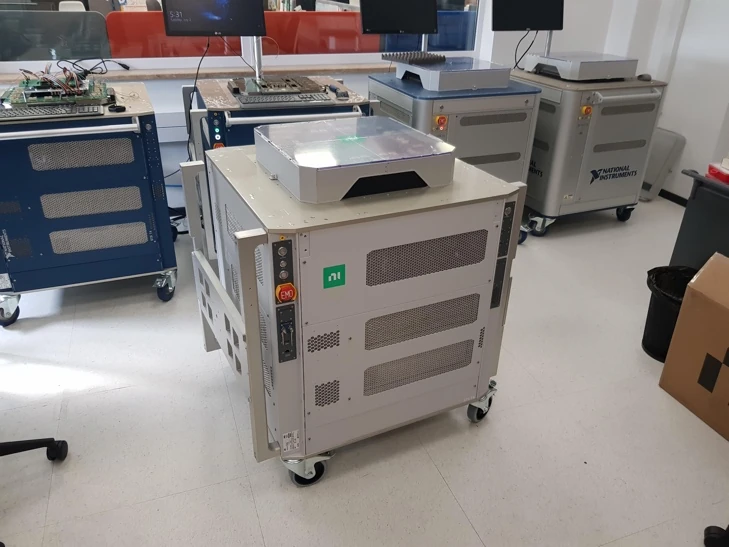
The modern world is moving very fast. Technology is changing not by days but by hours. Software and hardware are getting outdated as new, more capable, and efficient equipment is replacing what seemed very capable yesterday. Hence, for us, it is important to be up to date not only with our skill set but also with the HW used in our day-to-day job. We have worked very hard to modernize our fleet of equipment, which is why we are happy to announce that we have received new STS equipment that will help us cover new product families that we were not able to test before.
The new STS includes the VST 5842, NI's latest state-of-the-art product, as well as the VNA, which is the first of its kind, as it was fully designed by NI, unlike the other VNAs we had before. Together, these two products can cover frequency ranges up to 26.5GHz with 2GHz instantaneous bandwidth (BW). Alongside the VST and VNA, we have digital instruments and SMUs in quantities that allow us to showcase the testing capabilities of the STS and conduct test time benchmarking, one of the key parameters in production testing.
4 simple rules to increase your personal effectiveness. First - Planning
by Hrachya Pogosov, YEA Engineering
Let's talk a little bit about effectiveness and about different methods how to achieve it.
How do you think? What is effectiveness? In my opinion it's immeasurable value, that demonstrates the qualitative achievement of a goal by taking the path of least resistance at maximum speed.
In simpler terms, if you have a complex task ahead of you that needs to be solved, you should try to find the easiest and quickest way to solve it using as few resources as possible.
So, what kind base methods of effectiveness achievement are exist? I have identified 4 main rules and now lets consider first one.
Planning ...
About this theme there are a lot of methods and thousands books. And it's looks like the most banal advice. Some books recommend to schedule the whole life, some of then recommend to plan coming 5 years, some of them describe concrete techniques. You could research this books and chose your method. My opinion is this: although if paraphrase Murphy’s basic law "no matter how much you plan, things will often turn out differently", planning process is very important. It makes everything clear and helps structure thoughts for understanding the right direction of your life or work. It’s worth identifying major goals for yourself and systematically moving towards achieving them. Dwight David Eisenhower (34th president of the USA) said, that a plan is nothing, but planning is everything.
Stephen Covey in his book "The 7 Habits of Highly Effective People" wrote about importance of mission. In my previous article I told the same thing, but regarding the companies. So Covey said: "Roles and goals structure your personal mission and define its direction. If you haven't yet developed the principles of your personal mission, it's worth starting with roles and goals. A simple definition of different spheres of your life and, within each of them, two or three key results you must achieve to move forward, will open up the overall perspective of your life and indicate the direction of development."
Using this advice, 3 or 4 years ago I formulated my own mission. The main points was in my mind more than 5 years ago, for example - relocation in Armenia. But until the moment I wrote the mission, I didn't do anything.
For greater clarity I'd like to share it with you:
I want to live a long and happy life surrounded by family, friends, and loved ones. I aim to maintain strong family and friendship bonds, regularly nurturing quality relationships. I aspire to be a source of hope and support for them.
I want to live a life closely intertwined with travel and sports, organized in such a way that I can embark on journeys at least twice a year, conquer mountains, and actively engage in tourism.
To achieve the goals described above, I must find ways to earn a sufficient amount of money so as not to be dependent on the quantity. The ideal job for me would be remote projects related either to building an online business (ideally related to Armenia) or consulting in project management. Seasonal tourism in Armenia would also be an excellent option. I envision Armenia as my main place of residence.
In addition to everything else, I want to create a social project for providing material assistance to families affected in Armenia and Artsakh.
I rethink my mission 1 or 2 times per year. Change or correct something, but the main direction is constant.
For every goal have a road map, which I try to stick. But if something goes wrong or I forget keep to the plan, I never blame myself for this.
By trying different methodologies, I have chosen the optimal one for myself.
So, lets consider the combination of Dwight D. Eisenhower's matrix and the Pareto principle for prioritizing tasks in order of their maximum output.
Let me describe both of them.
Pic.Eisenhower Matrix
Eisenhower separated tasks on 4 types:
Important & Urgent. You should try to keep this quadrant empty. Here are the tasks, which you must close by yourself immediately. For example: important telephone call or email answering, payment for the credit or something like this;
Important & Not urgent. In this quadrant, you should place long-term goals that are based, for example, on your mission. It could be something about healthcare, education, sport, self-improvement. It is the main quadrant in the matrix;
Not important & Urgent. Here you should place tasks, which you couldn't delete, but the must to be done. All these tasks you should delegate to someone and just control them. For example your company must congratulate all customers with New Year. Is it important task? Of course - yes. Is it necessary to do it by yourself? Of course - not;
Not important & Not urgent. I think, you have understood the logic.
Pareto principle
For deciding, which tasks you should delegate, which of them you must delete and which you should to do by yourself, always use this principle for prioritization.
The Pareto Principle is a concept that specifies that 80% of consequences come from 20% of the causes. It means that for all your tasks you should chose these tasks which bring you 80% of results (success, money, achievement, progress end etc.) And you must concentrate at this 20%, another 80% you can delegate or delete.
It may seem straightforward in theory, but it's challenging to implement in practice.
Combination of this 2 methods helps you concentrate on really important tasks and it's doesn't matter in work or in life.
Ok, it was a theoretical part, but you could ask me: "How can I organize this system in reality?" Let me share 1 free online instrument with you.
At first, why online? Despite the fact, that I am adept of digitization, I like paper notebooks, but I use them as a draft of for initial brainstorming. After it I transfer filtered information into the digital world, which gives me the opportunity to find everything at any moment.
Trello is a very simple and powerful application for tasks organization. With free account it allows you to open until 10 boards. 1 board for 1 project and it's enough for personal using. From project to project you could change the template and now I will share with you my base template.
I created 9 columns on my personal board:
Board design is rules or how to use this board. I created hashtags for fast and easy filtering and searching;
I have already told you about Global Goals and road-maps;
Incoming column for all unfiltered ideas, projects, tasks...
After filtration i place tasks from Incoming column to 1 of 4 columns (Important & Urgent, Important & Not urgent, Not important & Urgent, Not important & Not urgent);
Then you could find Done column;
And column for Rejected/On hold tasks. When I don't make a decision about task/project and I don't want to delete it, I use this column as archive.
As you can see on screenshot above, Trello allows you to create inside the card to do lists, leave a comments, write a description, automate some routines make an integration with Google Calendar and many many more.
As you could see, using just 2 this methods you could improve quality of your life, systematize your thoughts, define main goals and understand how to achieve them.
Thank you very much for reading up to this point. The next rules I will describe in the next article.
Management Corner
4 simple rules to increase your personal effectiveness. Second - Control
by Hrachya Pogosov, YEA Engineering
Today I'd like to talk about the second rule of personal and professional effectiveness. It is controlling scope of works.
In the project, several dozen people from different departments of the company are sometimes involved (yes, not everyone can afford cross-functional teams), each with their own quirks, ambitions, or complete lack thereof.
According the Eisenhower Matrix (this method I described in my previous article) and common sense you should try to delegate as much as possible tasks. But sometimes you can't choose the person or the department to delegate to.
In an ideal, self-organized, and wonderful team of companies of the future, you will be able to assign a task to a colleague, and they will solve it no matter what in a top-priority order. But, unfortunately, things are not always so perfect, and the completion of any assigned task needs to be monitored; otherwise, in the best case scenario deadlines may be missed, in the worst case, they'll simply ignore you.
I don't even mention the fact that there is another group of co-executors developing various systems with whom you also need to interact closely.
All of the above leaves you no chance to avoid controlling all participants, both internal and especially external.
I'd like to share with you an example from personal experience.
I worked in the testing laboratory and organized climatic, mechanical and functional tests for electronic components and measurement equipment.
One of my constant client was a well-known connector's manufacturer, which we test in our lab during 2-3 years. This manufacturer bring us is about $30000 per year. The communication with the customer was excellent, filled with joyful meetings, firm handshakes, and joint 🥃
🥃
🥃 bar outings. Everything was hunky-dory until we had a change in
leadership.
The problems began with the financial and economic department (FED), although, to be honest, they had always been there, but this time they reached their peak. Once upon a time our FED decided to take control of pricing away from the laboratory management. This was an extremely wrong decision made by the director, which led to a lot of stress, tarnished reputation, and, jumping ahead, loss of a client. And all because of a discount of $700 that the client requested.
Of course I managed to get the discount for him, spending 3 days of my personal time, talking to everyone, starting from the head of the Financial and Economic Department and ending with the Deputy Director of Economics and Finance. Since 1 month I leave this lab and together with me, my client stopped working with this laboratory too.
You might ask how this relates to control, but it has a direct connection. If I had let everything go unchecked, the client would definitely have been dissatisfied. The financial and economic department was just collecting their salaries and working strictly according to regulations, showing no interest in retaining the client.
The moral is that until you have the perfect team, the progress of the assigned task should be transparent and 🕹
controlled. As we understand that there are no ideal teams, and all people are mortal, then the judgments described above apply to everyone.
From the self-controlling point of view I can give you another short advise:
Never believe yourself!
Always write your task in your own system. For example in Google Calendar, which have a great integration with Google Tasks. If your task have different statuses, change them or after closing first status task immediately open new one.
It doesn't matter which system you use, whether digital or old school (paper notes) — I like both! I always start by writing on paper or in a notebook. It's like a filter for my thoughts. Short daily tasks are not digitized; their life cycle starts and finishes on paper. Long-term tasks, after being filtered, are entered into Google Tasks or Trello. If it will be interesting, please let me know and I will describe it in more detail.
Thank you for your attention!
Management Corner
4 simple rules to increase your personal effectiveness. Third & Fourth - Analysis and Corrective actions.
by Hrachya Pogosov, YEA Engineering
I hope you hear about PDCA cycle. Today we will talk about the part of this system, which named "check", "act" and "standard".
Please look at the diagram below:
I briefly described all parts of the system for replicating well-known components:
So, today we will consider checking (which include deep analysis) and acting (which include corrective actions and standardization) processes.
Analysis
Any action that led to a negative result must be thoroughly analyzed to avoid repeating the mistakes.
Any action that resulted in a positive outcome must also be analyzed to determine whether it was due to chance or a certain pattern.
There are a lot of instruments and methods to conduct an analysis. Lets consider the mains.
Fishbone diagram or Ishikawa diagram
Ishikawa Kaoru, (July 13, 1915 – April 16, 1989) was a Japanese organizational theorist and a professor in the engineering faculty at the University of Tokyo who was noted for his quality management innovations. He is considered a key figure in the development of quality initiatives in Japan, particularly the quality circle. He is best known outside Japan for the Ishikawa or cause and effect diagram (also known as the fishbone diagram), often used in the analysis of industrial processes.
As a rule, the causes are identified as shown in the figure above. This method allows for covering and separating the most common reasons for the problem in engineering or manufacturing processes. The high-level causes you could choose yourselves, depending on the industry you work in.
At the next level you should define more detailed reasons for the problem sorted according the described directions (causes). You can deepen the tree as much as you think is necessary.
At this stage, you will have a complete picture of what is happening before your eyes. And you can start the analysis. The best practice is to create a Fishbone diagram with your team. It allows you to define the issue from different points of view. Now you and your team can focus on eliminating the most critical causes and ignore those that you are unable to influence or that have the least impact.
The good news is that you can use this method not only for manufacturing problem solving, also it allows to solve personal issues in everyday life.
5W method
After using the Ishikawa diagram, or in parallel, the 5 Whys method helps you to identify the root cause of the problem. This is a very simple method. You should ask yourself or your team "Why?" five times to get to the root cause and fix it.
We fix the root reasons and the second order reasons. Now we could brainstorm and understand how to solve problem, solving first and second order reasons.
What's next?
And then it is necessary to take corrective actions to avoid recurrence of problems. If this cycle helps to solve the problem, all actions should be standardized.
Media Corner
Ինժեներական քաղաք. ի՞նչ է ու ինչպե՞ս է աշխատում. Բիզնեսի անատոմիա
The Armenian tech sector has been consistently highlighted as one of the most promising corners of the country and a strategic imperative for Armenia’s future development. Over the last ten years, the industry has seen significant growth and maturation. An ecosystem that was once primarily centered around outsourcing with big local and international players like EPAM, DataArt, Instigate and Volo, has been transformed into a source of innovation, with many Armenian start-ups being recognized globally as leaders in their respective domains.
2021 saw Armenia celebrate its first home-grown unicorn in Picsart when the AI-powered photo editing suite surpassed the milestone after raising its $130 million Series C round from top-tier VCs such as Sequoia and Softbank. Krisp, SoloLearnSuperAnnotate, Activeloop, Cognaize, 10 Web, and Podcastle are also leaders in their fields and have successfully raised Series A and B rounds from top investors such as YCombinator, Sierra Venture, AI Fund, RTP Global, and Argonatic Ventures to name a few. The country is also home to the offices of many leading global tech firms such as NVIDIA, Synopsys, AMD, Adobe, VMware (by Broadcom), Siemens, Microchip, and Teamviewer. Many of these companies have joined the Armenian ecosystem by acquiring local start-ups for their innovation and talent, which now contribute to products used globally. Over the last few years companies founded by diaspora Armenians have also found a home in the country, most notably trades software giant ServiceTitan, and customer experience platform DISQO. As well, since 2022, the Armenian ecosystem has welcomed companies such as Yandex, Veam, Quantory, Grid Dynamics, Align Technologies and BostonGene, due to geopolitical changes in the countries they were operating in previously. Many of them have quickly become a part of the top 20 taxpayers from the IT industry.
This growth is evident in the economic data. The Armenian ICT sector has experienced consistent double-digit growth over the past several years, achieving nearly 30% growth in 2023 and accounting for 8.25% of the GDP in the same year.
The success stories, and the numbers behind them all point to the fact that the high-tech industry has the potential to continue to grow and be competitive globally. The Armenian government has also pointed this out, mentioning several times that the IT sector is of strategic importance to the country due to it being free of limitations such as sea access and cross-border trade that a landlocked country like Armenia may experience. Throughout the years, the government has been active in working to build a favorable environment for the industry by introducing programs such as tax incentives and grants for start-ups.
However, as the industry in Armenia matures, there is a need for an institutional and comprehensive approach to the policies that regulate the industry to ensure that its potential for growth and excellence is realized. Recognizing this need, the Union of Advanced Technology Enterprises (UATE) is taking proactive steps to address it.
Announcing UATE’s Policy Development & Advocacy Department
Since 2000, UATE has been crucial in fostering and developing a favorable environment for local and international tech companies in Armenia. Our business association comprises over 150 companies and organizations, representing more than 60% of the ICT tax base. Throughout our history, we have collaborated closely with stakeholders across the industry, including government, private companies, and civil society members. To continue this work and enhance our advocacy for public policies, we are announcing the formation of a new department within UATE, the Policy Development & Advocacy Department.
This department’s mission is to contribute to the development of the Armenian technological ecosystem by engaging in the formulation of public policies that regulate the high-tech sector. To achieve this, we will work closely with the tech community and the government to identify regulatory issues hindering the sector’s development and develop solutions based on international best practices and local conditions. The department will actively coordinate dialogue between the private and public sectors, aiming to reshape the regulatory framework and foster a prosperous industry.
Why Regulatory Predictability Matters
As a part of our mission to raise issues at the core of the development of the high-tech industry, and maintain a dialogue with stakeholders across society, we will be using this platform to present topics and provide our perspective on why certain issues matter. The first topic we’ve chosen to highlight is at the core of all issues surrounding any regulatory framework – the need for a regulatory environment that is predictable, stable, and competitive. This principle of regulatory predictability is important for a number of key reasons. First, it reduces uncertainty and builds trust and confidence among stakeholders. A clear and stable set of laws that govern the industry which are not subject to constant changes ensures that companies know the requirements of the environment they operate in, which enables them to focus on growth and innovation rather than navigating complex, and often expensive, regulatory hurdles. This in turn allows companies to focus on long-term planning strategy, and make strategic investments in research and development (R&D), as well as talent development. Lastly, regulatory predictability is imperative for attracting foreign investment and firms to your ecosystem. When expanding globally, a company considers factors such as talent and markets, but must also invest in understanding the regulatory environment of the new country. A track record of consistency and stability naturally helps put many concerns to bed, as the environment they’ll be operating in is easier to understand and plan for.
To create a more predictable regulatory environment, Armenia can focus on several key areas for improvement. One such area is taxation. In 2014, the Republic of Armenia adopted a law providing tax incentives, including a 0% corporate tax rate and a 10% flat income tax for start-ups with 30 or fewer employees. Originally set to expire at the end of 2017, this law has been regularly extended, most recently in 2022 and 2023. However, the current law is scheduled to expire at the end of this year, and it remains unclear what will replace it. The uncertainty in the taxation framework poses a significant challenge for global firms considering opening an office in Armenia or continuing their operations in the country. The stability and predictability of tax policies are crucial for attracting and retaining businesses, making it essential for Armenia to implement a long-term, globally competitive taxation policy to foster economic growth. Moreover, it is essential that the state’s taxation policy (including potential tax incentives) is centered around value creation and sustainable development of the overall tech sector (through promotion of R&D, innovation, etc.) rather than simply applying reduced tax rates.
Another relevant issue in building trust and confidence is the laws governing data protection in Armenia. In 2018, the European Union (EU) implemented the General Data Protection Regulation (GDPR), which sets standards for handling the personal data of EU citizens and residents. Due to the importance of the EU market, GDPR has quickly become the global standard for data protection. Although only EU states can formally adopt GDPR, the EU lists countries with “adequate” data protection frameworks aligned with GDPR standards. Armenia’s current data protection laws do not meet these standards and are not recognized as adequate by the EU. Consequently, a large international company wound down its R&D team in Armenia due to data processing restrictions. To continue operations, the company would have faced business challenges like restricting data processing and notifying customers about the new data location, raising GDPR compliance concerns. Armenia needs to enhance its data protection laws to meet GDPR standards and attract international businesses by ensuring EU recognition.
Another issue at hand are the laws governing the public procurement and tender system. We have regularly observed that tenders are announced with requirements that no local Armenian company can meet, such as experience in certain areas or specifications that have not been applicable in Armenia. Without creating an environment in which local tech companies can be competitive in government tenders, we lose out on the opportunity to develop local resources for future needs. This is particularly important for government procurement needs, as it reduces reliance on foreign countries.
Conclusion
Regulatory predictability and stability is an issue that touches all of the topics we have raised, and it is an important principle to keep in mind when thinking about creating an environment in which the high-tech industry can continue to develop. As seen from the examples discussed, simply having human capital and good ideas is not enough if the regulatory framework in which they exist is inadequate. As we continue to mature as an ecosystem, these are the hurdles we need to remove to ensure continued growth. The list of issues expands beyond the listed example, and through our platform we will continue to raise these issues to raise awareness and encourage discussion around the solutions. In the coming weeks and months, UATE will target and represent specific regulatory issues, including matters surrounding customs, laws on blockchain technology, the aerospace tech sector, cybersecurity, artificial intelligence, education, and laws surrounding investment and incorporating companies in the country.
Announcement Corner
Art & Engineering Lectures Announcement
by Andranik Meliqsetyan, NIY
Dear Engineering City Community please find below announcement for kicking off Art & Engineering Lectures which is a part of larger initiative of Art & Engineering in Exploration of Unknowns in The Era of ML/AI Driven Smart Manufacturing.
-------------------------------------------
We are pleased to inform you that we have prepared an educational program for you with the involvement of professionals from CYLAND.
Here is the schedule and topics of the lectures:
1.How to Expand Creative Space to the Size of the Universe?
Lecturer: Philipp Avetisov
Online
The first lecture provides an overview of the creative process, historical examples, and contemporary approaches in media art. It also highlights key problems and solutions in collaboration between artists and technical specialists.
2.Artist Talk with Media Artist Alexandra Dementieva
Online
3.Team of Media Artists and Engineers: Main Problems and Solutions
Lecturer: Philipp Avetisov
Online
The lecture provides an overview of the main issues faced by media artists and engineers when working together and suggests solutions through improved communication, flexible project management, and educational initiatives.
Data Interpretation for Media Art Installations + Demonstration of Installations Created in CYLAND
Media Laboratory
Lecturer: Alexey Grachev
In-person at the Engineering City
Alexey will talk about the changes and influence of open-source platforms, programming languages, and creative communities on media art. He will show installations created in the CYLAND media laboratory and explain the principles of their operation.
5.Collaborative Creative Work: Setup
Lecturer: Philipp Avetisov
Online
The lecture emphasizes the importance of mutual understanding and effective interaction between media artists and engineers. Collaborative work requires flexibility, openness to new ideas, and a willingness to compromise to achieve a common goal while maintaining the uniqueness of the creative vision and technical feasibility of the project. This will be discussed through specific examples.
6.Artist Talk with Media Artist Anna Franz
In-person at the Engineering City
Lecture by Natalia Kolodzei, Curator, Art Historian, and Media Art Collector from New York
Online
Each meeting will last approximately 45-60 minutes.
Language – English.
On the ZOOM platform with recording available for your convenience.
We will handle the technical side – create the ZOOM conference and send you the link.
It is best to schedule the meetings in the evening since some speakers are in America and we have a significant time difference.
Alexey will deliver his lecture in person when he is in Yerevan, so we can choose a convenient time for you.