The purpose of the Journal is to disseminate knowledge, experience, and best practice in engineering & manufacturing. The articles are written by practicing professionals in the Engineering City (EC). They cover issues relevant to their projects, operations, and organizations. The articles address the challenges of the time. As such, the Journal is also a chronicle of the evolution of the EC, its companies, and its individuals. It is the aim of the Journal to advance the engineering & manufacturing practice, to enrich the engineering & manufacturing community, and to contribute to the worldwide discourse in engineering & manufacturing.
Published by the Engineering Association
The Engineering City JournalIssue 15/2024Published by the Engineering AssociationYerevan, August 5, 2024
“Continuous Improvement Document” as a Resolution of Quality vs. Deadlines
by Rama, EA
Professional engineers understand that they work against deadlines.
They also have come to realize that the life of the project does not end at delivery, that the project must have a life after the delivery. That after-delivery life can be called the “Continuous Improvement” phase of the project.
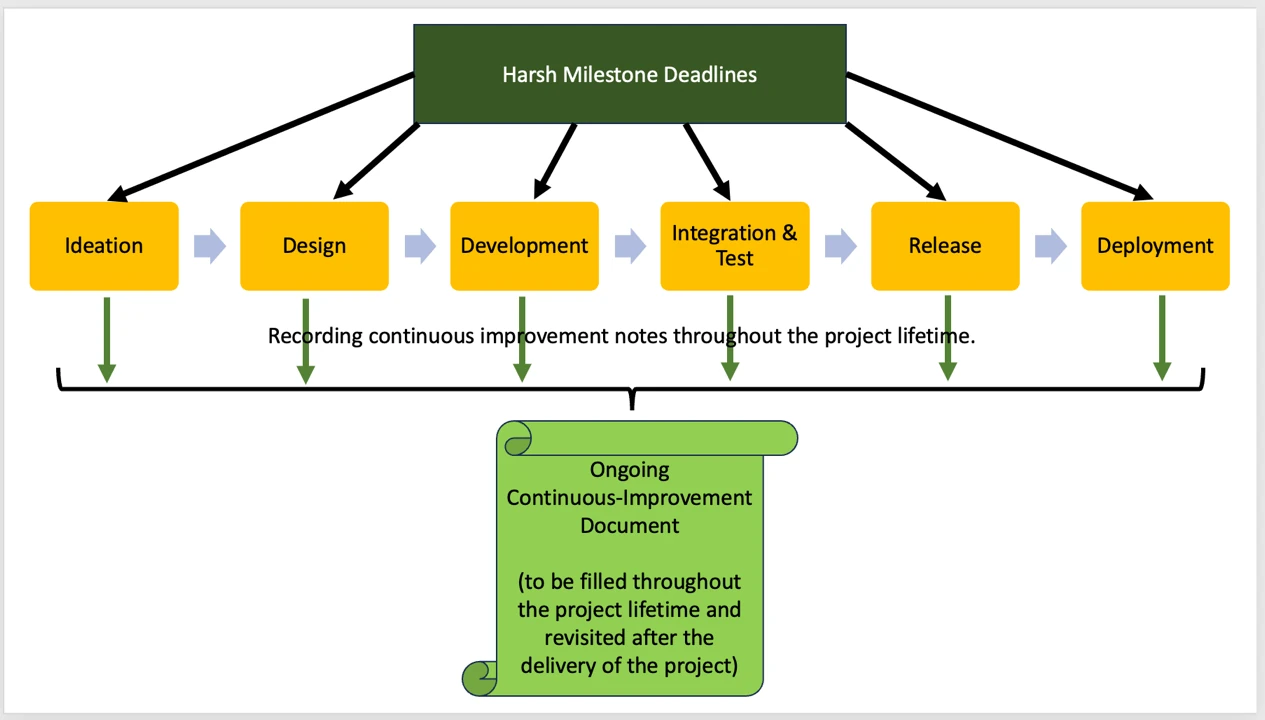
The necessity of the “Continuous Improvement” phase comes from the conflict between quality and deadlines. Most of the time, quality, functionality and characteristics of the product take a back seat in front of the tyranny of the deadlines. That conflict gets resolved through the Continuous Improvement phase.
A good technique to manage this phase is to have opened a running file by the name - “Continuous Improvements” as soon as the project starts and keepig it alive as long as the customer is using our product.
In this document, engineers record every compromise they had to make during their work. Here, engineers also record the technical support issues that come from the customers after delivery.
Pic.Opening a running file for Continuous Impromvent at the beginning of the project.
After delivering the project, the team starts addressing every entry of this document to create the improved version of the product.
The engineering guiding principles is a good way of thinking about Continuous Improvement.
Pic.Engineering Guiding Principles
Here, we can open up the “Cost” moment as:
So, as an example, let’s take a Transistor Production Tester project. If during the project we had achieved a 8 second test time for each transitor, which is very long for production test, but had to deliver the tester to the customer according to the deadline, then the continuous improvement phase would start after the delivery to reach a 2 second test time. But this issue should have been recorded at some point during the development of a tester in the “Continuous Improvement” document.
The product owner is he who defines the product, the product line, and the product road map.
If the project team lives in the current project and solves the current problem statements, then the product owner lives in the future and defines the next challenge statements.
He owns both the continuous improvement process and the innovative breakthrough process of his product line.
It is his product line that competes against the competitors’ in the market place through functionality, characteristics, quality, cost, …
It is he who disrupts the marketplace through incorporating new technologies in the product.
And it is he who orders technology research to the ARC for his product line.
The below picture shows where he gets his inputs from:
He is certainly guided by the engineering guiding principles:
And finally, it must be said that, although the product ownership is certainly a team ownership of the given product line, yet there still must be an individual product owner who acts as the first among equals in the product line team.
As I was surfing the web, I found this website that talks about Technology Research. link.
I found this text as a good description of what the ARC is meant to be. Below, I copied some text from that website.
“Technology research is a process that helps businesses to recognise technological opportunities and dangers (technology) that may have an impact on their future survival and success. It strives to gather and disseminate the technology data required for long-term planning and decision-making (business intelligence).
Technology research will help you identify the following:
Any new emerging technology areas
The level of competition
Industry’s current and emerging issues
Most recent developments and trends in a particular field
How you are seen in comparison to your competition, and how your competitors attract customers
Your possible clients, their location, and clients that are most likely to do business with you”
The ARC - Bringing the Practice of “Research” to the Engineering City
by Rama, EA
Research is about looking into the future, it is living in the future, it is a long-term survival strategy for people, companies, countries.
Research is a practice that has to be grown and developed. In general, people, companies, and countries are too busy with their day-to-day challenges and have no time to spend on research.
But, it is a “must” for long-term survival, it is a must if we want to be ahead of others when the future comes. In a sense, it is about creating the future before others get there .
Take for example this picture:
Here, the companies compete on producing squared wheels for the market. The competition is fierce because everyone is engaged in supplying the same thing to the marketplace.
But, there is a wise saying by Mark Twain:
Whenever you find yourself on the side of the majority, it is time to pause and reflect.
Mark Twain
This applies to both suppliers and customers. So, if you see that you are among the majority of suppliers, that everybody, including you, are engaged in producing the same thing (the squared wheel in this case), then you must pause and reflect. This reflection must bring about a new idea, an innovative idea, a disrubtive idea. In our case, that would be the rounded wheel.
Research is about breaking away from the majority.
Research is about positioning the company into the future.
Research is about getting there before the majority gets there.
But research is expensive. It demands all what is in short supply – time, people, new knowledge, equipment, finance, … As a result, companies tend to either get into small-scale research that gets interrupted often, or don’t get into research at all.
The ARC comes to the rescue. It promises to:
Manage the research for us
Provide us with the people for our research
Prepare the future workforce for us
Provide the equipment and the labs for our research
The challenges of using the ARC could be summarized as:
It is difficult to think about the future when you are busy with current projects
It may be difficult to formuate research projects
It may be difficult to delegate research to someone else
But we must start:
We must start generating research ideas.
We must start learning how to use this instrument – the ARC.
What is the practical side of the ARC for the EC companies?
The ARC is really an augmentation of our capacity in people and equipment. But not any augmentation, but an augmentation to work on the future.
People in the companies are loaded with projects and deadlines. You can rarely find idle people and free equipment in the companies. And if there are any, they soon get engaged in new projects.
Working on future positioning takes always a back seat when a new commercial project comes about. As a result, we tend never to get our hands onto the future, and the future always slips away from us.
On the other hand, the companies that figure out a way to work on the future at the same time as they work on the present will have a dramatic edge when the future comes.
Having the ARC as an augmentation of company capacity is one resolution to the problem of having to work on the presence and the future at the same time.
Pic.The genius of the “And”and the tyranny of the “Or” (a Dr. T quote).
The EC Journal became mostly about engineering management, about new product introduction, about new technologies, about engineering education, about EC news & announcements, about musings & art, … But it has failed to become a technical journal, which was its original intention.
With the ARC Journal, it is the hope that it becomes a technology research publication.
The ARC Journal will be placed at the same website as the EC Journal. If you would like to have access to it, then please subcribe to the EC Journal. Link.
You can find this announcement also on Telegram. Link.
Art & Engineering Corner
Artistic Expressions about the benefits of Writing
Friday Lecture - Foundations of Modern AI Systems, Friday, August 9
by Mihran Miroyan, Berkely Research Lab
Abstract
Artificial Intelligence (AI) has been a buzzword for the past couple of years. But what is AI, how did it all start and where is it going?
The first AI algorithms were developed in the mid-20th century. These algorithms were designed to mimic human decision-making but relied heavily on human-engineered rules and features, which limited their applications in the real world. Neural networks were also invented during this period, but their potential was constrained by limited data and computational resources. The digitization of the world and advancements in computer hardware have since led to significant progress in the field.
Machine Learning (ML), a branch of AI, focuses on identifying structures and patterns within large datasets. The three main paradigms of ML - unsupervised learning, supervised learning, and reinforcement learning - are foundational to the development of modern state-of-the-art AI systems, such as ChatGPT and Dall-E. These paradigms are employed to train large-scale deep neural networks on vast amounts of data. In this talk, we will explore these learning approaches and domain-specific deep learning architectures through two case studies: autonomous driving and generative language modeling.
Announcements Corner
Bring-your-Children-to-Work Day, August 23
Dear EC community,
We are excited to announce about a special new initiative we would like to launch - Children’s Day event at EC on August 23rd!
This is a wonderful opportunity for us to come together, introduce our children to the workplace, and foster new friendships among our office community and their children.
To ensure a fun and engaging experience for all, we kindly ask you to let us know if your child(ren) will be attending by completing data in the shared file.
Please provide their names and ages, which will help us work on activities suitable for different age groups.
Event Details:
Date: August 23
Time: TBD - it will be a half day event
Location: EC
Activities will include a tour of the office, interactive games, ensuring a memorable day for your children. Snacks and refreshments will be provided.
We look forward to a joyful day filled with laughter, learning, and new friendships.
You can also find this announcement on Telegram. Link.
Announcements Corner
The Engineering Week has been moved to October 1 – 3, Yerevan & Vanadzor
Please start activily promoting it among customers and partners. The AEW is a perfect opportunity to bring the customers into our EC Community. They must become part of the community.