The purpose of the Journal is to disseminate knowledge, experience, and best practice in engineering & manufacturing. The articles are written by practicing professionals in the Engineering City (EC). They cover issues relevant to their projects, operations, and organizations. The articles address the challenges of the time. As such, the Journal is also a chronicle of the evolution of the EC, its companies, and its individuals. It is the aim of the Journal to advance the engineering & manufacturing practice, to enrich the engineering & manufacturing community, and to contribute to the worldwide discourse in engineering & manufacturing.
Published by the Engineering Association
The Engineering City JournalIssue 5/2025Published by the Engineering AssociationYerevan, March 24, 2025
In this edition of the Journal, we can read a very timely article by Lusya Adamyan, ADG, on project management. She introduces two concepts – that of the Project Charter and that of the “T” type Project Leader. The Project Charter is presented as a document above the regular Project Plan that combines both the project strategy of the specific project with organization strategy. The need of the Project Charter rises from the uncertainties and complexities of certain types of projects, which now are overwhelming in the EC. Such a charter calls for a new type of a project leader, the “T” type project leader, who combines the vertical expertise of the specific project with the horizontal knowledge of the organization as a whole and its stakeholders’ interests. Besides these two concepts you can find a discussion on project uncertainties and complexities.
The second article is from Nina Hakobyan from the EC Talent Development team where she reports on the audit process that the Aerospace Engineering Master’s program underwent by a combined commission from the Academy of Sciences and a certified education auditing body. Our master’s program did not only pass the audit with flying colors, but also was pronounced as an exemplary program for others to follow.
Engineering Management Corner
Project Charter's Role in Managing Constraints: What to do, When to deliver
by Lusya Adamyan, ADG
Abstract
This paper is born out of a series of successive challenges, case studies, meetings, and monitoring results. In the following, certain techniques and methods will be discussed and proposed to address and assist the team in minimizing artificial uncertainties as much as possible. These methods will help teams recognize their environment, which navigates their technical expertise, enabling them to quickly generate business value from an idea. This process will involve evaluating the current state, defining opportunities and transparency, and establishing a clear pathway to transition from the current state to the future state. Furthermore, it will support the team leader’s transition from a self-organized role to a more generalized, self-organized leader, facilitating a shift from an I-shape to a T-shape model. T-shape leaders, equipped with both deep technical expertise and a broad skill set, are pivotal in establishing and leading cross-functional teams. These leaders don't merely follow technical desires but are able to balance and align team efforts with the strategic interests of the company. By seeing the broader picture, they are able to guide their teams while ensuring that the project remains in sync with organizational goals, ultimately fostering a more cohesive and effective team dynamic in an uncertain environment.
Additionally, the environment provides the necessary foundation for the project to be SMART (Specific, Measurable, Achievable, Relevant, Time-bound), a concept that is clearly articulated and defined in the project charter. This charter serves as a crucial document that ensures all stakeholders are aligned, clarifying the project’s scope, timelines, and expected outcomes, while also helping to establish clear objectives that drive the project’s successful completion.
The Project Charter is a foundational document in project management, providing formal authorization for a project’s initiation and offering a comprehensive overview of its objectives, scope, key stakeholders, and constraints. Serving as the guiding reference throughout the project lifecycle, the Project Charter ensures that the project team and stakeholders are aligned on expectations, goals, and processes. By defining critical elements such as cost, time, scope, risks, and required resources, it offers clarity and direction for project execution.
Beyond traditional project management principles, the Project Charter also plays a crucial role in aligning the project with business value. It helps teams involved in research, testing, and iterative development, especially when building a Minimum Viable Product (MVP), to step back, reflect, and ensure that the project delivers tangible outcomes that meet organizational objectives. Whether using a predictive, hybrid, or agile approach, the Project Charter serves as a key document that anchors the project’s scope, objectives, and deliverables while focusing on creating value from the very beginning. This introduction sets the stage for understanding how the Project Charter contributes to successful project outcomes, particularly in dynamic environments where flexibility and adaptability are essential.
2. Uncertainty management as part of project management
Much good project management practice can be thought of as effective uncertainty management, clarifying what can be done, deciding what is to be done, and ensuring that it gets done as noted earlier. For example, good practice in planning, coordination, setting milestones, and change control procedures, seeks to manage uncertainty directly. However, common practice does not consider the range of sources of uncertainty present in projects or what a coordinated approach to proactive and reactive uncertainty management can achieve. Two key areas of uncertainty featured in network discussions: uncertainty associated with estimating; uncertainty associated with stages of the project life cycle.
2.1 Uncertainty in estimates
An obvious aspect of uncertainty in any project concerns estimates of potential variability in relation to performance measures like cost, duration, or quality related to particular planned activities. For example, we may not know how much time and effort will be required to complete a particular activity. It was evident from network discussions, and all the case study presentations by project managers, that estimating activity for planning and control purposes is a critical project management process. The causes of uncertainty about estimates include one or more of the following:
lack of a clear specification of what is required;
novelty, or lack of experience of this particular activity;
complexity in terms of the number of influencing factors and associated inter-dependencies;
limited analysis of the processes involved in the activity;
possible occurrence of particular events or conditions which might affect the activity;
emerging factors unknowable at the start of the project;
bias exhibited by estimators, typically optimism bias
[1,2].
Thus, uncertainty results from vagueness, ambiguity and contradictions associated with lack of clarity because of lack of data, incomplete and inaccurate detail, lack of structure to consider issues, the working and framing assumptions being used to consider the issues, known and unknown sources of bias, limited control of relevant project players, and ignorance about how much effort it is worth expending to clarify the situation [3].
2.2. Uncertainty associated with stages in the project life cycle
Many significant sources of uncertainty that need to be managed in projects are associated with the fundamental generic management processes that make up the project life cycle. A fair number of sources are implicitly acknowledged in lists of project management ‘key success factors’ such as those offered by Gallagher [7]. Potential sources typically identified in this way are listed in Table 1 against various stages of the project life cycle. (By presenting Table 1 we do not mean to imply that projects can be characterized as a simple linear process, or simply in terms of the stages listed, but the scope of stages and level of detail is sufficient for present purposes. Ward and Chapman [8] provide a more detailed description of project life cycle stages and possible complications in practice.) All of the uncertainty management issues in Table 1 are best addressed very early in a project and throughout the project life cycle and should be informed by a broad appreciation of the underlying ‘root’ uncertainties. Chapman and Ward [3] offer a six Ws framework for this purpose based on the following six questions about a project:
Who are the parties ultimately involved?
What do the parties want to achieve?
What is it that each party is interested in?
Which way (how) is each party’s work to be done?
What resources are required?
When does it have to be done?
Understanding the uncertainty associated with each of these basic questions, and the implications of interactions between them, is fundamental to effective identification and management of project risk. The six Ws framework helps identify uncertainties early, which is crucial for managing risk throughout the project. Additionally, the section emphasizes that failure to clarify uncertainties in the early stages (like design or planning) often causes difficulties in later stages, particularly regarding time, cost, and quality.
Table 1. Typical uncertainty management issues in each stage of the project life cycle (Chapman and Ward, [3]. Copyright John Wiley & Sons Ltd., used with permission)
Stages of the PLC Uncertainty management issues
Conceive the product Level of definition Definition of appropriate performance objectives Managing stakeholder expectations
Novelty of design and technology Design the product strategically Determining ‘fixed’ points in the design Control of changes
Plan the execution Identifying and allowing for regulatory strategically constraints Concurrency of activities required Capturing dependency relationships Errors and omissions
Allocate resources tactically Adequate accuracy of resource estimates Estimating resources required Defining responsibilities (number and scope of contracts) Defining contractual terms and conditions Selection of capable participants (tendering procedures and bid selection)
Execute production Exercising adequate coordination and control Determining the level and scope of control systems Ensuring effective communication between participants Provision of appropriate organizational arrangements Ensuring effective leadership Ensuring continuity in personnel and responsibilities Responding effectively to sources which are realized
Deliver the product Adequate testing Adequate training Managing stakeholder expectations Obtaining licenses to operate
Review the process Capturing corporate knowledge Learning key lessons Understanding what success means
Support the product Provision of appropriate organization arrangements Identifying extent of liabilities Managing stakeholder expectations
A common source of difficulty in projects is a failure to carry out the design and plan stages thoroughly enough. Thus, a project proceeds through to execution with insufficiently well-defined specifications for production. During execution this gives rise to difficulties necessitating additional design development and production planning, and consequently adverse effects on the performance criteria of cost, time and quality. This problem of ‘premature definition’ can be most acute in novel, one-off projects involving new technology, particularly when key stakeholders attempt to impose unrealistic completion dates or cost targets. Sometimes this can be caused by politically motivated performance criteria, targets, and operating constraints: e.g. budgets too small to allow adequate resources to complete the project by a stated time, or to a given level of functionality [9]. In addition, some uncertainty about operating conditions and related factors outside the control of the project manager will always remain. Inevitably, judgments have to be made about the degree of detail and accuracy that is practicable in the design and plan stages.
The allocate stage of the project life cycle is a significant task involving decisions about project organization, identification of appropriate agents by the project owner, and allocation of tasks between them. The sources of uncertainty and risk associated with this stage of any project are considerable, primarily due to the three agency problems of: adverse selection, moral hazard and risk allocation mentioned earlier.
3. Understanding Project Management Complexity.
What is meant by project management complexity or project complexity? Why is it important to know now? How will knowing this make my life (as a project professional) easier? Organizational projects are by nature far-reaching and complex. Understanding how corporate projects start and take shape, and recognizing different types of complexity can help you determine the appropriate methodology for the project.
The birth of modern project management practices was heavily oriented around projects that were initiated based upon well-defined requirements that were known at the onset of the project. In most cases, the technology needed to support the requirements was also known and available. The creation of project management forms, guidelines, templates, and checklists accompanied by the waterfall project management methodology placed significantly more emphasis on the tools for project management than on the project management leadership styles or interpersonal skills needed.
Large projects are generally treated as complex projects because of the number of components that must interact. This includes factors related to component budgeting, legal issues, political issues, and contractor coordination efforts. It is very difficult to predict with any degree of certainty how all these components would interface with each other and interact over time.
The need for a better understanding of complexity began to appear in strategic projects that were smaller than megaprojects. These smaller strategic projects, such as those involving creativity, R&D, and innovation, were usually assigned to functional managers who were allowed to use any tools they desired and any leadership style they were comfortable with. As the turn of the century approached, companies recognized the need for a more structured approach to managing strategic projects and a better understanding of complexity. Some of the issues facing executives that appeared with strategic projects included:
Unable to make informed decisions in a timely manner due to a lack of good metrics.
Unable to tell if each project was creating business value until significant funds have been spent.
Unable to verify alignment of projects to strategic business objectives.
Unable to tell if the company was working on the right portfolio of strategic projects.
The root cause of most of these issues was that strategic projects were considered significantly more complex than most traditional or operational projects. Failures resulting from traditional projects were blamed on cost overruns and major schedule slippages. Failures on strategic projects arose from a poor understanding of complexity and assigning resources that could not effectively manage or deal with complexity. In many companies, up to 60 percent of the strategic projects failed to meet goals and objectives.
3.1. Degrees of Project Complexity
Most authors of complexity literature argue that the first step in managing a complex project is to identify the degree or magnitude of the complexity by classifying the type of complex project.[10] Dave Snowden identified four types of projects, each containing some degree of complexity, based upon the Cynefin framework:[11]
The Stacey Matrix1 was developed and published by Ralph Douglas Stacey. It is designed to help understand the factors that contribute to complexity and choose the best management actions to address different degrees of complexity. It was not specifically designed to address project delivery but is just as relevant to that area as any other.
The basis of the matrix is two dimensions: agreement and certainty.
1. Close to agreement, close to certainty
In this area of the matrix, data can be gathered from the past that can be used to predict the future. Construction and engineering projects typically have a wealth of technical data that allows them to be well specified and scheduled before delivery work starts. Work is controlled by monitoring against detailed plans.
2. Far from agreement, close to certainty
Some projects are very certain about which objectives are possible and how they can be delivered but there is less agreement about which objectives are of greatest value. This may be exemplified by a project manager who has trouble developing a business case that is acceptable to multiple stakeholders who have differing views on value.
In this area, skills such as negotiation, reaching a compromise and developing coalitions are important. Decision making becomes political rather than technical.
3. Close to agreement, far from certainty
Projects may have a high level of agreement about the desired objectives but not much certainty about the cause and effect linkages that will result in the desired objectives. Relationships between outputs, outcomes and benefits can often fall into this category when assumptions are made about how outputs will lead to benefits.
In cases like this a strong sense of shared vision among the stakeholders is necessary and a flexible and realistic approach to planning. The project manager and sponsor must visibly head towards an agreed future state (blueprint) even though specific paths are not fully predetermined.
4. The zone of complexity
This zone covers an area where the combination of low levels agreement or low levels of certainty make the project a complex management problem. This is the area that often triggers poor decision-making practices, when what it really needs are high levels of creativity, innovation and freedom from past constraints to create new solutions.
Adaptability and agility are key skills here, not just for the project manager but for the sponsor, team members and stakeholders. Approaches such as Concurrent Engineering and Systems Thinking are useful here.
5. Far from agreement, far from certainty
Where there is little agreement and little certainty, anarchy can prevail. Individuals and organisations sometimes resort to avoidance but such situations cannot always be avoided. Strategies are needed to address these situations should they occur.
This zone is often referred to as chaos rather than anarchy and the boundary between this and the zone of complexity is known as the ‘Edge of chaos’.
The Stacey matrix has a lot on common with other complexity-based models. For example, a project in Zone 1 is arguably the same as a Type A project in the WHOW model. Similarly, Zone 2 projects in this model are similar to Type B and so on.
Another related framework is the Cynefin Framework which helps understand the way to respond to circumstances around simple, complicated, complex and chaotic circumstances.
4. The Importance of Defining the Project Type When Developing a Project Charter: Defining Triple
Constraints in the Project Charter
The Project Charter should define clear limitations, setting benchmarks and creating a Minimum Viable Product (MVP) based on the Stacy Matrix framework, which addresses the "what" and "how" questions in relation to project requirements and methodology. The Matrix categorizes projects based on certainty and agreement around the requirements and how to achieve them. Depending on whether the project is simple, complicated, or chaotic, the approach to the Project Charter changes.
Simple Projects: A project is simple when the team has clear requirements, meaning the specifications are within acceptable values. Let’s consider these acceptable values as the team’s skill set and previous experience, that is, the environment in which the team is capable of viewing and managing the project’s progress. This environment is crucial to successfully creating the expected outcomes, or the uniqueness of the project. In this context, the project environment can be understood as the conditions, skills, and experience the team brings, which influence the project's approach and execution, often highlighted through tools like the Stacy Matrix. This type of project is classified as a Predictive project, where the scope is fixed.
Complicated/Complex Projects: This type of project is classified as complicated. It has a clear understanding of the scope and end goals, but the way to achieve these goals requires expertise and specialized skills. The project follows a hybrid approach, combining predictive and agile methodologies.
Predictive: The scope is clearly defined from the start, but the execution is flexible and adaptive.
Agile: While the scope remains fixed, adjustments to time and cost can be made depending on expert evaluations and the project’s evolving needs. Flexibility is key, especially in an environment with technological uncertainty.
Chaotic: This type of project adopts an Agile, flexible development approach, where the scope is not fixed but evolves based on continuous collaboration with the customer and changing requirements. The project is built on the following 4 Agile values:
Individuals and Interactions Over Processes and Tools
Emphasizing collaboration within the team and with stakeholders.
Working Software Over Comprehensive Documentation
Prioritizing the delivery of functional software over extensive documentation.
Customer Collaboration Over Contract Negotiation
Fostering continuous communication and adapting to the customer’s needs.
Responding to Change Over Following a Plan
Remaining flexible and adapting to changes rather than strictly following a pre-set plan.
This flexible approach shapes the way the project charter is created, focusing on high-level goals, iterative development (MVP), and continuous collaboration rather than rigid, detailed planning. The project charter reflects the need for adaptability, leaving room for scope adjustments and emphasizing ongoing stakeholder engagement.
4.1 Project Charters for each project type
In essence, the Project Charter is valuable across all types of projects because it serves as the guiding document that aligns stakeholders, sets boundaries for scope, time, and cost, and provides a foundation for successful project execution, whether in a traditional, agile, or hybrid context.
Table 2.Project charter value-based project type
In essence, the Project Charter is valuable across all types of projects because it serves as the guiding document that aligns stakeholders, sets boundaries for scope, time, and cost, and provides a foundation for successful project execution, whether in a traditional, agile, or hybrid context.
5. The Importance of T-Shaped Leaders in Rapid Business Value Creation
In modern organizations, effective leadership is crucial for achieving business success. While leaders with deep expertise in one area—often called "I-shaped" leaders—are valuable, they may lack the ability to collaborate across different functions. On the other hand, T-shaped leaders bring a unique and crucial advantage to the table.
A T-shaped leader has:
Depth of expertise in one specific area (the vertical line of the "T").
The ability to collaborate across various disciplines (the horizontal line of the "T").
This combination enables T-shaped leaders to understand the broader organizational context, collaborate seamlessly with diverse teams, and adapt to complex, fast-changing business environments. Their cross-functional mindset fosters innovation and effective problem-solving across the company.
In the 1980s, the concept of T-shaped professionals was introduced by McKinsey & Company, and it gained further attention in 1991 when David Guest discussed the importance of engineers with broad skills. Companies like IDEO championed the idea by hiring individuals who not only excelled in one field but could also contribute to and collaborate with various teams.
Today, T-shaped leadership is seen as essential for driving rapid business value creation. This leadership model allows businesses to break down silos, flatten hierarchies, and foster collaboration, which in turn leads to faster decision-making, innovation, and more effective execution. By prioritizing T-shaped skills—broad thinking, collaboration, and general management knowledge—organizations position themselves to respond quickly to market needs and create business value at an accelerated pace.
Let's emphasize the fact of why T-shaped people are necessary. T-shaped people are those who are able to define and establish the minimum value to be created, unlike I-shaped people who, due to their perfectionism, seek to dive deeply into achieving perfection. In this situation, T-shaped individuals bring balance and are focused on creating a Minimum Viable Product (MVP), which becomes possible through their involvement.
6․Conclusion:
The purpose of this article was to explore the uncertainties that arise within projects, as demonstrated through the case study. By understanding where a project team stands in relation to its goals and objectives, it becomes easier to identify how it can align its actions with the company’s strategic vision. Through this alignment, teams can make informed decisions about when to stop endless research and focus on delivering the Minimum Viable Product (MVP) that generates tangible business value. One of the most effective paths to achieve this alignment and drive towards successful project outcomes is by promoting the use of a Project Charter. The Project Charter provides the foundation for clear direction, stakeholder alignment, and effective decision-making, helping the team to manage uncertainties and ensure that the project stays on track towards delivering value that aligns with the company's overarching goals.
References
[1] Buehler R, Griffin D, Ross M. Inside the planning fallacy: the causes and consequences of optimistic time predictions. In: Gilovich T, Griffin D, Kahneman D, editors. Heuristics and Biases – the Psychology of Intuitive Judgment. Cambridge University Press; 2002. [2] Armor DA, Taylor SE. When predictions fail: the dilemma of unrealistic optimism. In: Gilovich T, Griffin D, Kahneman D, editors. Heuristics and Biases – the Psychology of Intuitive Judgment. Cambridge, UK: Cambridge University Press; 2002. [3] Chapman CB, Ward SC. Project Risk Management: Processes, Techniques and Insights. second ed. John Wiley & Sons; 2003.
[4] Ward SC. Requirements for an effective risk management process. Project Management Journal 1999(September):37–42.
[5] Eisenhardt KM. Agency Theory: An Assessment And Review. The Academy of Management Review 1989;14(1):57–74. [6] Chapman CB, Ward SC. Managing Project Risk and Uncertainty: A Constructively Simple Approach to Decision Making. Chichester, UK: John Wiley & Sons Ltd.; 2002. [7] Gallagher K. Chaos: project success factors, In: Proceedings of Implementing Technology and Project Management Conference, September, 1995, pp. 21–36. [8] Ward SC, Chapman CB. Risk management and the project life cycle. International Journal of Project Management 1995;13(3):145–9.
[9] Flyvbjerg B, Bruzelius N, Rothengatter W. Megaprojects and Risk: An Anatomy of Ambition. Cambridge: Cambridge University Press; 2003.
[10] Portion of this section has been adapted from Wikipedia, Types of complexity.
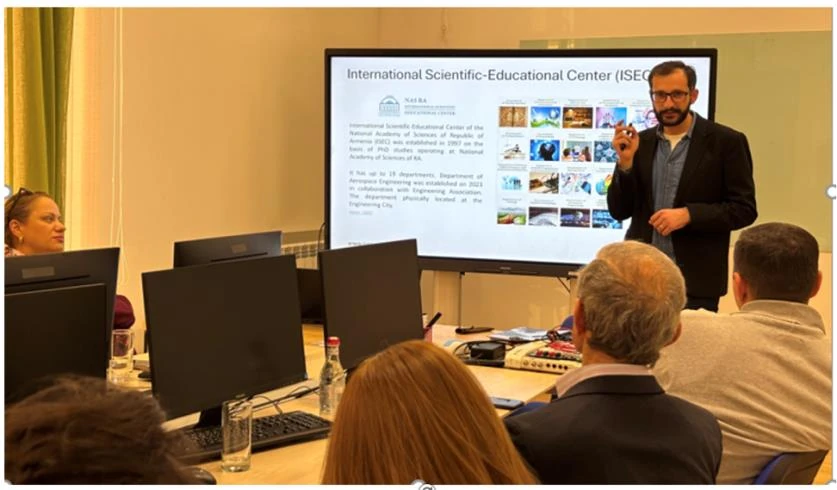
Ինչպես գիտեք, 2023 թվականին Ինժեներական ասոցիացիայի նախաձեռնությամբ` ՀՀ Գիտությունների ազգային ակադեմիայի գիտակրթական միջազգային կենտրոնում հիմնադրվել է Ավիատիեզերական ճարտարագիտության ամբիոնը։
Ամբիոնում այժմ սովորում է 19 մագիստրոս, ովքեր աշխատում են ոլորտի Ինժեներական կազմակերպություններում և իրականացնում կազմակերպությունների կողմից առաջադրված հետազոտություններ և մագիստրոսական թեզեր։
2025 թվականի փետրվարի 28-ին Ինժեներական քաղաք էր այցելել ՀՀ ԳԱԱ գիտակրթական միջազգային կենտրոնի աշխատանքային խումբը՝ մագիստրոսական ծրագրի մոնիթորինգի նպատակով։
Աշխատանքային խմբում ընդգրկված էին Գիտակրթական կենտրոնի ուսումնական աշխատանքների գծով փոխտնօրեն Երջանիկ Զարգարյանը, դեկան Ատոմ Մխիթարյանը, կրթության որակի ապահովման բաժնի պետ Նարինե Վարդանյանը, դեկանատի ավագ մասնագետ Ջուլիետա Սևյանը, ուսումնական մասի գլխավոր մասնագետ Մարգարիտա Մարկոսյանը, Մասնագիտական կրթության որակի ապահովման ազգային կենտրոնի (https://www.anqa.am/) աշխատակից՝ Մենուա Սողոմոնյան, Ամբիոնի վարիչ Անդրանիկ Աղաջանյանը, կրթական ծրագրերի ղեկավար Արարատ Ստեփանյանը և համակարգող Նինա Հակոբյանը։
Մոնիթորինգի ժամանակ ներկայացվեց կատարված աշխատանքը և ստացված արդյունքներն ու գրանցված հաջողությունները։ Հանդիպման ժամանակ հնչեցին բազմաթիվ հարցեր։
Մոնիթորինգի աշխատանքային խմբի համար առավել հետաքրքրիր էր այն կրթական մոդելը, որով աշխատում է ամբիոնը, երբ մագիստրոսներն ամբողջությամբ ինտեգրված են ինժեներական կազմակերպությունների, հետազոտական կենտրոնի կիրառական հետազոտություն ունեցող նախագծերին։
Որակյալ կրթության կազմակերպման համար մեծ արժեք ունի նաև գործատուների և կրթությունը կազմակերպող հաստատության միջև սերտ կապը, երբ կազմակերպության մեջ առկա խնդիրը կամ դրա մի մասը կարող է լուծում ստանալ մագիստրոսական թեզի կատարման շրջանակներում։
Մոնիթորինգի ժամանակ խոսվեց նաև այն մասին, որ Բազային ամբիոնի մոդելը շատ զգայուն է և հնարավորություն է տալիս արագ արձագանքել առաջացած խնդիրներին և լուծում տալ դրանց, շեշտադրվեց, որ դասախոսության կամ գործնական աշխատանքի կատարման որակի, ձևաչափի մասին հետադարձ կապը ամբիոնի ղեկավար անձնակազմը ստանում է անմիջապես։
Ամփոփելով հանդիպումը՝ մոնիթորինգն իրականաոցնող խումը նշեց, որ սեղմ ժամկետներում կատարվել է մեծ ծավալի աշխատանք և որ Ինժեներական քաղաքի մագիոստորսական ծրագիրն արդիական է, կենսունակ և մրցակցային։