
The Whole and the Parts – Which Type of a Community?
English translation
Like anything else, a community is a whole with its parts.
It is the relations that exist between the whole and the parts on one hand, and between the parts and the parts on the other that define the type of a community that we have.
Here are some models:
The Atomistic Model
The Formal Model
The Interdependent Model
The Structurally Interdependent Model
1. Atomistic Model
In this model, there are practically no relations – neither between the whole and the parts, nor between the parts and the parts. In this model, the whole is just the sum of the simple parts.
The EC would be an atomistic community if it were just a location that rents out office space to companies. Here, the EC has no mission other than renting out office space. The companies could be from different industries (not only engineering) and they could care less about each other. Each company exists on its own and for its own purpose.
2. The Formal Model
Here, we see that there are relations between the parts and the whole, yet there are no relations between the parts and the parts.
The EC would be a formalist community if the EC had a purpose and direction yet the companies in the EC are in no relation with each other yet. Here, the companies are tied with the purpose of the whole (engineering), yet the companies don’t have a relationship with each other. They are all just engineering companies. The companies may see the potentiality of the available shared services that the EC offers, yet they don’t yet leverage them, nor do they know how to contribute to them. Most new companies in the EC see the EC as such – a nice place to be with some potentialities.
3. The Interdependent Model
Here, there are no relations between the parts and the whole, yet there are relations that are being created between the parts.
The EC would be an interdependent community if the EC had no overall purpose, nor directions, nor any conditions on the companies, but the companies create certain relations with each other just because of being in the same location. Here the EC is just a nice neighborhood, where neighbors enjoy each other’s company.
3. The Structurally Interdependent Model
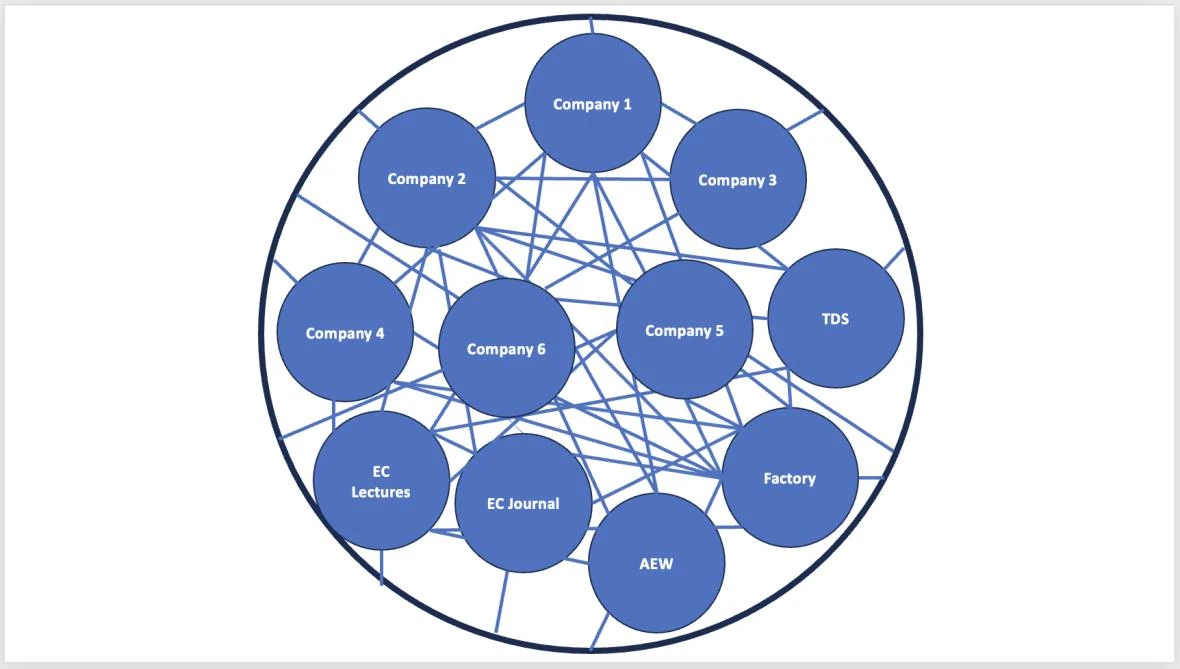
Here, each part is connected to the whole, and all parts are connected with each other as well.
This is the model that we want to reach in the EC. Here the EC has a clear mission and purpose. It brings into the community companies that share this purpose. And companies get into full relations with each other. Also, they benefit from all the shared services that the EC provides and actively contribute to them. In this model each part strengthens the other.
Here is how the EC Community would look like in this model:
In the EC, the parts are not only the 60 companies that will reside in the EC, but also all the shared services are parts of the community (TDS, AEW, ARC, EC Journal, EC Lectures, Factory, Workshops, Accelerator, Supercomputer, EA, …)
The evolution of the community will depend on how the parts interact with each other. It is these interactions that will evolve the community. The more dynamic these interactions, the faster it will evolve to new qualitative heights – which also means competitive advantage and leadership for all.
And we get this picture of the community’s evolution:
Pic. The speed of the evolution of the community will depend on the quantity of the interactions of the parts with each other and the relations of the parts with the purpose of the whole.
Now, it must be said that to achieve this is not an easy task. This is a process that we all must work on knowing well that such a community will give us a huge competitive advantage and leadership position. One of the best ways to achieve this is through getting big joint projects.
If we achieve such a community, this would be something!
Do you agree?