The purpose of the Journal is to disseminate knowledge, experience, and best practice in engineering & manufacturing. The articles are written by practicing professionals in the Engineering City (EC). They cover issues relevant to their projects, operations, and organizations. The articles address the challenges of the time. As such, the Journal is also a chronicle of the evolution of the EC, its companies, and its individuals. It is the aim of the Journal to advance the engineering & manufacturing practice, to enrich the engineering & manufacturing community, and to contribute to the worldwide discourse in engineering & manufacturing.
Published by the Engineering Association
The Engineering City JournalIssue 9/2025Published by the Engineering AssociationYerevan, June 9, 2025
This edition is all based on speculations – speculations caused by AI.
With AI, knowledge becomes cheap, With AI, time shrinks to zero, Will university diplomas still be needed?
Will the duration of education stay the same?
What will job resumes look like?
What new gates will AI open?
…
We hear that AI is getting stronger by the minute. The more information is collected in data centers, the faster the GPUs work in supercomputers, the more efficient the algorithms operate the stronger AI becomes.
There are already different versions of ChatGPTs – there is a free version, then there is a $20/month version, then there is a $200/month version, then there might be a $2,000/month version, and then, perhaps, a $20,000/month version. This means that if we don’t get the answer right in a lower version, then there could be an answer in a higher version.
The articles in this edition try to speculate on how the education system may change in the era of AI. But these are speculations because no one knows how things will develop.
We are with the hope that with these articles we will have triggered an interesting discussion on the pages of this journal.
Talent Development System (TDS)
Speculations on “Diploma Theses” in the age of AI
by Rama, Engineering Association
English translation
Would like to note that this article is in the genre of speculations. I write this with an anticipation that many will refute it (опровергнуть).
I will claim that the nature of work that students will do on their BSc diploma theses will dramatically change in the age of AI.
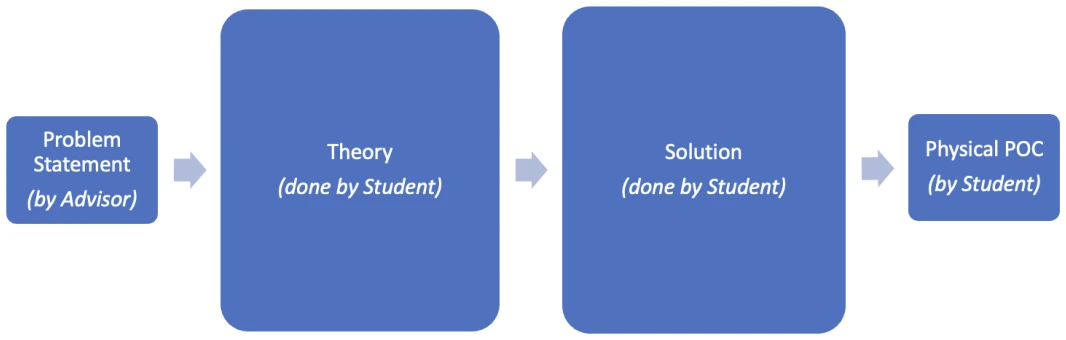
The typical diploma work goes through these four phases:
Problem Statement. This is given by the diploma advisor (дипломный руководитель). The problem statement usually includes the method that the student must implement.
Theory. This is when the student collects and reads theoretical materials on the subject and on the method.
The actual solution to the problem statement. This is usually the implementation of the method defined by the advisor on the actual subject. This is on the level of equations and calculations.
The Proof of Concept. The concept is proved either through a software simulation or through a physical proof of concept, or both.
Pic.Traditional Flow of Diploma Work.
Now, let’s introduce AI into the equation. And look what shocking things we may observe:
Pic.Flow of Diploma Work in the era of AI.
Here, the AI generates the solution to the problem statement right away. And what is remained for the student to do is to validate the solution firstly theoretically, and then through a Proof of Concept either as software simulation or physical POC.
Notice that the Solution and the Theory have switched places. In the traditional case (without AI), reasearch and theoretical work proceeds the solution, wherease, in the second case (with AI) the solution comes before the theoretical work.
But another thing could be noticed here.
Here, the time spent by the students on each of these phases will also change. Previously, the bulk of student’s time was spent on the theory and solution. No time was spent on the problem statement as it was generated by the advisor, and in many cases the student had little time left to spend on the POC, especially on physical POC.
Pic.Most of the time spent on Theory and Solution.
But now, look how this may change.
Pic.With AI, most of the work is spend on the Problems Statement and the Realization of the Solution.
Now, the solution is already generated by AI.
The student now can spend a good amount of the time generating the Problem Statement together with his advisor, something that was previously done exclusively by the advisor. And what is a Problem Statement? Since the diploma works are written in the EC, this means that the problem statements are given by companies. Meaning, that the problem statements must benefit the companies. The problem statement, then, contain strategic problems that the companies face in the marketplace. They compete with companies in the marketplace. And the competition is in how fast a company can get a new working product onto the marketplace. It is this real market aspect that must guide the problem statement, and the student must get drawn into this discussion and together with his advisor justify the problem statement. It will include company vision, purpose, strategy, competition, other market forces, available technologies, economics, business, organization realities, organization plans. 40% of the diploma will be spent on this, as a result of which the student will dramatically mature. This because the ability to generate a real-life problem statement is maturity.
The other 40% he will spend on the physical POC (not only software simulation). But not only that, he will now have plenty of time to get all the way to building a physical prototype (something very valuable to the companies).
Pic.With AI, there will be enough time to get all the way to the product prototype.
But lo and behold, what do we get here? We get “Technology Research”. Because:
Physical POC + Prototype = Technology Research
And here we close the loop on the ARC (Advanced Research Center), the mission of which is to do Technology Research.
Pic.POC + Prototype = Technology Research.We see the realization of ARC’s mission in the diploma works.
The point here is that the student will spend the first 40% of his time on the justification of the problem statement, and the last 40% on technology research.
The middle 20% will be spend on engaging in a conversation with the AI, on getting AI to get to his solution, and to go through a theoretical validation of AI’s solution. What would have previously taken three months, can now get done in two weeks. You may ask – where is the student’s theoretical knowledge here? The answer is that that knowledge will come out and deepen during the theoretical validation of AI’s solution.
In summary, we can notice that with the introduction of AI into the diploma work the work of the student gets shifted from theoretical solution to a technological solution, from theoretical work to physical realization.
Do you agree with this article?
Talent Development System (TDS)
Speculations on Resumes in the Age of AI
by Rama, EA
English translation
When we put C# in our resumes, this means that we don’t know Assembly language anymore.
When we put Solidworks in our resumes, this means that we don’t know how to draw with paper and pen anymore. When we put Altium Design in our resumes, this means that we don’t know how to draw and calculate circuits and anymore.
And companies hire us anyway. Why? Because the number one concern of companies is “Time”. Meaning, how fast can we produce and put a working product onto the marketplace. And the more tools we know, the faster we can produce.
Now we will need to add a new skill in our resume – the skill of using AI. But it mustn’t be just a line. It must be a whole section. We should show how much we have engaged AI in our work and how much time have we saved by doing so. We must mention how we leveraged the knowledge of AI to do our work, and how many AI agents have we deployed to get organized. Because companies will value how much time has been saved. Time, as we know, is the main issue for commercial companies.
Diplomas may no longer matter. We will show how we used AI to accelerate, to create, to innovate. We will show the problem statements that we have justified, the projects that we have finished with the aid of AI. This is what companies will value.
Having worked on a project in the “Bagrevand 21 Program” with AI may suffice to land a job in the EC companies.
Do you agree with this article?
Talent Development System (TDS)
Speculations on Education Duration in the age of AI
by Rama, EA
English translation
. School education in 9 years, . BS degree in 2 years, . MS degree in 1 year.
In other words, with AI, people will mature much faster.
It is very possible that in the EC, no official university degrees will be needed. Very possible, that showing a certificate of having successfully accomplished a project in the “Bagrevand 21 Program” will suffice to land a job in the EC companies. Meaning, we may land a meaningful job at the end of the 1st or 2nd year in university.
The point here is that AI will accelerate the maturity of the student.
The point here is that if this is true, and if we succeed in transforming the education system, then people will be productive in the society much earlier. And if this is the case, then this is a winning ticket relative to others who have not yet transformed.
What about PhDs? The difficulty with PhDs will become the generation of such problem statements that the AI has no answers to yet, or has very little answers, or is very vague in the answers. PhDs will be truly about generating new global knowledge – knowledge not yet available in AI. But it is not clear whether the number of PhDs will dramatically increase or will dramatically decrease as a result.
Do you agree with this article?
Talent Development System (TDS)
Speculations on School Education in the age of AI
by Rama, EA
English translation
Pouring knowledge into the heads of children for 12 years. The outcome is a person with Knowledge in his head.
Now with AI, we have the whole of human knowledge at our fingertip all the time.Do we still need 12 years of pouring knowledge into our heads in school?What must change?
The mission of schools is to prepare us for life. But what type of life will it be?
Previously it was about knowledge.
It cannot be knowledge anymore. Knowledge now is cheap and at our fingertips at all times. So, schools cannot be a teacher pouring knowledge into the heads of the children and then testing their memory if they can remember.
AI may have freed humanity from all that. Then what will be needed?
School education will become not about pouring old knowledge (the knowledge that is given in schoolbooks) but about teaching how to create new knowledge.
How do you teach creating new knowledge?
I believe that the subjects will be taught as the history of the subjects. Because when you teach the history, you are also teaching how knowledge had been created in each stage of the subject’s history.
Let’s take the “Number System” in mathematics, for example. How should the number system be taught? It should be taught as the history of the number system.
So, it must be taught in the sequence as it has appeared historically:
Natural numbers
Whole numbers
Integers
Rational numbers
Irrational numbers
Real numbers
Complex numbers
It should be shown that each number system came about in certain conditions, with certain needs, as a result of certain limitations of the previous system, as a solution to a certain crisis that the current system could not solve. It is during these periods that new knowledge was generated.
For example, the natural numbers came about when there was a need to count cattle, the whole numbers came about to represent “nothing” (the zero), the integers came about to account for debt and losses in commerce, the rational number came about to divide lands, the irrational numbers came about to solve certain geometrical problems, the real numbers came about to express certain physical phenomena, the complex numbers came about to assist engineers. As you may
notice, mathematics did not come about as an abstract endeavor. It came about to solve real-life problems. And this is what must be shown to the students.
On the S-curves, the crises (the limitations) of a previous number system are marked with a red circle. The new number system is generated as a resolution to these limitations. But the limitations are not abstract. They are embedded in real-life crises.
Pic.Past and Future History of Inventions of the Number System showing the Crisis-Invention dynamics.It is this dynamic that must be shown to the students.
Teachers must put the students in these crises situations for the students to re-live and re-invent the Number System on their own. As such, the students replicate the evolutionary history of the Number System and learn how to generate new knowledge. This is in sharp contrast to just transferring the Number System as is to the students.
And it is understanding these limitations that forces the generation of new knowledge. This is the mechanism of generating new knowledge.
What type of learning is this? This is not project-based learning, this is not hands-on learning. We may call this crises-based learning, or, limitation-based learning, or perhaps, history-based learning.
Here the teacher must put the child in the condition of crisis as it appeared historically. The child then must conceptualize the situation, identify the crisis (the limitations), formulate the problem (the problem statement), and provide a resolution to the crisis. By this he will have created new knowledge as it appeared historically. In other words, he will have replicated the actual evolution of knowledge creation of the current subject (here the number system). The role of the teacher here is not teaching, but assisting, guiding, and helping the child through this process.
The transfer of knowledge is less important here. The teacher must help the child to formulate the problem statement as they appeared in history as a result of a certain need and then help the child to come up with the answer by himself. In other words, we are moving from teaching the subject to having the child discover the subject.
Math is no longer about training the brain on solving math problems, but as an actual instrument to solve real life problems.
New problem statements are what forces the creation of new knowledge, and the problem statement comes from current real-life conditions, from understanding limitations, crises. So, the problem statement must have a historical perspective to it.
Such a historic approach should be applied to all subjects – physics, chemistry, biology, sociology, philosophy, …
Every physics law, every chemical equation must be presented starting with its history. What was present at the time, what was the limitation, what was the crisis, what are the things that could not be solved, and then how this was resolved. Here, we could also add the available technologies of the time. So, here we get into the history of technology as well.
In other words, the child is repeating the history of the subject as his own creation. But not only that, but the process of knowledge creation is also now dramatic. This is because, he will re-live the drama of the crisis that forced the new knowledge, and he will now be an actor in this drama. And this is by itself very attractive to the students. As such, we brought dramatic theater into teaching the subjects.
This will connect the child to the history of humanity as his own history and place him as a contributor to the history of humanity like any other before him.
It must be shown to students that they will be responsible of generating new knowledge for the future crises. Because the future crises will be their crises that they will be called to solve. And the mission of schools is to prepare them for that.
Pic.The purpose of schooling will be to prepare studentsto generate new knowledge for future crises.
In this approach, we look at the child as a creative mind that will create new knowledge in society, and not as a person who will just apply the old knowledge on new problems, because that can already be done by AI.