The purpose of the Journal is to disseminate knowledge, experience, and best practice in engineering & manufacturing. The articles are written by practicing professionals in the Engineering City (EC). They cover issues relevant to their projects, operations, and organizations. The articles address the challenges of the time. As such, the Journal is also a chronicle of the evolution of the EC, its companies, and its individuals. It is the aim of the Journal to advance the engineering & manufacturing practice, to enrich the engineering & manufacturing community, and to contribute to the worldwide discourse in engineering & manufacturing.
Published by the Engineering Association
The Engineering City JournalIssue 11/2025Published by the Engineering AssociationYerevan, June 24, 2025
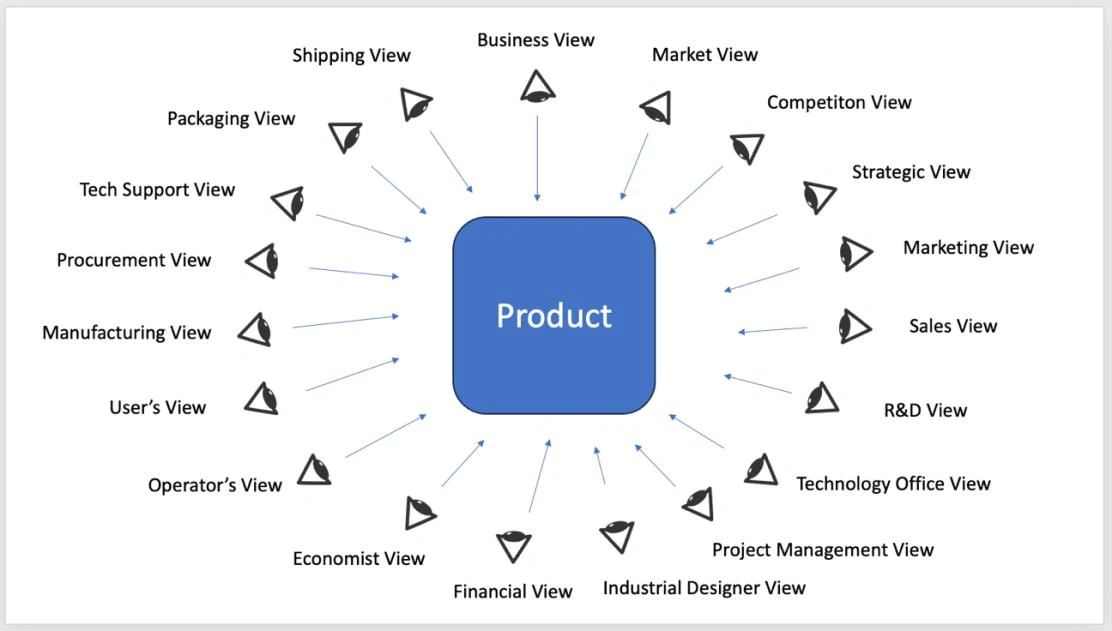
When the idea of a new product comes about it must be viewed from different angles. Each view has an owner and reflects the metrics that he is concerns about. It is the totality of these views that produces a commercial product. Otherwise, the product cannot be called commercially viable.
Pic.The different Views of a Commercial Product
Roughly, it looks like this:
Business View
Gross Margins
Time to Market
Market Share
Growth
…
Product Marketing View
Market demand for the product
Customer Base
Novelty in the product
Price
Forecast
…
Competition View
Rival products in the market
Alternative products in the market
…
Strategic View
Differentiators from competitors’ products
What is the novelty in the product
…
Marketing View
Data Sheets, brochures
How to market it – forums, trade shows, mailers, social media, …
…
Sales View
Selling points of the products
Weak points of competitor products
…
R&D View
The Technical Requirements
Engineering capabilities
Engineering availability
…
Technology Officer
What technologies to use
Using latest technologies
…
Project Management View
Deliverables
Time
Budget
…
Industrial Designer View
Aesthetics
Corresponding to the brand
Logo size, placement locations, …
…
Financial View
How to finance the project
ROI
…
Economist View
Cost of each stage
Introduced Efficiencies
Budget vs Actual
…
Operator’s View
How to operate it
User interface
…
User’s View
Ease of use
User experience
Learning curve
…
Manufacturing View
The manufacturability
Design for Manufacturing issues
Manufacturing process
…
Procurement View
Material sources
Alternatives
Importation routes
…
Tech Support View
Supportability of the product
…
Boxing & Packaging View
Boxing material
Box sizes to fit transportation
Packaging BOM
…
Shipping View
Transportation choices
Shipping routes
Shipping licenses
…
…
Engineering Management Corner
The “– 3 + 1” Methodology in Generating the Problem Statement
by Rama, EA
One good way to generate a problem statement is to list the three problems statements that proceeded it and one problem statement that will come after it:
Describe the current problem statement.
List the three problem statements that proceeded the current one with the solutions that were given to them each time. This will show how we got to the current problem statement. This will also show the progressive nature of the current problem statement. This historical view of the current problem statement also provides the insight into the nature of the problem.
Describe a possible problem statement that may come after the current one. This could not be seen in the beginning, but it should be anticipated at some point during the process of solving the current problem. If we can spot the trend, then we can see the next problem statement. The trend is best spotted through the history of the problem statements.
Graphically, it looks like this:
Engineering Management Corner
Time → 0. Have you involved AI in your Task?
by Rama, EA
All competition could be reduced to one parameter – the reduction of time.
Time from idea to market, or time from problem statement to market.
The main agent for time reduction is technology.
The speed at which an organization can learn a new technology and introduce it into the organization becomes a major differentiator.
That is the responsibility of the Chief Technology Officer (CTO) in the company.
The bad news is that new technologies are coming out with an incredible frequency.
But the good news is that the newer technologies are also becoming much easier to use. Meaning that the learning curve and the implementation curve are getting much shorter.
AI is the latest big technology.
What makes it different, it seems, is that it is universal and very easy to use.
So, in this case it is not an issue of learning the skill of using it, but it is about getting it into the DNA of the organization.
With AI, it is no longer about what we know, or how much we know. It will be how well have we integrated AI into our tasks.
The question that management will soon start asking is - “Have you involved AI in your task?”. If the answer is - no, then we have spent too much time on the task, this means that we waisted time.
Do you agree with this article?
Engineering Management Corner
Generating Data Sheets using AI
by Rama, EA
The following data sheet for a Fault Insertion Unity (FIU) was generated with AI in 3 minutes with a simple prompt.
Engineering Management Corner
Technical Writings using AI
by Rama, EA
AI is already being used heavily in technical writing. AI can generate the technical documentation as we design the architecture, or write the software, or develop and hardware.
And when it comes to formatting the documentation, it suffices to introduce the format that the company uses to the AI prompt, and we get the desired documentation in the output.
Engineering Management Corner
Resource Scheduling using AI
by Rama, EA
If you have many engineers on staff and every engineer is engaged in multiple projects, then optimal scheduling of the engineering resource becomes a serious task. The difficulty is not as much in planning the resources in the beginning of the projects as much as keeping up with the constant changes in the projects, customer requirements and delays in information. Such constant changes require a constant re-scheduling and re-assigning of the resources.
There are already AI packages that can optimize resource allocation across multiple projects, considering skills, availability, and project priorities. Predictive analytics can forecast resource needs and identify potential bottlenecks.
Would be good if the project managers in the EC try some of these packages and share their experiences with the whole community.