The purpose of the Journal is to disseminate knowledge, experience, and best practice in engineering & manufacturing. The articles are written by practicing professionals in the Engineering City (EC) in Yerevan. They cover issues relevant to their projects, operations, and organizations. The articles address the challenges of the time. As such, the Journal is also a chronicle of the evolution of the EC, its companies, and its individuals. It is the aim of the Journal to advance the engineering & manufacturing practice, to enrich the engineering & manufacturing community, and to contribute to the worldwide discourse in engineering & manufacturing.
Published by the Engineering Association
The Engineering City JournalIssue 16/2025Published by the Engineering AssociationYerevan, August 25, 2025
There, you will find 7000 ChatGPT Prompt Database – for Every Use Case
This GitHub repo includes:
Prompts for marketing, programming, writing, content creation, and more
Categorized structure – easy to find what you need
Special “Prompt Injection” section to push the limits of AI
AI Corner
How to Prompt the new GPT 5
by Gurgen Gurgenyan, ATG
English translation
Save this P.R.O.M.P.T. framework to master it:
→Purpose: State the goal, allowed tools, and what “done” means.
Pick minimal or high reasoning effort.
→ Role: Give a persona + clear tool rules.
Remove contradictions for cleaner reasoning.
→ Order of Action: Ask for a quick plan, then execution, then a short “done” summary. Add “keep going until solved” if needed.
→ Mould the Format: Define style, structure, and length.
Restate every 3–5 turns for consistency.
→ Personality: Set mood, tone, and verbosity (short / medium / long) to match your audience.
→ Tight Controls: Cap tool calls if needed (e.g., “max 2 lookups”), Or insist on full persistence for complex work.
n8n Corner
Popularizing n8n in the EC
by Rama, EA
English translation
We are introducing a new corner in this Journal for the n8n tool with the purpose of popularizing it in the EC and with the purpose of creating a user community around it.
n8n is a tool to automate internal company workflows. We heard about it first time in a lecture given by Gurgen Gurgenyan, AI Engineer at the ATG company.
Using such a tool rhymes well with the engineering guiding principles of automating everything and accelerating everything (EC Journal, Issue 10/2024).
Pic.The Engineering Guiding Principles
If the reality of this tool is as advertized, and if companies learn how to implement it in their internal operations, then we believe that the EC companies will get a huge advantage in the marketplace.
The initial trials of the tool look very promising.
In this corner we intent to bring examples of its use.
n8n Corner
Automation of a Mass Mailing using n8n
English translation
The below program was written by Vahe Vahanyan, a 3rd year student intern at YEA Engineering. It is a simple program that automates the mailing process of a datasheet of a newly created product to a big not-so-clean database. The program is simple, yet the benefits in time and effort were huge.
Engineering Management Corner
Transformation - The Art of Staying Alive
by Nane Meliksetyan, ATG
English translation
Legacy in Motion: What a 1400-year-old company taught us about transformation
At ATG’s latest Operations Team meeting in Engineering City, we didn’t begin with KPIs, deadlines, or updates. We began with a legacy.
Kongō Gumi, the world’s oldest company, was founded in 578 AD in Japan. For over 1,400 years, this construction company has endured wars, disasters, economic collapses, and technological revolutions.
How?
By transforming — continuously, courageously, and consciously.
It wasn’t mystical. It was mindset.
A readiness to shift when the world shifts.
A refusal to stay flexible in a world that demands motion.
A deep respect for both tradition and change.
“Then what does transformation really mean?”
The question hangs in the air. Answers emerge, from the heart:
Growth — not just of the company, but of the individuals within it.
Change — sometimes slow, sometimes seismic.
Re-evaluation — the courage to question what we do and why we do it.
A living process — a way to stay relevant, stay sharp, and stay human.
Transformation is the art of staying alive — in every sense of the word, not just existing, but evolving.
Why Do We Need?
The next question follows naturally: "Why do we transform?". Because sometimes, we must, as the terrain shifts beneath us, standing is no longer an option. It becomes dangerous. So, we transform to:
To grow
To adapt
To survive
Sometimes, transformation isn’t a choice. It’s a necessity. A survival instinct for companies and people alike.
Systems in Motion: The Attractor
Imagine a forest.
Wolves, rabbits, rivers, trees, each one is a part of delicate balance. Now imagine one small change: more wolves. The entire ecosystem responds. More wolves mean fewer rabbits. Fewer rabbits mean more grass. And slowly, subtly, the forest becomes a different one. The “attractor,” or the natural state the system gravitates toward, shifts with it.
Our organizations work the same way.
Change one variable — a team, a goal, a policy, a process — and the whole dynamic starts to adapt. The "system" never really sits still. And if we try to freeze it, we fail to lead it. Understanding this means understanding that we’re not here to control the forest.
We’re here to tune into it, to guide its shifts, to move with its rhythm, not against it.
At this point, another question pops out.
When Does Transformation End?
There are two answers:
Never — Because the end of one phase is just the beginning of another.
Or, R.I.P. — Because the moment we stop transforming, we stop growing. We fade.
Transformation is infinite. And that’s a good thing.
Growth Through Discomfort
There’s something people don’t say enough: Transformation is uncomfortable. For companies, transformation means challenging its status, disrupting familiar routines, and pushing beyond what feels safe. It challenges us, it shakes up what’s working. While comfort may feel cozy, it doesn’t foster growth or innovation. Discomfort signals that change is underway — it’s a necessary part of evolving, improving, and staying competitive in a fast-moving world. As a company, embracing discomfort means moving toward progress, not retreating from it.
Living in Determined Chaos
Right now, our company, like many others, is living in what we called determined chaos, a state where everything is
changing, all the time. But unlike random chaos, this is intentional. It’s messy, but it has purpose, vision and fire. The forest is changing, the wolves are running, and the system, our system, is alive.
So, we move with it, we shape it and we let it shape us, too. Because like Kongō Gumi, we’re not just trying to survive the centuries. We’re building in motion, and motion is our legacy.
Change Management
The core driver of transformation is change, and with that comes the essential question:
How do we manage change? The answer lies in change management.
Change doesn’t happen in isolation. It needs ownership. That means taking responsibility both individually and collectively for how change is introduced and sustained. One of the first steps is to have a sponsor or mentor, someone who supports the initiative and actively promotes it throughout the organization.
Every environment is different. Some individuals are naturally more flexible, open to change, and eager to grow. Others may prefer the comfort of familiar systems that already seem to work well. To begin any transformation, it’s crucial to start with the willing - the pioneers. This group of like-minded individuals can form the foundation of the new approach.
From there, the organization begins to operate in parallel: the “new way” and the “old way” coexist for a time. But as the results and benefits of the new approach become visible through the pioneers’ work, others are more likely to follow. Eventually, this shift paves the way for broader adoption and when needed, the formal enforcement of new practices.
EC Community News
EC Chess Tournament
English translation
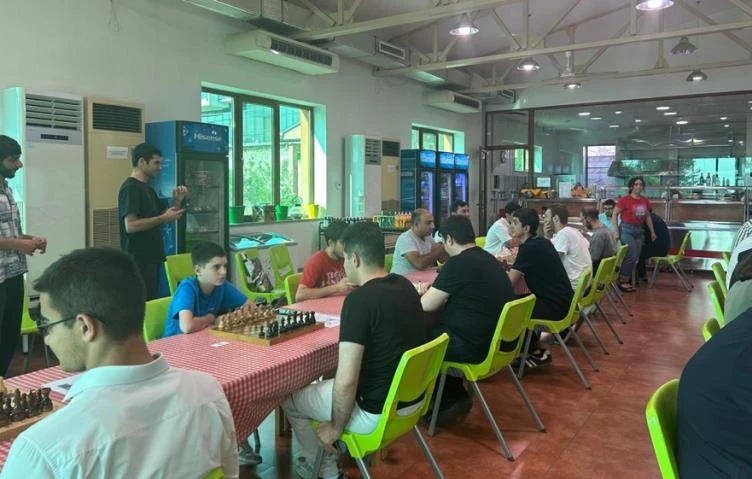
Davit Torgomyan from Yerevan Aerospace Engineering initiated and organized the first EC Chess Tournament. Twenty-eight chess players from inside and outside the EC participated.
Pic.28 chess players participated in the EC Chess Tournament
Musings Corner
The Intellectual
by Rama, Engineering Association
English translation
Who is the intellectual? Here is one definition:
The intellectual is a person who operates in theories. Meaning that, in his practical work, he either consciously implements a theory, or derives a theory from his practice, or explains what he is doing through a theory.
The intellectual will not rest until he gets to the theory of what he is doing or will not act till he knows the theory of his planned actions. Hence, his practice turns scientific.
It may be useful to contrapose this with “skills”. A skillful person is very good at what he is doing, but he may not know the theory of what he is doing, or why he is doing it.
As we work, we most of the time get hung up (зациклимся) on skills. But skill is not theory. We might have become very skillful at something and produce great things but may not know the theory behind what we are doing. Hence, we don’t act as intellectuals.
Skills cannot be communicated from man to man; skills can be gained only through practice. But theory, on the other hand, can be communicated. Hence, theory is also a tool of communication.
Skills cannot be transferred to a machine. For a machine to work skillfully like a human a certain algorithm must be put into that machine. To come up with the algorithm, you need the theory (a formula).
This is why reading and writing are two key partners of the intellectual – reading, to find the theory behind the practice; and writing, to formulate the theory of his practice and to communicate it.
Notice how practical work is tied very closely to theoretical work in the intellectual. This turns our actions into scientific actions.
This would be an intellectual.
Graphically, this could be depicted as below:
Pic.Spotting the theory of what we are practicing.Pic.Inducing a theory from what we are practicing.
Here is another way of looking at it:
Everything that we do has two components – the practical part and the theoretical part. The practical part is what we do on a day-to-day basis at work.
But everything that we do is either an application of some theory (even if we don’t consciously recognize it), or a theory can be induced from that what we do. Meaning, there is a science behind everything that we do.
Here is yet another way of looking at it:
Everything that we do has a universality to it. Everything that we do has a general theory behind it. This is the science of that what we do in practice.
It is this science that the intellectual seeks out.