The purpose of the Journal is to disseminate knowledge, experience, and best practice in engineering & manufacturing. The articles are written by practicing professionals in the Engineering City (EC) in Yerevan. They cover issues relevant to their projects, operations, and organizations. The articles address the challenges of the time. As such, the Journal is also a chronicle of the evolution of the EC, its companies, and its individuals. It is the aim of the Journal to advance the engineering & manufacturing practice, to enrich the engineering & manufacturing community, and to contribute to the worldwide discourse in engineering & manufacturing.
Published by the Engineering Association
The Engineering City JournalIssue 17/2025Published by the Engineering AssociationYerevan, September 16, 2025
The combination of maximizing automation and reducing time and cost forms the North Star of the engineering practice.
AI enables all three components of the North Star – it automates, it reduces time, and it reduces cost.
The outcome must be more time and buget for new product R&D (R&D Time for New Products → ).
Hence, it is advisable to review ALL apsects of the engineering operation and work towards introducing AI
everywhere!
Read, for example, the next article.
AI Corner
Searching for Parts in the Inventory Database using AI
English translation
by Rama, Engineering Association Narbeh Nahapetyan, YEA Manufacturing
In the current exercise, we looked into the process of procurement and seeked to reduce its cost.
Problem Statement
The inventory databases are usually huge databases with thousands of parts, especially when the parts are electronics components.
The traditional search method that is based on simple keyword matching was not catching all the parts, although they were in the inventory. This is because the inventory may have the same parts pruchased from different suppliers, each of which have their own description format, syntax, and part numbers different from other suppliers.
Also, the traditional search approach did not allow for finding substitute parts (close-enough parts) as we didn’t know how to search for them.
This was making us procure the parts again, eventhough they were in the inventory. In Armenia, each procurement is an importation exercise, which means that the cost of shipping and brokering gets added to each purchase.
These are clear limitations of the classical search method.
Wish List
We would like that the user describes what he is searching for in human language without having to know the precise description formats and syntaxes of the various suppliers and to find close-enough parts for his search.
For example, a user prompt may look something like this:
I need capacitor, capacitance from 20pf to 30pf, voltage around 35v, package can be 0603 or 0805, tolerance between 1% to 5%.
The Solution
Introduce AI into the search process by which we will effectively move away from simple keyword matching to conceptual search that allow for sophisticated matching based on meaning and intent, rather than just keywords. The conceptual search recognizes relationships and context, not just exact keyword matches.
Use Open AI as the AI Engine.
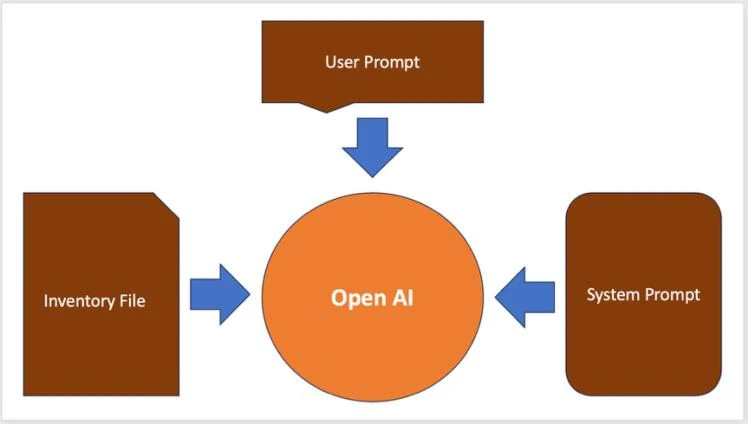
The AI program will have the following architecture:
The inventory file that contains the inventory data
The User Prompt that allows for human-like language
The System Prompt that will instruct the AI Engine of the search logic
Pic.Architecture of the AI Program
Here it should be mentioned that Open AI operates with vectorized data, so the Inventory File must be converted into vectorized data. Also, the original file may be too big for a fast search, so it is advisable to filter it down by certain categories. For example, if the search is for a capacitor, then we would filter the file down to only capacitors. The sequence that will convert the original inventory excel file to vectorized data takes the following look:
Open AI works well with Jason format data/text.
And the architecture will look like this:
Pic.Architecture of the AI Program
Moving to the System Prompt. The System Prompt is what defines the logic for matching the User Prompt with the Vectorized Data.
The System Prompt may look like this:
. You are a search assistant.
. The Data section in the prompt always consists of 3 fields separated by commas: Part Number, Description, Stock availability.
. Before matching, normalize both the Data and the user query as follows: 1- Convert all text to lowercase.
2- Replace all separators (such as '/', ',', '-', and multiple spaces) with a single space. Best Matches:
. Start with items that are Exact Matches.
. Then include items that are not exact but share many tokens or have close numeric values.
. Order all results from highest match score to lowest.
. Token order does not matter; extra tokens in the Description are allowed.
. Do not include partial token matches (e.g., "TO-277A" does not match "TO-277").
. Scoring and Output Rules: . Assign a matching score on a **0–10 scale** (10 = perfect match, 0 = completely unrelated).
. Always include the matching score in the format: [Matching Score: X/10].
. Always include stock availability in the format: (Stock availability: N).
. Always include the reason in the format: (Reason: …) with a short explanation such as "package differs", "voltage differs", "tolerance differs" and … . Format the answer in plain text with exactly one heading:
. Best Matches:
Do not add any other text, explanations, or headings.
We can implement this algorithm from within the original inventory file by using Macros.
The best part is that the system prompt can also be updated collaboratively by users and the AI development team to achieve a much better search outcome.
Now let’s see the result of the search using AI.
The User Prompt was this:
I need capacitor, capacitance from 20pf to 30pf, voltage around 35v, package can be 0603 or 0805, tolerance between 1% to 5%.
The search generated the following reply:
Part Number: 06035U300GAT2A, Description: 30 pF ±2% 50V Ceramic Capacitor C0G, NP0 0603 (1608 Metric), [Matching Score: 9/10] (Stock availability: 8) (Reason: capacitance and voltage match, tolerance slightly tighter)
Part Number: 06035A300JAT2A, Description: 30 pF ±5% 50V Ceramic Capacitor C0G, NP0 0603 (1608 Metric), [Matching Score: 8/10] (Stock availability: 20) (Reason: capacitance and voltage match, tolerance at max level)
Part Number: C0805C220K5GAC7800, Description: 22 pF ±10% 50V Ceramic Capacitor C0G, NP0 0805 (2012 Metric), [Matching Score: 6/10] (Stock availability: 7) (Reason: capacitance match, voltage slightly higher, tolerance not matched)
And this is what we were looking for.
From the user’s perspective the search was simple and fast. There was no need to know the exact syntax of the part. Also, the system answered with all possible replacements to the requested component that exist in the inventory.
Incredibly, with AI we hit on all aspects of the North Star – we automated the search, we reduced the time of the search, and we reduced the cost of procurement.
Engineering Management Corner
Engineering Unit vs Manufacturing Unit vs Manufacturable Unit
by Rama, EA
English translation
The further we develop the Engineering/Manufacturing relationship, the further we discover the details of this relationship.
In the beginning we had this simple picture in mind.
Then, we realized that there must be a middle phase between Engineering and Manufacturing, which we later found out that it is called “Design for Manufacturing (DFM)”.
Then, we realized that before the DFM, there is another phase that we now call the “Manufacturing Relesase”, which comes after the “Engineering Release” and before the “DFM”.
Now we understand that there are three types of releases, each of which will produce a different type of a unit:
Engineering Release – here the outcome is the Engineering Unit.
Manufacturing Release – here the outcome is the Manufacturing Unit.
Design to Manufacture (DFM) Release – here the outcome is the Manufacturable Unit.
Which, in practical terms, translates to three types of Documentations:
Engineering Documentation
Manufacturing Documentation
DFM Documentations
Here is how the story of the product unfolds. Many times, especially if we are developing a customized product for the customer, it suffices to send the customer the “Engineering Unit”. The production of the Engineering Unit is fully the responsibility of the Engineering team, although engineers may request manufacturing services to complete the engineering unit. Here the release document produced in the Engineering Release phase is addressed to the engineers.
Then, as it often happens, this product gets ordered again by the same customer or other customers. This is when the product must be handed to the manufacturing team as it should be considered as a production order, not an engineering order.
So a new release phase must be kicked off, what we now call the “Manufacturing Release” phase. Here the release documents are addressed to the manufacturing team, meaning that all the drawings and schematics must have the information needed to be produced by manufacturing. Producing this document is still the responsibility of the Engineering team.
The Manufacturing Release documents, then, can be sent to different manufacturers in different countries, each of which will have its own production technologies and production processes, and hence will go through their own “DFM Release” phase so as to create its own Manufacturable Unit production process. Hence, if there can be only one Manufacturing Release, there could be different DFM Releases depending on the manufacturer. The responsibility of the DFM phase is a joined responsibility between the manufacturer and engineering.
Hence, when engineers finish their project, they should clearly specify what Unit do they have in mind – the engineering unit, the manufacturing unit, or the manufacturable unit. Many times we miss this specificity, and when the time to production comes, it turns out that manufacturing release and DFM release have not yet been done, which will surely delay delivery to customer.
Here, we must add another case – the case when manufacturing is part of the engineering organization. Then, things get to move multipe times faster. In this case, a production engineer could be part of the engineering design team and guide the design with production in mind. We can call it – Initial DFM. Also the Engineering Unit can be shown to the manufacuring team before shipping the unit to the customer. This is because, no matter how much the engineers try, their mind is focused on the functionality of the product, not its consumer’s view, whereas the manufacturing team has a good eye from the consumer’s perspective.
Pic.The case when manufacturing is part of the engineering organizationTDS
The Four Pillars of Engineering Education in the EC
by Rama, EA
English translation
We believe that the engineering education that we provide in our Industry-Based Talent Development System (IB-TDS) must rest on, at least, these four pillars:
Engineering Sciences. This is about the theory (Lectures).
Engineering Projects. This is about practicing the theory, solving problems, and getting all the way to the results. (Bagrevand 21, Internships, Diploma Projects, …).
Engineering Leadership. This is about technology research. This will also require knowledge about the history of the evolution of the technologies. (the ARC).
Engineering Management. This is about organizing the engineering practice. This is also about the culture of engineering (will be soon introduced in the EC as after-hour classes).
The outcome of such an education will be mature engineers that can do engineering, do research, and manage different aspects of the engineeirng organization from early on.
Pic.The four pillars of Engineering Education in the EC