The purpose of the Journal is to disseminate knowledge, experience, and best practice in engineering & manufacturing. The articles are written by practicing professionals in the Engineering City (EC) in Yerevan. They cover issues relevant to their projects, operations, and organizations. The articles address the challenges of the time. As such, the Journal is also a chronicle of the evolution of the EC, its companies, and its individuals. It is the aim of the Journal to advance the engineering & manufacturing practice, to enrich the engineering & manufacturing community, and to contribute to the worldwide discourse in engineering & manufacturing.
Published by the Engineering Association
The Engineering City JournalIssue 6/2026Published by the Engineering AssociationYerevan, March 31, 2026
The life span of the Engineering City, like the life span of any human organization will dependent on the number of generations that are engaged in its life at any given time. The more the number of generations, the longer it will live and prosper. If we succeed in having all these 7 generations in the EC at any given time now and into the future, then the EC will have a long life to come.
Pic.The 7 Generations of the ECEC Community News
EC Library Re-Opens its Doors
English translation
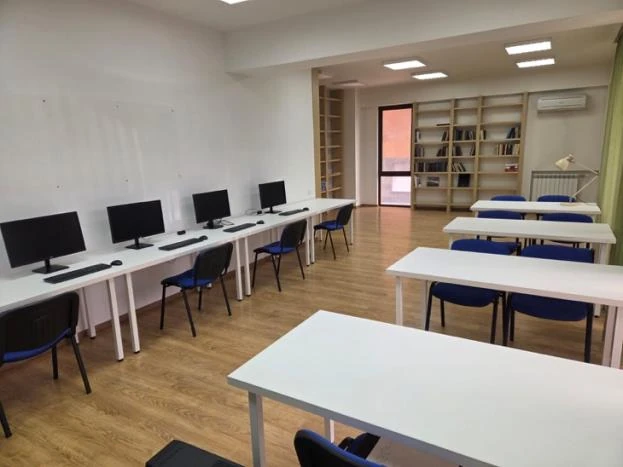
After a long break, the EC Library has re-opened its doors.
This is a good quite room for reading and working. There is also a break-out room for small meetings.
EC Community News
EC Library Receives New Books from AESA
by Rama, Engineering Association
English translation
AESA is the Armenian Engineering & Scientists of America.
Periodically, wreceive books from their members. They also support our Aerospace Engineering Master program with student scholarship and research equipment.
Here are the books that we have received -
EC Community News
Collecting Bottle Caps for Children in Need
English translation
The EC Cafeteria has launched a plastic bottle caps collection campaign to finance the purchase of wheel chairs for children in need.
A massive amount of caps are being collected on a daily basis from EC companies and their families.
This is all about being a proud and responsible citizen.
Armenology
Moving Back Home - Opening Branch Offices in the Regions
by Rama, Engineering Association
English translation
The country faces the following contradiction:
For people in the regions to have a good job they must move to Yerevan, But, for the regions to develop, people must stay in the regions.
As such, talent is moving out of the regions into Yerevan. Population in the regions is diminishing; the population of Yerevan is increasing. More than third of the population is concentrated in Yerevan. This is by itself a strategic threat.
What if the people who work in the Yerevan-based companies move back to their regions, open branch offices of their Yerevan-based companies and work remotely from there. The technologies make this very easy. Even equipment could be operated remotely now. They can come back to Yerevan once or twice a month for general meetings.
But back home, they will not only work in the branch offices, but they will also teach in their local schools and universities, as such developing their communities and enlarging their local offices.
As such, we will have solved both problems without any trade-off – to stay in the region and develop it on one hand, and leverage a Yerevan-based work opportunity at the same time.
Armenology
Museum of Science & Technology Receives a New Artifact – РМУ (Small-sized Control Relay)
by Rama, Engineering Association
English translation
The museum has reveived a gift from Mr. Mkrtich Ishkhanyan. It is a small-sized control relay manufactured in Kapan Relay Factory.
The below information is from the data sheet that you can find on the following web site: http://www.155la3.ru/rmu.htm.
RMU — (R)ele (M)alogabaritnoye (U)pravlyayushcheye (small-sized control relay). An old relay that became the basis for developing an entire family of relays.
The RMU relay is a non-hermetic (let us note this!) neutral monostable DC relay.
It was originally developed for aircraft equipment, but its range of application expanded, and it was used in a variety of small-sized automation, signalling and communication equipment.
The number of break, make and changeover contacts is from one to four; the contact material is Ср999. There are single- and double-winding versions (i.e., two independent relays in one housing).
The relay contacts withstand 100 000 cycles at a resistive load of 1A/27V or 0,1A/300V DC, as well as 0,1A/115V AC at 400 Hz. The relay withstands 250 shocks with acceleration up to 150 g.
The RMU relay was developed in the early 50s by specialists of OKB-3 together with staff of the OGT and OGK (chief technologist’s and chief designer’s departments)
of the St. Petersburg plant
"Krasnaya Zarya"
; in a 1954 reference they still carry the note
"not yet mastered in
mass production"
. Further modernization was carried out by the Yerevan Relay Plant.
They were first produced, from 1953, by the same "Krasnaya Zarya" (workshop No. 4), and later production was transferred to the Kapan Relay Plant (Armenia).
The Armenian language, unlike, for example, English and Russian, wages a consistent struggle for self-purification, trying to create equivalent Armenian versions for every foreign word.
Ani Makinyan, Head of the Department of Armenian Language and Literature, “Shirakatsi Lyceum”