The purpose of the Journal is to disseminate knowledge, experience, and best practice in engineering & manufacturing. The articles are written by practicing professionals in the Engineering City (EC) in Yerevan. They cover issues relevant to their projects, operations, and organizations. The articles address the challenges of the time. As such, the Journal is also a chronicle of the evolution of the EC, its companies, and its individuals. It is the aim of the Journal to advance the engineering & manufacturing practice, to enrich the engineering & manufacturing community, and to contribute to the worldwide discourse in engineering & manufacturing.
Published by the Engineering Association
The Engineering City JournalIssue 14/2026Published by the Engineering AssociationYerevan, August …, 2026
Nairi Quantum - a new company and a new direction.
Quantum Communication – not only new in Armenia, but also new in the World.
Michel Kulhandjian, a Research Scientist at Rice University in Houston, Texas, has been visiting the EC for a couple of summers now, each time thinking about ways of bringing the new field of “Quantum Communication” to Armenia. This time he has figured it out and has already put together the initial team.
His article tells the story.
Technology Corner
Quantum Communication — A New Frontier, and Why It Matters for Armenia
by Michel Kulhandjian, Nairi Quantum
English translation
Every message you send today — a bank transfer, a private note, a state secret — is protected by mathematics. We trust that certain problems are too hard for computers to solve quickly. But that trust has an expiry date: powerful quantum computers, now under development around the world, will one day solve those problems easily, and much of today’s encryption will no longer hold. This is not science fiction — governments and companies are already preparing for it.
There is a particular urgency that many people do not realise. An adversary can record encrypted data today and simply store it, waiting for the day a quantum computer can break it — a strategy known as “harvest now, decrypt later.”
Sensitive information sent this year may already be sitting in an archive, waiting. This is why the move to quantum-safe communication is being taken seriously now, years before large quantum computers arrive.
Quantum communication is one of the answers. Instead of protecting a message with mathematics, it protects it with the laws of physics.
How it works
The idea is beautifully simple. Information is carried on single particles of light — photons. The laws of quantum mechanics say that you cannot measure or copy a single photon without disturbing it. Think of a message written on a soap bubble: the moment anyone touches it to look, it pops, and both sender and receiver know. A single photon behaves in much the same way. This “tamper-evident” quality of nature is what makes the security so powerful — it does not assume the eavesdropper is weak or the mathematics is hard; it relies on physics that cannot be cheated.
Quantum communication in three ideas
No-cloning. You cannot copy an unknown quantum state. A photon carrying information cannot be secretly duplicated, so an eavesdropper cannot quietly take a copy of the message.
Entanglement. Two photons can be linked so that measuring one instantly reveals the state of the other, no matter how far apart they are — a uniquely quantum resource for correlation and security.
QSDC. Quantum Secure Direct Communication — sending the message itself through the quantum channel, without first exchanging a separate key. This is the frontier we have chosen.
The best-known form of quantum communication is Quantum Key Distribution (QKD), which uses these principles to share a secret key that then protects an ordinary message. Our focus goes one step further — Quantum Secure Direct Communication (QSDC), in which the message itself travels through the quantum channel, with no separate key needed. It is a younger and more demanding frontier, where only a handful of groups in the world are working — and, until now, none in our region.
Where the world stands
The field is moving quickly. China has demonstrated quantum-secured links over hundreds of kilometres of optical fibre and even via satellite; Europe and the United States are investing heavily in national quantum programmes. Yet the number of groups working on the direct-communication frontier remains small, and in the Caucasus and our neighbourhood there is, as yet, no one. That gap is precisely the opportunity.
Why it matters
Secure communication is the foundation of a modern society — banking, healthcare, government, defence, and critical infrastructure all depend on it. As quantum computers mature, institutions that cannot protect their data will be exposed. Quantum communication offers protection that does not depend on assumptions about an adversary’s computing power; its security is rooted in the laws of nature. The countries and institutions that build this capability early will hold a lasting advantage — in security, in industry, and in standing.
Armenia is increasingly investing in advanced technology — in artificial intelligence, in computing, in the infrastructure of a modern digital economy. As that digital future grows, so does the need to protect it. Quantum communication is part of that answer — the security layer for the very technologies Armenia is building.
Our plans
At Nairi Quantum, we are building this capability step by step, the way good engineering is built. We begin with software-defined radio (SDR) and simulation — familiar, affordable instruments already used across the Engineering City — to learn the protocols, model the physics, and demonstrate the communication logic. Next, we move to real single-photon experiments, together with partners in Armenia’s growing quantum-optics community. In time, we aim toward entanglement-based links, the most advanced form. Each phase is a rung on a ladder — small and affordable at first, growing as our people and our results grow. Along the way we publish, we build a testbed, and we train.
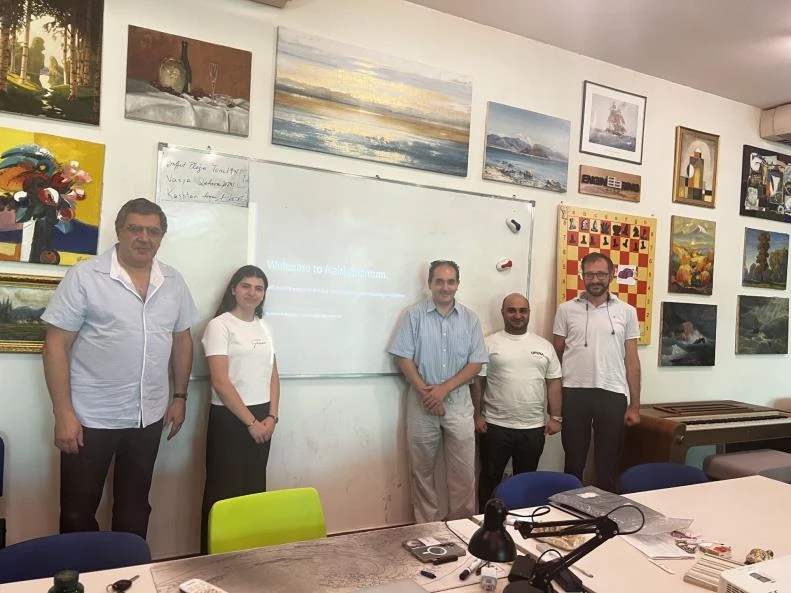
The Nairi Quantum team at the Engineering City, Yerevan. From left to right: Aram Salatian, Nathalie Jouljian, Michel Kulhandjian, Martin Pinamyan and Andranik Aghajanyan.
Our team
What makes this possible is the team. Nairi Quantum brings together young Armenian engineers and researchers — some here in Yerevan, others contributing remotely from across the diaspora — combining signal processing, software-defined radio, and a shared eagerness to learn a field none of us was born into. We are guided by advisors of international standing, and hosted, with gratitude, at the Engineering City with the support of NI-Armenia. The lab is not only a place to do research; it is a place to grow — to publish, to learn from world-class mentors, and to connect with the global research community.
How this helps Armenia
At its heart, this is about Armenia. Building the first quantum communication laboratory in the country and the region does several things at once.
It creates a new high-technology capability on Armenian soil — one tied to national security and digital sovereignty. It trains a generation of Armenian engineers in one of the most advanced fields in the world, giving talented young people a reason to build their careers here and to connect that talent to the world, rather than only to leave. It opens doors to international collaboration, research grants, and partnerships that flow back to Armenia. It carries real economic potential — a frontier capability today can become a company, and an industry, tomorrow. And it strengthens the Engineering City’s ecosystem, adding a scientific frontier to a community already known for its engineering.
Perhaps most importantly, it places Armenia on the map in an emerging field where being early counts, and where a small, focused country can genuinely lead rather than follow.
Great things often start small and quietly. Every field has its first light — the moment an instrument first sees. We believe Armenia can be part of the quantum future not as a spectator, but as a contributor. That work has begun, here, at the Engineering City — and we warmly invite the community to follow it, and to join it.