The purpose of the Journal is to build-up and share our knowledge in manufacturing as a contribution toward the high-tech manufacturing movement in Armenia.
Published by the Engineering Association
The EC Manufacturing JournalIssue 3/2026Published by the Engineering AssociationYerevan, June 15, 2026
The purpose of having a factory in the Engineering City was to learn how to do production of high-tech products, to learn how to design and manage a production process, to learn the KPIs of production, to educate a new generation of production engineers and machine operators, and to prepare the future manufacturing leaders.
Below is an article describing the production process for a very large order – 22,000 modules.
Each bigger volume order is a training anew. The small-batch production processes no longer apply. The last big order was for 2,000 pieces. That looked large at the time. But now, with this order everything changed.
In such orders, speed and efficiency take on a whole new dimension. Every movement of the hand is counted as a cost. Creating jiggs and automating the processes, and later robotizing them, are the names of the game here.
The new processes that were created for this order became an an instruction document in itself.
Now we can imagine the Factory City. The joy, the pride, the commradership.
But, we also realized how geopolitical turmoil effects manufacturing the quickest. Supply chains and shipping logistics get affected right away. Everything slows down, except the customer deadline, which remains stubbornly fixed.
We are preapring the manufacturing leaders of the future.
The Birth of a New Journey on the Manufacturing Floor
by Marina Saguinian, Engineering Association
English translation
Armenia is sending STEM Education kits to the United States High School Districts. What a story! Engineering Education starts in Armenia and spreads around the world.
The Plan
On March 17, 2026 an order was received to deliver to the US 1,600 Education Kits consisting of 22,600 Modules by June 30 2026.
The Details
Education Kits: 1,600 (525 Analog, 525 Digital & 550 Smart Logger) Modules: 22,600 Electronic Boards: 23,150 Overall Materials: Short of 1,000,000 (899,550) SMT Components: 394,950 THT Components: 45,550 Material used in Assembly: 459,050
Preparation Process
The core team started meeting ahead of the order to brainstorm strategies and mitigate risks due to the incredibly high volume and tight timeline. The factory had never received such a big order.
An internal bi-weekly meeting was scheduled thereafter to ensure sure we were all aligned.
A weekly meeting was scheduled to ensure customer visibility to the whole process. This weekly communication built trust and allowed the customer to provide inputs to the processes as well
Procurement Strategy was discussed considering the geographical unrest and tight timelines. Due to the large volume of materials, the recommendation was to invoke multiple partial shipments with the priority placed on materials related to THT Assembly, deemed to be the most time-consuming portion of the project.
Production Strategy started with identifying bill of materials (BoM) of all the modules in order to establish One Source Of Truth. The Production Control Monitoring Report (PCM) is used to track all materials throughout all stages of the production process from Receiving to Packaging and Labeling. Other Modules of the PCM report was invoked for visibility, reliability and consistency purposes.
This was the start of a new process to manage the material supply, the production plan, the project plan and share visibility with customer and partners alike. This allowed us to mitigate the risks, provide contingency plans and manage priorities.
Managing the Production Plan
The PCM report was used and managed by Narbeh to track the production plan. This included generating Part numbers for each module and developing corresponding QR codes to affix on each Module as per the request of the customer.
The Production plan also tracked the movement of materials from receipt to final production allowing us have visibility to timelines and potential risks.
Due to tight timeline and the volume of mass production, the project required us to come up with ways to reduce timelines. The traditional assembly depended on manual labor and ensuring quality was of the essence.
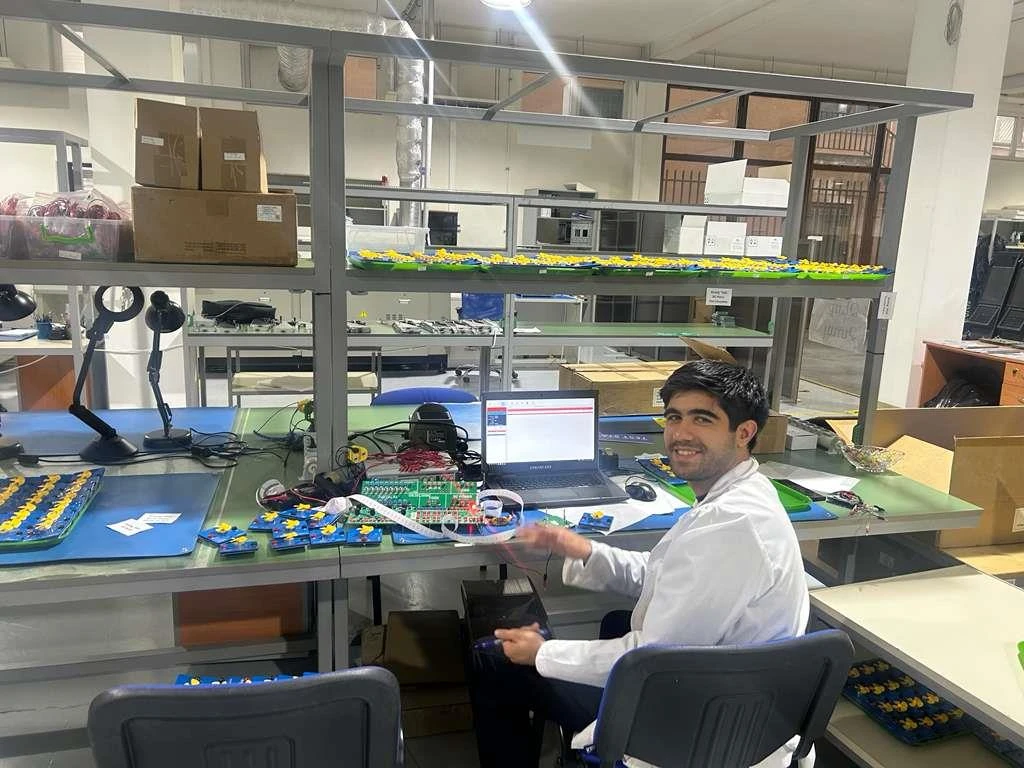
The team came up with ideas to develop 3D printed jigs that dramatically minimized the traditional Assembly time wherever there was intensive manual labor. The team considered everything from Assembly to Packaging.
Traditionally each module took on average 1.5 minutes.
Jig to ensure quick assembly (40 sec) , all pieces aligned and reduces the final step.
Jigs were made for any shape to ensure the layers are lined up properly and reducing the rate of failure
Traditionally we need to make holes to secure the Jumper Mini Modules on the packaging
Now with this simple jig
you puncture
and secure
Ideas came about for future automation in this process as well as recommendations to redesign the modules and make them more cost-effective. All these will be documented and reviewed upon completion of delivery.
The Team
The traditional production and assembly process required us to take in 20 additional resources to meet the tight timelines. The introduction of jigs gave us a headstart. As the core team was also very familiar with the project, they offered to work longer hours and weekends as needed and bring up 6 interns instead of 20. This ended up to be a successful strategy. The interns managed to successfully integrate with the core team.
The Packaging Strategy
The Packaging strategy by Mr. Ghukasyan started in the early stages of the project to ensure secure transport and ensure sufficient materials on hand.
This also included understanding the requirement to display on Packing labels in order to comply with both contractual requirements as well as ensuring ease of identification not only at the customer level but also at the level of customs clearance, during export and import processes
Export process started in the early stages to ensure correct and compliant documentation, box labeling etc.. to avoid potential delays.
Shipping process involved identifying trusted partners and selecting the most cost effective yet speedy delivery. In order to ensure meeting the tight timelines and avoid risks in the geopolitical arena, the recommendation was to send partial shipment prior to final deadline. This was mainly to mitigate the risks of airport closures and/or unexpected delays in receiving the materials in full. This also served the purpose of having customer receive a smaller first batch, check quality, provide feedback and use the modules for demo purposes. Our main goal was the success of the customer which would lead to potential future orders.
Import process started in the early stages of the project to identify brokerage firms and ensure documents were in compliance and minimize delays
Risks and Mitigation Plans
The wars in the region, a major risk causing delays in the supply chain and transit routes.
The procurement process was dependent on one major External Supplier collecting materials from various vendors.
The Local Suppliers did not have experience dealing with such volume and invariably had problems with calibration of their machines leading to quality problems.
One of the modules was still in development stage and hence a product that was still being tested
We mitigated the risks by prioritizing materials needed for the most time-consuming tasks which did not have dependencies first and requested partial shipments from suppliers.
This was easily accomplished by Narbeh as he analyzed the newly established PCM (Production Monitoring Report) module called the Material Supply Snapshot that included all the raw materials per module and per task( SMT, THT, Final Assembly). He was able to identify the dependencies and recommended a prioritization list to procurement.
This allowed manufacturing to perform inspection controls as materials arrived, provide feedback and focus on the most time-consuming processes, namely the THT assembly that did not have SMT dependencies.
In order to ensure customer was not at risk of delays, we divided the shipment into 3 sub-batches and decided to ship partially. This would allow the customer to have a headstart with sufficient modules to start their own packaging strategy process to the end user, check quality of batch received, start their testing and demo strategy and provide feedback as needed. A smaller batch also allowed for testing the product that was still being finalized to be tested and send to customer for feedback.
Receiving
We received the first sets of shipment.
The traditional process of receiving and handing off to Manufacturing was both time consuming and repetitive. In order to avoid delays upon receiving shipments, it was decided to reduce the time and have both teams (the Manufacturing Receiving team as well as Partner) consolidate work and receive together.
This saved at least 3 or 4 days. As we were using one source of document (PCM) that we shared with Partner, this allowed us to quickly identify missing or faulty components and report as soon as possible. At the same time, we documented all issues found during inspection control of third party items and for future reference
Production
As partial shipments and materials started to arrive and receive on the factory floor, we gained a huge advantage due to the preparations and plans made in advance.
The team focused on the first sub-batch of 60 using the tools developed to automate and increase their efficiency. They were however flexible. If there was a delay in starting a subsequent module in the first sub-batch due to delays in receiving materials, they proceeded to continue production beyond their initial goal. In the end when it was time to ship the first batch of 60, many of the modules for which all the materials had been received had already been produced, assembled and tested. This will give us huge leap forward when the time comes to ship the next sub-batch and get us closer to meeting the deadlines.
End-of-Line ProductionTest
As assembly of modules were completed, the Test process would take place in parallel. Once again the focus on the first batch of 60 Modules and if time allowed, they continued their tests to include the remaining quantities.
A Test Report was generated and all information including the number of reworks and wastes are documented
Packing
According to the Packing Strategy, a packing team was established to focus on the materials and to produce secure packaging. The boxes were already identified during the Preparation Stage. The team worked with Partner to acquire remaining materials.
Ensure enough cushion for he modules to be secure
And minimize risk of water-damage
This included ensuring dividers were measured
and inserted correctly,
Checking the consistency of the QR codes
And affixing to the back of each module
Placing each module per its designated spot as per the Packaging Strategy Report
Packing Labels
The Grande finale!
The Packing Labels were already planned to be automated.
No more cutting strips of paper. No more glues or tapes. The naming convention remained the same all throughout the process.
Everything is ready :
The source file had all the needed information. Every piece of information is automatically taken from the source file.
You add to it the Packing strategy: Which modules are placed in What Layer of Which Box . All you need is to weigh the box, enter this last piece of information and Volia !
Narbeh had collected all the needed data in the PCM report and its advanced modules. The data was automatically transferred to the label placement.
Print, Remove and place. That is all!
The Documentation
Once again leveraging the source file, the Commercial Invoice to accompany the shipment, a Pack slip identifying the contents of each box as well as Consolidated Pack slip is generated. These documents are cross-checked with Export and Import Brokers as well Shippers.
All the documents use the same naming conventions as the Packing labels as they are generated from the same source files. This allows for consistency and reliability of data
№
Product
Module
Module Part Number
QTY
1
Analog Electronics Education Kit
Mixed Connection Module
PI-AS-AN-MC0-00
120
Parallel Connection Module
PI-AS-AN-PC0-00
60
PNP Transistor Module
PI-AS-AN-PT0-00
24
2
Analog Electronics Education Kit
N-Channel Transistor Module
PI-AS-AN-NC0-00
60
PNP Transistor Module
PI-AS-AN-PT0-00
36
NPN Transistor Module
PI-AS-AN-NT0-00
60
Microphone Module
PI-AS-AN-MP0-00
42
3
Analog Electronics Education Kit
Microphone Module
PI-AS-AN-MP0-00
18
Audio Amplifier Module
PI-AS-AN-AA0-00
60
Analog-Kit
PI-AS-AN-AK0-00
0
DC Power Module
PI-AS-AN-DP0-00
60
4
Analog Electronics Education Kit
Potentiometer Module
PI-AS-AN-PM0-00
60
Transformer Module
PI-AS-AN-TR0-00
60
5
Analog Electronics Education Kit
Speaker Module
PI-AS-AN-SP0-00
60
DC Motor Module
PI-AS-AN-DM0-00
60
6
Analog Electronics Education Kit
Series Connection Module
PI-AS-AN-SC0-00
60
Digital Electronics Education Kit
AND Module
PI-AS-DG-AD0-00
60
7 Segment Module
PI-AS-DG-7S0-00
60
NOT Module
PI-AS-DG-NT0-00
24
7
Digital Electronics Education Kit
NOT Module
PI-AS-DG-NT0-00
36
Buffer Module
PI-AS-DG-BF0-00
60
Page 1 of 3
Shipping First Batch on June 8th 2026
We were 2 weeks later than our original deadline mainly as a result of delays of material both local and external as well as quality issues with the local supplier.
This gave the R&D time to complete their functional tests and freeze the version of the Smart logger
The end customer agreed with the new schedule.
The team was getting more and more excited and were all involved in the final processes of packaging, quality assurance of packaging of first batch
Each boxing was tailered to the modules on hand to ensure safe and secure transport thanks to the efforts of Mr Ghukasyan.
Accompanied by a corresponding packing slip in the box
Some modules required spares, so they were packed together with their corresponding modules
Some devices were more sensitive than others and required extra special packaging. The bulbs on this module were of such example. A custom hole was opened in the securing carton to ensure the bulbs are free of any constraint and at the same time do not get damaged in transit.
Final Labels affixed thanks to efforts of Narbeh and Commercial Documents finalized.
And Voila the First Batch of 60, 14 boxes and a total of 209 Kg is ready to depart.
Our focus is now on feedback from Quality from customer in case of the need for further adjustments prior to the even larger next batch awaiting us
Next batch by ~ end of June 2026
Approx 115 boxes, Gross Weight Approx 1710 kg
Analog - 465 Set 588x391x183 Digital - 465 Set 588x391x183 Logger 523 Set 410x750x155
Our journey in discovery of betterment of processes, new automation and continuous improvement continues.