We are taking out the “Talent Development System Corner” from the EC Journal and are dedicating a separate Journal to it.
Over the years, the EC Community has been investigating the best approaches to engineering education. It has named its approach as the “Industry-Based Talent Development System (IB-TDS). With all the changes in technology and society, education should not only reflect the needs and sprit of its time but also anticipate and prepare the engineers for the future. Modern education is an ongoing and never ending responsibility and is an essential element in our engineering competitiveness.
The Industry-Based Talent Development System (IB-TDS) – Bringing Education to Industry
by Rama, Engineering Association
English translation
The Industry-Based Talent Development System (IB-TDS) is an integrated education–industry platform located inside the Engineering City. Its purpose is to bring education directly into the industrial environment, where students learn engineering through real company projects, real engineering practices, and direct mentorship by professional engineers.
All programs are conducted inside the Engineering City, in proximity to operating engineering companies, research laboratories, test facilities, and industrial project teams.
The IB-TDS transforms education from a classroom-centered model into an industry-embedded talent development system.
Main Components:
BSc. Program in Measurement Devices & Systems(in collaboration with the Polytechnic) Prepares engineers for companies working in precision instrumentation, industrial systems, aerospace systems, automation, medical devices, and advanced manufacturing.
MSc. Program in Aerospace Engineering(in collaboration with ISEC of the Academy of Sciences)
Develops specialized engineering talent for Armenia’s emerging aerospace, defense, satellite, UAV, and advanced systems sectors.
Introduction to Engineering Program(Bagrevand 21 Program) A foundational program that exposes students to the nature of engineering work, engineering thinking, design processes, measurement, experimentation, prototyping, and project-based problem solving.
Internship Program Accelerates the transition from student to professional engineer.
School Program (An After-School Program) Pupils are introduced to engineering through hands-on projects, laboratory work, mentoring, and exposure to companies.
Pic.IB-TDS Flyer
Culmination of this Year’s IB-TDS
English translation
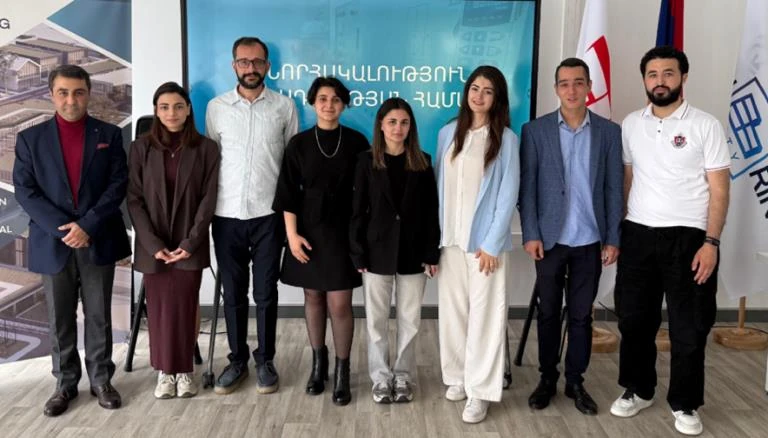
Andranik Aghajanyan, Project Integration Grigor Shirinyan, DigiCore Rama, Engienering Association
Two measurable results of the IB-TDS are to graduate engineers and to place them into companies. During the months of May and June these two measures appear as it is the month of graduation.
MSc. Thesis Defenses – Aerospace Engineering
May 15, 2026
The Defense Committee The Newly Graduated MSc in Aerospace Engineering
THESIS DEFENCE
INTERNATIONAL SCIENTIFIC-EDUCATIONAL CENTER OF NAS RA Aerospace instrument engineering 2024-2026
Master's student
Supervisor
Company
Topic
11:00-11:20
Arsenyan Yeranuhi Henriki
Astghik Hakobyan PhD (Tech.), Assistant
Center for Scientific Innovation and Education
Design of multirotor and fixed-wing UAVs and their charging station
11:20-11:40
Dabaghyan Avet Artaki
Ararat Stepanyan PhD (Phys.-Math.), Assistant
NI Emerson
Modelling and simulation of ground-surface reflections for radar validation
11:40-12:00
Hayrapetyan Shushanik
Suren Eyramjyan PhD (Tech.), Assistant
ATG
Design of a nanosatellite communication system
12:00-12:20
Mamyan Davit Tigrani
Andranik Aghajanyan PhD (Tech.), Assistant
Project Integration
Design of an inertial navigation system
12:20-12:40
Manjikyan Hovhannes Hakobi
Ararat Stepanyan PhD (Phys.-Math.), Assistant
NI Emerson
Design of a system for measuring the characteristics of a radar digital transceiver module
12:40-13:00
Javahiryan Nerses Arshaki
Andranik Aghajanyan PhD (Tech.), Assistant
Butekh
Processing and classification of air-situation information
13:00-13:20
Vardanyan Anushavan Samveli
Avetik Grigoryan
“Bazumk” Space Research Laboratory
Research and design of an orbit-lowering system for a low-orbit satellite
13:20-13:40
Hakobyan Rafayel Arturi
Ararat Stepanyan PhD (Phys.-Math.), Assistant
NI Emerson
Direction-of-arrival modelling in a passive radar test system
13:40-14:00
Zakaryan Hayk Tigrani
Nubar Poghosyan
Institute of Radiophysics and Electronics of NAS RA
Design of a radio transmitter for the ground segment of satellite communication
14:00-14:20
Antonyan Tigran Vardani
Suren Eyramjyan PhD (Tech.), Assistant
ATG
Research and design of an interference-resistant receiver system for global navigation satellite systems
14:20-14:40
Zetilyan Manvel Hovhannesi
Aleksandr Fedorov
Amungo Navigations
Design of a high-frequency filter for the 400–800 MHz range based on digitally tunable capacitors
BSc. Diploma Defenses – Measurement Devices & Systems
June 10, 2026
The Defense Committee The Newly Graduated BSc in Measurement Devices & Systems
NATIONAL POLYTECHNIC UNIVERSITY OF ARMENIA
CHAIR OF ELECTRONIC DEVICES AND MEASUREMENT SYSTEMS
N
Student's surname, name, patronymic
Company
Supervisor's surname, name
Thesis title
1
Adamyan Inesa Klimenti
GROVF
Artavazd Khachatryan Rudiki Lecturer
Design and simulation of a RISC-V processor
2
Hovsepyan Gayane Armeni
YEA ENGINEERING
Susanna Rafiki Tadevosyan Lecturer
Design of a servo motor emulation system
3
Madantsyan Aram Armeni
EVAN
Andranik Armeni Aghajanyan PhD (Tech.), Assistant
Design of a system for measuring insulator conductivity in high-voltage circuits
4
Baghalyan Petros Hovhannesi
ARC
Andranik Armeni Aghajanyan PhD (Tech.), Assistant
Design and development of an active electronically scanned radar
5
Khachatryan Anna Armeni
ENGINEERING HUB
Andranik Armeni Aghajanyan PhD (Tech.), Assistant
Design and development of a modular multifunctional SHF platform
School Graduation Project Presentations
May 25, 2026
Stage 1 Group – Robot Head Project
Students and roles:
Andranik Hayrapetyan — Hardware, Mechanical
Boris Mnatsakanyan — Hardware
Ruben Petrosyan — Software
Vahan Araratyan — Embedded Systems
Narek Minasyan — Software
Abel Poghosyan — Software
Andranik Badalyan — Hardware
DigiCore Stage 1 Group worked on a Robot Head Project. The students built a robotic head that reacts to its environment using sensors, movement, and visual emotion display.
The system includes sensors for collecting measurement data, OLED displays for showing eye emotions, and a servo motor for head movement. The students learned how sensor data can be used to control the robot’s behavior, such as changing emotions or moving the head based on external conditions.
Throughout the project, the group studied the basics of software engineering, hardware engineering, embedded systems, and mechanical design. They started from fundamental physics concepts, learned how electronic components work, and applied this knowledge to build a working robotic prototype.
As a result, the group gained hands-on experience in combining software, electronics, sensors, measurements, and mechanical movement into one interactive robotic system.
Stage 2 Group – Smart Home System
Students and roles:
Vardan Vardanyan — Hardware
Hrachya Melkumyan — Software
Narek Ginovyan — Hardware
Alex Ter-Hovhannisyan — Hardware
Syoma Alexanyan — Software
Grigor Zaqaryan — Software
Yana Alexanyan — Hardware
Lilit Hakobya — AI, Embedded Systems
Artash Avetisyan — AI, Embedded Systems
DigiCore Stage 2 Group worked on a Smart Home System. During the project, the students built a system that uses several sensors to collect data from the environment, make measurements, and use those measurements to make decisions.
The group learned how hardware and software work together in an embedded system. They worked with sensors, microcontrollers, electronic connections, and code logic. Through this process, they understood how sensor data can be transformed into meaningful actions in a smart home environment.
The students also implemented an LLM-based feature in their project. The LLM helped convert raw sensor values into more understandable status descriptions for the user. In addition, the group used AI tools during the development process for research, code writing, problem solving, and improving their workflow.
As a result, the group gained practical experience in hardware engineering, software engineering, embedded systems, sensor-based automation, and AI-assisted development.