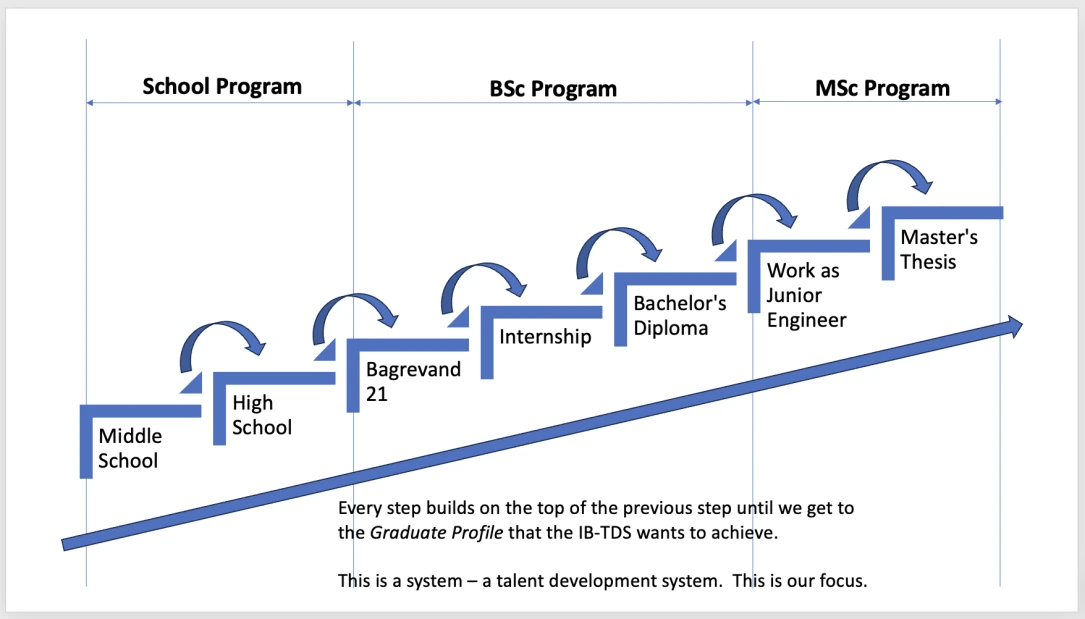
The power of everything is them being part of a system. In other words, the power is in “The System”. Because when there is a system, then every element that is in the system is inter-connected and works towards the purpose and goals of the system. In other words, the elements take on a vectored development, and the system together with its interconneded elements moves rapidly to its goals. Real competition is a competition between systems, not individual elements.
. What is a system?
A system is a grouping of interconneded elements that work together towards the unified goal. The better the interconnectedness of the elements, the more effective the system is in pursuing its goals.
A system approach is the oppoite of the intervention approach. The intervention approach usually targets localized problems, for example a training for a certain skill or acquiring certain knowledge.
We called our Talent Development efforts in the EC – the Talend Development System (TDS). This is because we wanted to solve the engineering education problem holistically. This, of course, does not exclude interventions when needed. It should be mentioned that we arrived to the System approach gradually and after implementing many interventive solutions throughout the years. The System appeared sometimes a few years ago as, initially, the sum of interventions, and then later, as a delibarate whole integrated system.
Every element in the TDS is now interconnected with every other element. Every consequence step is logically built on top of the previous one.
Pic.The Talent Development as a System
The “Graduate Profile” of the IB-TDS
by Rama, Engineering Association
We have a good picture of what an engineering graduate should look like, and all our activities are honed towards that image. We know what must the education system produce for the engineering companies. Hence, all our activities are honed towards that image. In other words, there are no random courses, nor random activities in the TDS. Everything is interconnedted, aligned, timed, and synchronized towards getting to that image of the graduate. This is a system. And this image that we want to receive at the outcome is called the Graduate Profile.
The image of the graduate is called the Graduate Profile.
Every education system defines the Graduate Profile that it wants to achieve at the end.
In our case, we called our education system the Industry-Based Talent Development System (IB-TDS). Calling it Industry-Based already hints to the profile of the graduate.
Our program is fully integrated into the industry projects of the EC companies.
Projects, projects, projects.
Projects alongside with theory and fundamentals.
Engagement in projects – starting from middle school to high school to undergraduate to graduate.
It is all about projects – real industry projects.
Many projects, different projects, different company projects, different industry projects.
Continuous problem solving, and using many different technologies and tools.
Figuring things out on their own, getting into all kinds of applications.
Collective work, presentations, justifications.
And mentorships by professional engineers.
By the time the students graduate from the IB-TDS they will have already a huge portfolio of accomplished projects. Their resumes will be filled with the projects accomplished by the time they graduate.
The outcome?
A courageous engineer, diversified, flexible, courageous, social.
This is the Graduate Profile of the IB-TDS.
Check out the projects that the 1st and 2nd year students will be engaged in within the Bagrevand 21 program in the next article.
Start of the New Bagrevand 21 Projects
by Rama, Engineering Association,
Andranik Aghajanyan, IB-TDS
May 26, 2026
As we graduated the MSc and BSc students this year, we lay the ground work for the next batch of engineers. The Bagrevand 21 Program is a foundational program that exposes 1st and 2nd year students to the nature of engineering work, engineering thinking, design processes, measurement, experimentation, prototyping, team work, and project-based problem solving.
Below are the projects that the EC companies have defined for this year’s Bagrevand 21Program. The students will work on these projects for the next three months.
31 students are engaged, From 6 different unviersities, That will work on 17 real industrial projects, In 11 EC companies, Under the mentorship of 17 professional engineers, And 2 education supervisors.
This is a huge undertaking. And this repeats every year.