The power of everything is them being part of a system. In other words, the power is in “The System”. Because when there is a system, then every element that is in the system is inter-connected and works towards the purpose and goals of the system. In other words, the elements take on a vectored development, and the system together with its interconneded elements moves rapidly to its goals. Real competition is a competition between systems, not individual elements.
. What is a system?
A system is a grouping of interconneded elements that work together towards the unified goal. The better the interconnectedness of the elements, the more effective the system is in pursuing its goals.
A system approach is the oppoite of the intervention approach. The intervention approach usually targets localized problems, for example a training for a certain skill or acquiring certain knowledge.
We called our Talent Development efforts in the EC – the Talend Development System (TDS). This is because we wanted to solve the engineering education problem holistically. This, of course, does not exclude interventions when needed. It should be mentioned that we arrived to the System approach gradually and after implementing many interventive solutions throughout the years. The System appeared sometimes a few years ago as, initially, the sum of interventions, and then later, as a delibarate whole integrated system.
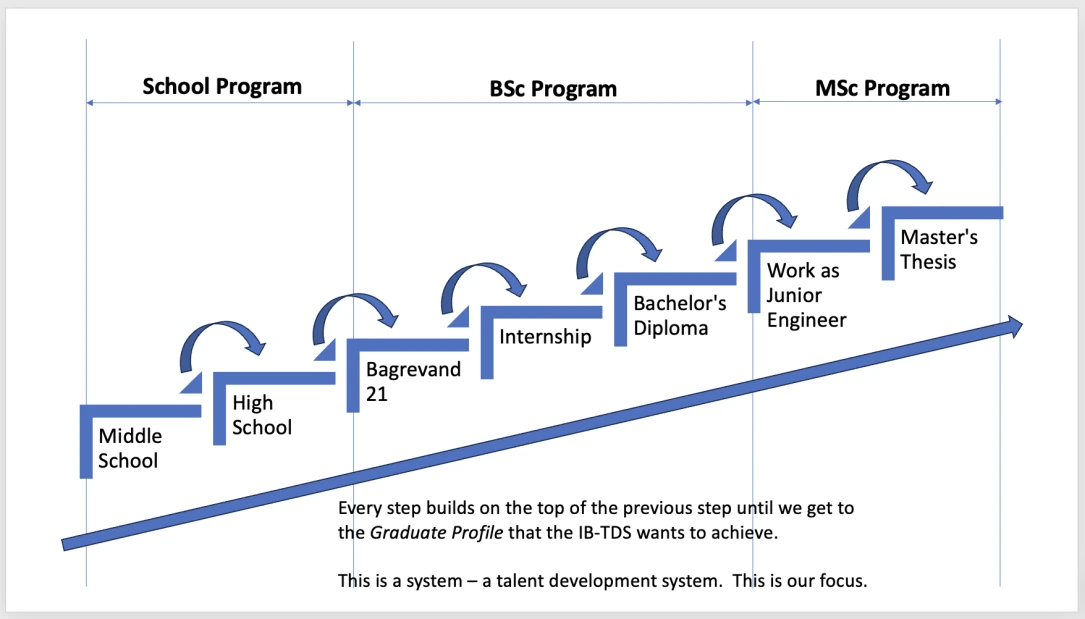
Every element in the TDS is now interconnected with every other element. Every consequence step is logically built on top of the previous one.
Pic.The Talent Development as a System
The “Graduate Profile” of the IB-TDS
by Rama, Engineering Association
English translation
We have a good picture of what an engineering graduate should look like, and all our activities are honed towards that image. We know what must the education system produce for the engineering companies. Hence, all our activities are honed towards that image. In other words, there are no random courses, nor random activities in the TDS. Everything is interconnedted, aligned, timed, and synchronized towards getting to that image of the graduate. This is a system. And this image that we want to receive at the outcome is called the Graduate Profile.
The image of the graduate is called the Graduate Profile.
Every education system defines the Graduate Profile that it wants to achieve at the end.
In our case, we called our education system the Industry-Based Talent Development System (IB-TDS). Calling it Industry-Based already hints to the profile of the graduate.
Our program is fully integrated into the industry projects of the EC companies.
Projects, projects, projects.
Projects alongside with theory and fundamentals.
Engagement in projects – starting from middle school to high school to undergraduate to graduate.
It is all about projects – real industry projects.
Many projects, different projects, different company projects, different industry projects.
Continuous problem solving, and using many different technologies and tools.
Figuring things out on their own, getting into all kinds of applications.
Collective work, presentations, justifications.
And mentorships by professional engineers.
By the time the students graduate from the IB-TDS they will have already a huge portfolio of accomplished projects. Their resumes will be filled with the projects accomplished by the time they graduate.
The outcome?
A courageous engineer, diversified, flexible, courageous, social.
This is the Graduate Profile of the IB-TDS.
Check out the projects that the 1st and 2nd year students will be engaged in within the Bagrevand 21 program in the next article.
Start of the New Bagrevand 21 Projects
by Rama, Engineering Association,
English translation
Andranik Aghajanyan, IB-TDS
May 26, 2026
As we graduated the MSc and BSc students this year, we lay the ground work for the next batch of engineers. The Bagrevand 21 Program is a foundational program that exposes 1st and 2nd year students to the nature of engineering work, engineering thinking, design processes, measurement, experimentation, prototyping, team work, and project-based problem solving.
Below are the projects that the EC companies have defined for this year’s Bagrevand 21Program. The students will work on these projects for the next three months.
31 students are engaged, From 6 different unviersities, That will work on 17 real industrial projects, In 11 EC companies, Under the mentorship of 17 professional engineers, And 2 education supervisors.
This is a huge undertaking. And this repeats every year.
N
Project Name
Project's short description
Tools to Be Used (Software & Hardware)
Expected Results
Company
Mentors from company
UR team's supervisers
Student
1
Laser-Based UART Optical Communication System
Project demonstrates a bidirectional optical wireless communication system using a laser diode and photodiode, where modulated (PWM) UART serial data is transmitted through free space. Two NI myRIO-based nodes act as both transmitter and receiver, enabling a simple data transfer application in which text messages, images or any other information are exchanged optically and displayed in real time.
Software:
LabVIEW (Real-Time / FPGA optional)
NI myRIO Toolkit
LabVIEW Serial / UART libraries
Basic rule-based chatbot logic (LabVIEW)
Hardware:
NI myRIO
Laser diode with constant-current driver
Photodiode or phototransistor
Transimpedance amplifier (op-amp based)
Comparator or thresholding circuit
Discrete components (resistors, capacitors)
Optical mounts / alignment hardware
Breadboard and power supply
Successful transmission and reception of UART data over a free-space optical link
Real-time text message/data exchange between two nodes using a laser diode
Stable communication at low to moderate baud rates (e.g., 9600 bps)
Correct decoding and display of received messages
NI-Emerson
Davit D, Vahan K +374 91 656556
Azatuhi Ulikyan Zaven Khanamiryan
Hayk Hovhannisyan, Karen Mkhitaryan
2
FM Radio Interferring System
Implementation of FM transmit-receive system to transfer audio signal
Study of interferece signal types for FM radios
Implementation of different interference signals on top of FM radio
Validation of the best performed interference signal type
USRP, LabVIEW
NI-Emerson
Ararat Stepanyan
Azatuhi Ulikyan Zaven Khanamiryan
Edgar Nersisyan, Irina Mkrtchyan
3
Wireless Mouse PCB Test System
Implementation of a wireless mouse PCB test system using NI PXI platform.
Create a system, for making main functionality tests of a wireless mouse. The system will use NI PXI platform, LabVIEW and TestStand.
Learnings:
NI PXI platform
TestStand
How to make an electronics test system
How to use NI progarmmable power supplies
How to make measurements with DMM
How to use PXI DAQ
LabVIEW, TestStand
PXI-2567
PXIe-4080
PXIe-2527
PXI-2568
PXIe-6363
PXIe-4112
PXIe-8135
PXIe-1078
LCD Screen
Keyboard
Mouse
NI-Emerson
Gevorg Parsyan 093348016
Azatuhi Ulikyan Zaven Khanamiryan
Varazdat Poghosyan, Ernest Ghazaryan
N
Project Name
Project's short description
Tools to Be Used (Software & Hardware)
Expected Results
Company
Mentors from company
UR team's supervisers
Student
4
ECU Measurement and Calibration
Selected students will be introduced to automotive communication protocols and the ASAM MCD standard while contributing to the enhancement of an existing ECU measurement and calibration toolkit by developing and integrating new features for a real-world, market-ready product.
Standard - ASAM MCD
Hardware - NI XNET USB-8502
Protocols - NI-XNET (CAN), TCP/IP, UDP/IP
Programming tools - LabVIEW, VeriStand, C/C++
NI-Emerson
Pargev Malkhasyan, Garegin Grigoryan +37493736251
Azatuhi Ulikyan Zaven Khanamiryan
Davit Nalbandyan
5
CF CAN Hub
A custom multi-channel CAN hub for a quadruped robot. The board will connect the main computer with multiple CAN buses used by actuators and other embedded devices, improving communication reliability, diagnostics, and control update rate.
Embedded C/C++, STM32 or similar MCU, CAN/CAN-FD, USB/UART, PCB design, firmware development, Linux tools, robotics communication, testing and debugging.
A working prototype of the CF CAN Hub, including schematic/PCB review support, basic firmware, CAN communication tests, documentation, and validation on the robot or test bench.
Cyber Fusion
Suren Atoyan, Gevorg Harutyunyan
Azatuhi Ulikyan Zaven Khanamiryan
Arsine Nahapetyan
6
CF IMU
A custom inertial measurement unit for a quadruped robot. The board will read accelerometer, gyroscope, and possibly magnetometer/barometer data, run basic calibration and sensor fusion, and provide stable orientation/motion data to the robot.
Embedded C/C++, STM32 or similar MCU, SPI/I2C/UART, IMU sensors, sensor calibration, sensor fusion, PCB design, ROS 2 integration, signal validation, testing and debugging.
A working prototype of the CF IMU, including schematic/PCB review support, firmware for sensor reading and calibration, initial sensor fusion output, documentation, and validation with the robot software stack.
Cyber Fusion
Suren Atoyan, Gevorg Harutyunyan
Azatuhi Ulikyan Zaven Khanamiryan
Shushanik Ginosyan
7
Fitness Tracker
A portable device for human movement tracking should be designed based. The system will detect human movement actions based on IMU sensor data. An embedded AI model will be trained for movement tracking.
Edge Impulse
AI for Embedded Systems
ESP32
IMU Sensors
A portable device with custom PCB, firmware and enclosure will be designed.
Project Integration
Rafayel Khachatryan 095226116
Azatuhi Ulikyan Zaven Khanamiryan
Kristina Sukiasyan, Artak Baghdasaryan
8
Decision Pipeline
A local AI-based decision support system that helps companies transform ideas into structured requirements, workflows, and resource plans. The platform analyzes projects, identifies gaps, prioritizes tasks, and supports management decisions while keeping company data private.
Python, Streamlit, Local LLMs, Ollama, Data Analysis, Requirements Engineering, Workflow Design, Project Management, Resource Planning, AI-based Decision Support
A working prototype that allows managers to enter project ideas, analyze requirements, generate workflows, estimate needed resources, and improve decision-making speed and quality.
DigiCore
Grigor Shirinyan 098075553
Azatuhi Ulikyan Zaven Khanamiryan
Vahe Galstyan, Emil Hovhannisyan
N
Project Name
Project's short description
Tools to Be Used (Software & Hardware)
Expected Results
Company
Mentors from company
UR team's supervisers
Student
9
Satellite Data Reception and Processing via a Ground Station
The project acquaints participants with the mission and operation of a ground station for satellite data acquisition. Students will operate the station, receive signals, and process data by performing LoRa demodulation to extract satellite health information from beacon transmissions. Reception will be confirmed through the satellite's call sign. In addition, participants will study the structure of image data and attempt to receive imagery from openly accessible satellites.
Technologies: Communication link between space and ground segments; LoRa modulation/demodulation; software-defined radio (SDR); RF measurement instruments (spectrum analyzer, signal generator); antennas; data processing and coding. Disciplines: Satellite communications, radio frequency engineering, signal processing, telemetry data handling, and embedded systems.
Successful reception of telemetry from satellites of Peter the Great St. Petersburg Polytechnic University; extraction of satellite health status data; integration and visualization of the acquired data on a real-time monitoring dashboard.
Russian-Armenian University EC ISEC Aerospace Engineering Department
Martin Pinamyan 099993953
Azatuhi Ulikyan Zaven Khanamiryan
Siranush Kagaryan, Anna Aleksanyan
10
UAV Jamming System
The aim of the project is to design and integrate various subsystems for UAV jamming system. Mostly related to RF subsystems.
RF measurement devices
RF components
RF Microelectronics
SDR
Antenna
A working jamming system for UAVs will be developped
Engineering Hub
Tigran Manukyan 095644641
Azatuhi Ulikyan Zaven Khanamiryan
Vardan Frankyan , Anna Kirakosian
11
A wearable medical device for user activity tracking
A compact and efficient device which purpose is to collect a valuable medical data. It is supposed to be a "smart upgrade" for wheelchairs, prostheses and another medical equipment, to enhance the rehabilitation process and improve user experience.
A fully operational circuit board integrated in a production-grade prototype.
ArmBionics
Ivan Bikashov 094044071 Marina Davtyan 055990089
Azatuhi Ulikyan Zaven Khanamiryan
Liana Sayadyan
12
Smart Gimbal Research Project
This project focuses on the development of a universal multi-axis gimbal system for stabilization and precise control of cameras, sensors, and other payloads used on unmanned aerial vehicles (UAVs) such as drones.
The system is designed to provide smooth and accurate stabilization during flight using brushless motors, IMU sensors, and embedded control algorithms.
The development of a mathematical control algorithm, the design of a control board, the implementation of the algorithm into embedded hardware, and the creation of a functional gimbal prototype for UAV applications.
YAE
Danil Vinogradov 093851686
Azatuhi Ulikyan Zaven Khanamiryan
Rafayel Zakaryan, Hayk Hakobyan, Davit Grigoryan
13
In-Vehicle Radar Test System
In-Vehicle Radar Test System based on 4x4 reflector matrix array used for target biometrical parameters simulation.
Target simulation stand / setup. Software control panel for system blocks and radar data visualization.
YEA Engineering
Susanna Tadevosyan 094808809
Azatuhi Ulikyan Zaven Khanamiryan
Nare Papikyan, Sergey Harutyunyan
14
ATG
Azatuhi Ulikyan Zaven Khanamiryan
Mane Hayrapetyan, Ruzanna Vardapetyan
N
Project Name
Project's short description
Tools to Be Used (Software & Hardware)
Expected Results
Company
Mentors from company
UR team's supervisers
Student
15
Integration of an Interactive Graphical Monitor in EV Charging Stations
The main objective of this project is to design and develop an interactive Human-Machine Interface (HMI) for an Electric Vehicle (EV) charging station. As an educational and practical project, it focuses on real-time visualization of the charging process and provides users with the ability to dynamically control and modify technical charging parameters.
Students need to write firmware for an STM32 microcontroller in the C language that will receive charging information from the charger via UART protocol and send that data in a specified format to the HMI display via RS485 ModBus; alongside this, they must design interactive widgets for the display.
The monitor must dynamically display the following real-time data: State of Charge (SoC), Charging Power & Energy, Time Metrics, Set Charging Limits, Adjust Power Output
EVAN LLC
Aram Madantsyan +37494363979
Azatuhi Ulikyan Zaven Khanamiryan
Gor Aslanyan, Hayk Musinyan
16
Educational Embedded System Design with Stock-Oriented Component Selection Using Automatic Tester Development as a Case Study
Educational embedded systems project focused on automatic tester development using STM32/Arduino platforms with emphasis on stock oriented component selection and practical hardware/software design.
Development of a POC embedded automatic tester system along with practical training experience in schematic design, PCB development, embedded programming, and stock oriented engineering methodologies.
YEA
Narbeh Nahapetian
Azatuhi Ulikyan Zaven Khanamiryan
Vahan Poghosyan, Garik Harutyunyan
17
Collaborative Robot-Based Pick-and-Place Assembly of Screw-Mounted Connectors on Product Enclosures
Educational smart manufacturing project focused on collaborative robot integration for pick and place assembly tasks using the DOBOT CRA robot.
Collaborative Robotics, Industrial Automation, Robot Programming, Pick and Place Systems.
Development of a POC collaborative robotic assembly setup capable of performing connector pick and place operations with designed trays, jigs, and structured robot workflows for educational and industrial training purposes.