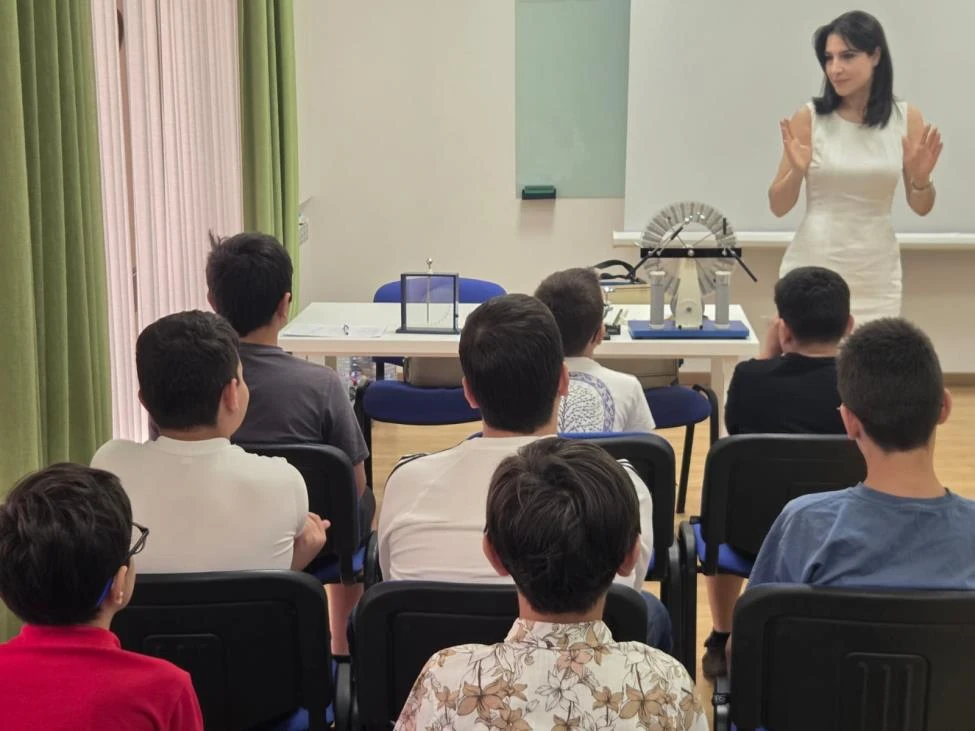
Over the years, we had noticed that many school graduates stay away from engineering specializations because they will have to give an entry exam in Physics. It seems that math is not as fearful as physcis is. Hence, many technically inclinded children choose Computer Science over engineering where the required exams are math and Armenian language only, and physics exam is abscent.
The idea of the summer camp was to introduce Physics and physical phenomena to middle school children.
We live in the physical world. Everything that we experience from small to big is physics. We may not know it, but it is physcis. This is why not knowing physcis, or not loving physics is absurd.
The program is to show the physcis behind every little thing that the children experience in every day life.
I attended a few classes. What is happening is incredible. The lessons are interactive and the children are eagerly engaged in the class. The discovery that the children are doing is that they already know all this. They just didn’t know that this was Physics.
Now, we need to bring this into the system, in our case the EC Talent Development System (TDS). If we don’t do this, then this initiative will be just an isolated intervention initiative with nothing following from it. On the other hand, if we bring this into the TDS, if we integrate it into the system where there is a continuation, where there is a build-up, where there is a targeted profile, then we will get an incredible multiplicative effect and this initiative becomes part of a whole.
This is how this could be done:
Here, the kids will then flow right into the EC School program. A strong physics background will only strengthen the engineering sense. From the EC School program they can fearlessly, then, go into professional engineering equiped with both physics and engineering backgrounds. This would be a strong system approach.
The Blue Print of the EC Summer Camp
by Grigor Shirinyan, DigiCore
English translation
General Information
Camp duration: 1.5 months / 6 weeks
Lesson duration: 3 hours per lesson
Main direction: Practical physics, engineering, experiments, science culture, technology visits, teamwork, and creative problem solving.
Schedule
2 lessons per week
3 hours per lesson
Total: 6 hours per week
Duration: 6 weeks
Total number of lessons: 12
Total duration: 36 hours
This program is designed for students who want a balanced summer program with practical science lessons, several educational visits, movie days, and one creative entertainment day.
Program Structure
Type of activity Number of lessons Total hours
Practical physics and engineering lessons 5 lessons 15 hours
Scientific movie days with discussion 2 lessons 6 hours
Educational visits 4 lessons 12 hours
Video game day 1 lesson 3 hours
Total 12 lessons 36 hours
Lesson Plan
Week 1
Lesson 1 — Welcome to the World of Physics and Engineering
Students are introduced to the camp, safety rules, teamwork, and the idea that physics explains how the world works. The lesson includes simple experiments with force, motion, balance, friction, and gravity. Students work in groups and complete small engineering challenges.
Practical activities:
Build a paper bridge and test how much weight it can hold.
Explore friction using different surfaces.
Test balance and center of mass with simple objects.
Lesson 2 — Electricity and Simple Circuits
Students learn how current flows and how batteries, wires, switches, resistors, LEDs, and motors work. The lesson is focused on building and testing circuits, not memorizing formulas.
Practical activities:
Build a simple LED circuit.
Add a switch to control the circuit.
Compare brightness with different resistors.
Build a mini electric motor or vibration motor demonstration.
Week 2
Lesson 3 — Visit to Smart Manufacturing and Robotics Lab
Students visit the smart manufacturing and robotics laboratory. They observe how robots, machines, sensors, and automated systems are used in real engineering environments.
Main goals:
Understand how robots help in manufacturing.
See examples of sensors, machines, and automation.
Connect classroom physics with real technology.
Lesson 4 — Scientific Movie Day 1: Space, Robots, or Future Technologies
Students watch a selected scientific movie or documentary connected to space, robotics, or future engineering. After the movie, they discuss the real science behind what they watched.
Activities:
Movie screening.
Group discussion: What was real science and what was fiction?
Short creative task: Design one technology from the movie in a realistic way.
Week 3
Lesson 5 — Light, Optics, and Vision
Students explore how light travels, reflects, bends, and creates images. The lesson connects optics with cameras, eyes, robots, and space telescopes.
Practical activities:
Reflection experiment with mirrors.
Refraction experiment using water or transparent materials.
Build a simple periscope.
Explore lenses and magnification.
Lesson 6 — Visit to EC Factory
Students visit the EC factory and see how real products, devices, or engineering systems are created. They observe the connection between design, production, machines, materials, and quality control.
Main goals:
Understand how ideas become physical products.
See how engineering teams work.
Learn about production, testing, and manufacturing.
Week 4
Lesson 7 — Sound, Waves, and Vibration
Students learn how sound is created, how waves move, and how vibration is used in technology. The lesson includes experiments with strings, cups, speakers, and simple sound devices.
Practical activities:
Build a cup-and-string phone.
Observe vibration using a speaker and small particles.
Compare high and low sounds.
Create a simple sound experiment.
Lesson 8 — Visit to Science and Technology Museum
Students visit the Science and Technology Museum. The visit helps students understand how scientific discoveries and engineering inventions changed everyday life.
Main goals:
Explore historical and modern technologies.
Understand the development of science and engineering.
Connect museum exhibits with physics topics from the camp.
Week 5
Lesson 9 — Heat, Energy, and Pressure
Students explore thermal energy, heat transfer, air pressure, and energy transformation. The lesson includes safe experiments showing how invisible forces can create visible effects.
Practical activities:
Balloon and air pressure experiments.
Heat transfer demonstration.
Build a simple paper spinner powered by rising warm air.
Explore energy transformation using small devices.
Lesson 10 — Scientific Movie Day 2: Engineering Challenges and Discovery
Students watch a second scientific movie or documentary, this time focused on invention, exploration, scientific discovery, or engineering problem solving.
Activities:
Movie screening.
Discussion about the engineering problems shown.
Team activity: Solve one challenge inspired by the movie.
Week 6
Lesson 11 — Visit to Space Museum
Students visit the Space Museum and learn about space exploration, rockets, satellites, astronauts, and the physics needed to explore space.
Main goals:
Understand basic space science.
Learn how rockets and satellites work.
Connect physics topics such as motion, gravity, energy, and communication with space technology.
Lesson 12 — Video Game Day: Physics, Logic, and Team Challenges
The final lesson is a special video game day. Students play selected educational, physics-based, engineering, or teamwork games. The day is not only entertainment; it helps students understand logic, strategy, systems, physics, and problem solving.
Activities:
Physics-based game challenges.
Team competition.
Discussion: What physics or engineering ideas appeared in the game?
Final camp reflection and certificates.
General Lesson Format
Each 3-hour lesson follows an interactive structure:
Warm-up discussion — 15–20 minutes Students answer questions, make predictions, and discuss what they already know.
Short explanation — 20–30 minutes The instructor explains the main idea using simple language, examples, and demonstrations.
Main experiment or building activity — 90–120 minutes Students work individually or in teams to build, test, observe, measure, and improve.
Challenge or competition — 30–40 minutes Students complete a small challenge connected to the topic.
Reflection and conclusion — 10–15 minutes Students explain what happened, why it happened, and where the idea is used in real life.
Main Learning Goals
By the end of the camp, students will:
Understand basic physics through experiments, not only theory.
Learn how engineering connects science with real-life problem solving.
Build simple systems and test how they work.
Improve teamwork, creativity, and communication skills.
Visit real science, technology, manufacturing, robotics, and space-related environments.
Understand how physics appears in machines, robots, games, space, and everyday life.
Become more interested in science, engineering, robotics, and technology.
Practical Physics Topics
The practical lessons of this Summer School will touch upon some of the below physics topics (not all). A continuation of this summer camp has been already designed to cover the remaining of the below topics. In the case of a successful feedback from this camp, we will offer a continuation to it.
The camp includes practical lessons from the following areas:
Forces and motion
Gravity and friction
Electricity and circuits
Magnetism and motors
Light and optics
Sound and waves
Heat and temperature
Energy transformation
Air pressure and fluids
Rockets and space physics
Simple machines
Sensors and robotics
Engineering design and testing
Special Camp Activities
The program includes:
Visit to Smart Manufacturing and Robotics Lab
Visit to EC Factory
Visit to Science and Technology Museum
Visit to Space Museum
Scientific movie days with discussion
One video game day connected to physics, logic, and teamwork
Final project presentation for the intensive option