The true purpose of education is to teach how to think.
There are many theories about thinking. In this edition, four types of thinking are introduced – the levels of cognitive development, the higher levels of cognitive developement, the engineering levels of thinking, and the company levels of thinking.
As we design our courses and engage the students in our company projects, it is advisable that all these types are deliberatelly touched upon in one way or another. That turns every course and every project into a wholistic development for the students and teachers alike.
How to Design a Course – Levels of Cognitive Development
by Rama, Engineering Association
A person’s learning process goes through different stages of cognitive development.
As we design courses for the Talent Development System (TDS) we should plan on developing all levels of cognitive development by the student.
Accordingly, the process of teaching must reflect these levels and the tests must also reflect these levels.
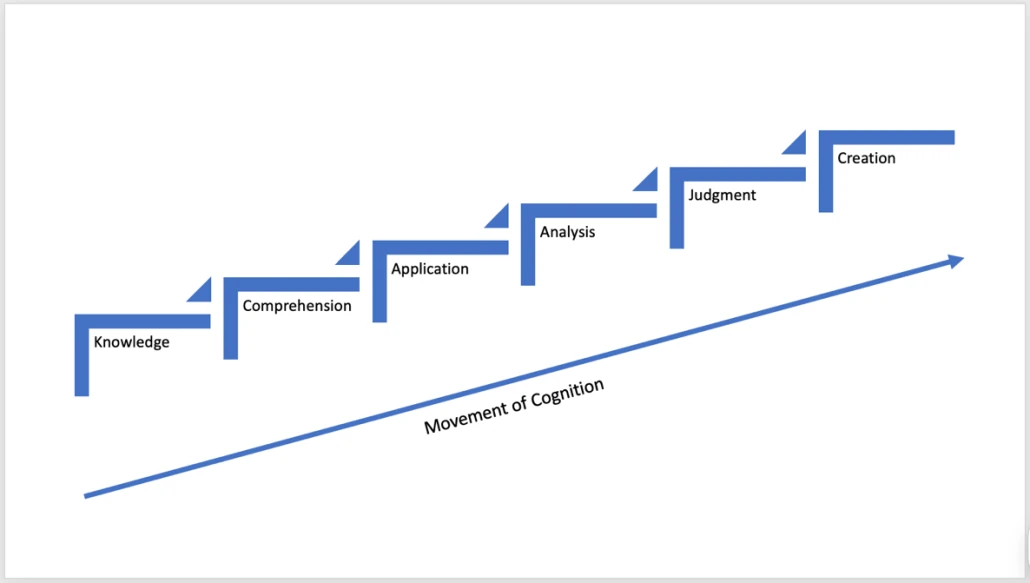
There are six levels of cognitive development that were developed by Benjamin Bloom and are known as Bloom’s Taxonomy of Learning. Below, I copied these levels from the internet.
Knowledge/Remember: Recalling facts, terms, or basic information.
Comprehension/Understand: Understand material and grasp meaning.
Application/Apply: Use knowledge in practical situations.
Analysis/Analyze: Break information into parts to understand relationships.
Evaluation/Judge: Make judgments based on criteria and standards.
Synthesis/Create: Combine information to form a new idea or propose solutions.
Below is a description of each level, again copied from the internet.
Knowledge. Remembering. The illusion of knowing. Lifeless information. Cramming information. No insight, no depth, no transformation.
Comprehension. The birth of meaning. Understanding the facts. The mind as a processor, not as storage. Explain ideas in own words, summarize concepts, interpret meaning, connect different pieces of information. Reshape information, simplifying it. Summarizing. Internalizing information. Use information in real stiuation. Understanding the idea. Breaking down complexity into something meaningful. Teaching is about making people think, not transfering information. To ignite thinking. Questioning ideas. Understanding requires effort, not recognition.
Application. Where knowledge becomes power. Comprehension give meaning, application give purpose. From understanding to action. Where theory meets reality. Ideas no longer abstract, but functional. Solving problems, implement concepts, adapt knowledge to new situations. True learning starts to show itself. Using a formulat to solving a real problem. Doing something with the ideas. Giving opportunities to apply the knowledge. Real world problems. Without it, knowledge remains passive. Tell me and I forget, teach me and I remember, involve me and I understand. Understanding deapens when it is used. Active learning rooted in experience. Knowledge is to interact with the world. Participants, not observers. Stuck between theory and reality. Problem solving.
Analysis. Breaking the Illusion. Not using knowledge, but questioning it. Asking why? Why did this happen, what cause it. What’s hiddent beneath the surface. Disect ideas, examine relationships, identify patterns, uncover motives. Looking under the hood of information. Compare, categorize, question, challenge. Real critical thinking begins. Question, challenge, dig deeper. Distringuish truth from manipulation. Quality of the mind is revealed by its questions, not answers. Analysis is about asking better questions.
Evaluation. The birth of judgement. Deciding what is right, what is wrong, what is valuable and what is not. Evaluation is where knowledge becomes wisdom. Questioning claims, test ideas. Weigh evidence, form reasoned conclusions. Compare perspectives, critique arguments, decide what truly holds value. This is not blind opinion, it is informed judgement. Which leaders to support, scientist reviewing for accuracy, manager judging performance, in every day choices. Selecting what to believe, what to trust, what to reject. Without knowledge, you have nothing to judge, without understanding you misinterpret, without application your thinking remains theoretical, without analysis you fail seeing deeper patterns, without creation you cannot imagine alternatives. It requires the full development of the mind. Refusing to accept things at face value.
Creation, the power to create. Thinking stops consuming the world, starts building it. Combining knowledge, understanding, analyzis into something new. Producing ideas. Innovation. Writer creating a story from scattered ideas, a scientist forming a new hypothesis, an entrepreneur building something that didn’t exist before. Pieces come together, not randomly but meaningfully to form something original. Imagination is more important than knowledge. Complexity cannot be solved by old ideas, it requires new thinking, new perspectives, new solutions. Not finding the right answer, but to create a new one. Originality, not accuracy. Thinking independently. Imagining what could be done, not just knowing what has been done.
This approach also helps in designing the questions to be asked the students for the tests, exams, and for the scoring. Each cognitive level will require a certain type of questions that must be defined ahead of time.
Higher Levels of Cognitive Development
by Rama, Engineering Association
Bloom’s taxonomy is about learning a particular subject. It moves from the lower level to the higher level of cognition. But there are yet higher levels of thinking. I chose the following thinking levels that I thought most important.
Systems Thinking: this is the ability to see the parts in the whole and the whole in the parts.
Dialectical Thinking: this is the ability to see reality as interactions, contradictions, change, crisis (S-curve).
Evolutionary Thinking: this is the ability to see the directional evolutionary tendencies (sequence of S-curves).
Contextual Thinking: this is the ability to see the topic within its bigger context (the Super System, Panarchy).
Engineering Levels of Thinking
by Rama, Engineering Association
Engineering is about providing technical solutions to society’s challenges. It is a fundamentally creative process. Much could be written here. However, I focus on the following thinking levels, which are levels within the “Creation” level in the Bloom’s taxonomy:
Situational Thinking: this is the ability to identify the nature of the situation (Cynefin Framework).
Problems Thinking: this is the ability to reach the formulation of the problem statements.
Solutions Thinking: this is the ability to provide solutions to the problems.
Methodological Thinking: this is the ability to identify the right approach and method to solving the problem.
Scientific Thinking: this is the ability to apply math and scienentific discoveries in the solution process.
Conceptual Thinking: this is the ability to think conceptually.
Technological Thinking: this is the ability to think technologically.
Inventive Thinking: this is the ability to find breakthough solutions (TRIZ). Leads to patents.
Innovative Thinking: this is the ability to convert solutions into commercial products.
Company Levels of Thinking
by Rama, Engineering Association
But there are many other ways of thinking that must be developed with time.
Below are some (not all) of the levels that get developed on a company level. Since the students of the TDS are engaged in company projects from the very beginning, it is advisable that the students get introduced to these types of thinking during their projects.
Here, the thinking moves from a higher level of thinking down to the lower levels.
Missionary Thinking: this is the ability go give purpose and meaning to the company.
Visionary Thinking: this is the ability to envision the path towards the purpose.
Values Thinking: this is the ability to define the behavioral value set that will support the vision.
Markets Thinking: this is the ability to identify the customer base that the company will serve.
Strategic Thinking: this is the ability to convert vision to strategy (value proposition, competitors, margins).
Business Thinking: this is the ability to reach & increase the gross margins of the products and the company.
Tactical Thinking: this is the ability to convert strategy to a plan of actions.
Process Thinking: this is the ability to see everything as a process in time.
Organizational Thinking: this is the ability to organize people and resources to execute the plan.
Communal Thinking: this is the ability to engage the wider community to execute the plan.
Opportunistic Thinking: this is the ability to spot opportunities towards fulfilling the strategy.
Professional Thinking: this is the ability to perform the actions in the plan.
Each project could be started by pointing out the above thinking processes. It tells the student why the company is working on this project, how this project came to the company, how the processes within the company are organized, who were the competitors, … This will give ground the project in reality, as opposed to just being an education project.